NLL Bolt Type Strain Clamp
Product Overview
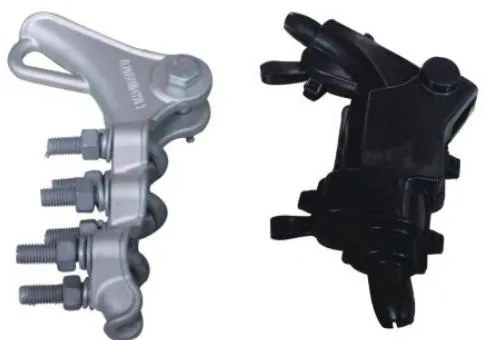
The NLL Bolt Type Strain Clamp is a specialized strain clamp designed for fixing and tensioning of ACSR, AABC, and stranded aluminum conductors on distribution lines. Widely recognized in the industry under alternative names including bolt-type strain clamp, dead-end grip, tension clamp, this product serves as a critical component in 10 kV and below overhead lines systems. NLL bolt-type strain clamp is suitable for 10kV and below overhead lines, fixing aluminum stranded wire, steel core aluminum stranded wire, overhead insulated aluminum wire or overhead insulated steel core aluminum wire on strain poles. If used for overhead insulated wire, please strip the insulation layer before installation and equip with insulation cover.
Advantages
- “Bolt-type compression design” — uniform clamping pressure distributes stress evenly across the conductor, preventing deformation
- “Non-magnetic aluminum body” — cast aluminum alloy eliminates hysteresis and eddy current losses under power frequency
- “Corrosion-resistant finish” — all exposed steel hardware is hot-dip galvanized for long outdoor service life
- “Wide conductor compatibility” — multiple models cover conductor cross-sections from 16 mm² to 400 mm²
- “Easy field installation” — wrench-tightened bolt mechanism requires no special tools or compression equipment
Technical Parameters
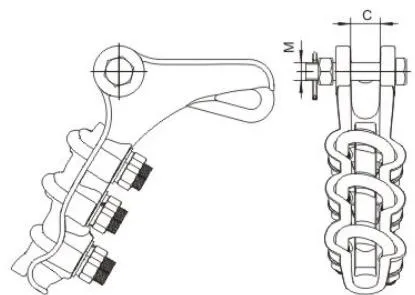
| Model | Applicable Wire Diameter (including wrapping) (mm) | Main Dimensions (mm) | Nominal Failure Load (kN) | |
|---|---|---|---|---|
| M | C | |||
| NLL-1 | 8.0~12.0 | 16 | 18 | 40 |
| NLL-2 | 11.0~16.0 | 16 | 18 | 40 |
| NLL-2(Reinforced) | 11.0~16.0 | 16 | 18 | 60 |
| NLL-3 | 15.0~20.0 | 16 | 27 | 70 |
| NLL-4 | 19.0~24.0 | 18 | 29 | 90 |
Note: Made of high-strength cast aluminum alloy, no magnetic hysteresis loss. Smooth appearance, long service life. ◆ Easy to install and use. Dimensions may vary slightly based on manufacturing tolerances. Contact our engineering team for custom sizes or special requirements.
Material & Manufacturing
- Material: high-strength cast aluminum alloy
- Secondary components: hot-dip galvanized steel bolts and hardware
- Surface treatment: Hot-dip galvanizing in accordance with ISO 1461 / ASTM A153 / IEC 61589, minimum zinc coating thickness 65 μm
- Manufacturing process: Precision forging, casting, or CNC machining of critical dimensions, followed by full galvanizing immersion. Dimensional accuracy controlled within ±0.5 mm tolerance on mounting interfaces
- Quality assurance: Every batch undergoes dimensional inspection, galvanizing thickness testing (magnetic or gravimetric method per ISO 2178), and visual surface examination. Mill test certificates (MTC) available upon request
Application Scope
- Fixing and tensioning of acsr, aabc, and stranded aluminum conductors on distribution lines
- 10 kV and below distribution lines for ACSR, AABC, and aluminum stranded conductors
- Overhead line terminal and tension tower dead-end connections
- Pole-top and crossarm conductor termination points
Frequently Asked Questions
Q: What is the difference between NLL and NXLH? A: NLL is standard bolt-type strain clamp for ACSR/ABC conductors. NXLH series is designed specifically for aluminum-clad steel conductors with enhanced mechanical grip.
Q: Can NLL clamps be reused? A: NLL clamps can be reused if the bolt and conductor groove are undamaged. Inspect for groove deformation or corrosion before reinstallation.
Q: What torque should be applied to the bolts? A: Refer to the manufacturer torque specification (typically 25-45 N·m depending on model). Over-tightening may deform the conductor.
Industry Standards & Compliance
| Standard | Scope |
|---|---|
| IEC 61589 | Galvanizing requirements for overhead line hardware |
| ISO 1461 | Hot-dip galvanized coatings on iron and steel articles |
| ASTM A153 | Zinc coating (hot-dip) on iron and steel hardware |
| GB/T 2314 | General requirements for overhead line fittings |
| GB/T 2317 | Mechanical testing methods for overhead line hardware |
| DL/T 765.2 | Suspension and strain hardware for overhead power lines |