P Clevis
Product Overview
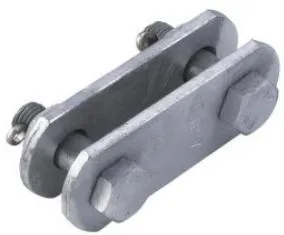
The P Clevis is a specialized clevis designed for connecting insulator strings to supporting hardware on towers and crossarms. Widely recognized in the industry under alternative names including clevis fitting, U-bolt clevis, clevis connection, clevis link, this product serves as a critical component in overhead transmission and distribution lines systems. Cotter pin is stainless steel, the rest are hot-dip galvanized steel parts.
Advantages
- “Pivotal connection design” — allows insulator string to swing freely, accommodating wind and thermal conductor movement
- “High tensile strength” — forged steel body rated for heavy mechanical loads in tension and compression
- “Corrosion-resistant galvanizing” — hot-dip galvanized per ISO 1461 for extended outdoor service life
- “Standardized interfaces” — ball, socket, or clevis eye configurations match common insulator and hardware fittings
- “Compact profile” — minimal size and weight reduce structural loading while maintaining mechanical integrity
Technical Parameters
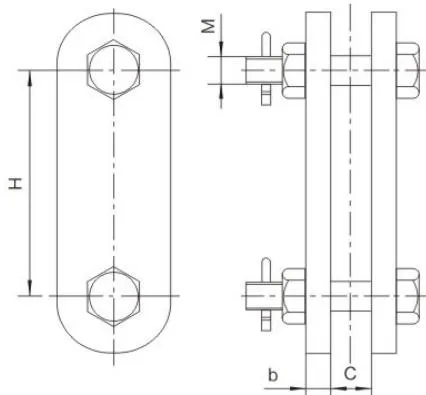
| Universal Design Model | Model | Main Dimensions (mm) | Nominal Failure Load(kN) | Reference Weight (kg) | |||
|---|---|---|---|---|---|---|---|
| C | b | M | H | ||||
| P-7 | 18 | 6 | 16 | 70 | 70 | 0.70 | |
| P-10 | 20 | 8 | 18 | 80 | 100 | 1.00 | |
| P-12 | 24 | 10 | 22 | 90 | 120 | 1.85 | |
| P-16 | 26 | 12 | 24 | 100 | 160 | 2.50 | |
| P-21 | 30 | 14 | 27 | 120 | 210 | 3.85 | |
| P-25 | 34 | 16 | 30 | 120 | 250 | 5.20 | |
| P-30 | 38 | 16 | 36 | 120 | 300 | 5.50 | |
| P-0770 | 20 | 6 | 16 | 70 | 70 | 0.70 | |
| P-1080 | 20 | 8 | 18 | 80 | 100 | 1.10 | |
| P-1290 | 20 | 10 | 22 | 90 | 120 | 1.85 | |
| P-16100 | 22 | 12 | 24 | 100 | 160 | 2.40 | |
| P-21100 | 24 | 14 | 24 | 100 | 210 | 2.70 | |
| P-25120 | 28 | 16 | 27 | 120 | 250 | 5.00 | |
| P-32120 | 32 | 16 | 30 | 120 | 320 | 5.30 | |
Note: Dimensions may vary slightly based on manufacturing tolerances. Contact our engineering team for custom sizes or special requirements.
Material & Manufacturing
- Material: forged steel or malleable cast iron
- Secondary components: hot-dip galvanized finish
- Surface treatment: Hot-dip galvanizing in accordance with ISO 1461 / ASTM A153 / IEC 61589, minimum zinc coating thickness 65 μm
- Manufacturing process: Precision forging, casting, or CNC machining of critical dimensions, followed by full galvanizing immersion. Dimensional accuracy controlled within ±0.5 mm tolerance on mounting interfaces
- Quality assurance: Every batch undergoes dimensional inspection, galvanizing thickness testing (magnetic or gravimetric method per ISO 2178), and visual surface examination. Mill test certificates (MTC) available upon request
Application Scope
- Connecting insulator strings to supporting hardware on towers and crossarms
- Insulator string connection points on transmission towers and distribution poles
- Strain and suspension assembly hardware linkage
- Dead-end and tension tower insulator attachment
Frequently Asked Questions
Q: What is the difference between ball clevis and socket clevis? A: Ball clevis (P-type) connects to socket-type insulator caps. Socket clevis connects to ball-type insulator pins. Select based on your insulator configuration.
Q: What load ratings are available? A: PD clevis fittings are available from 70 kN to 300 kN nominal failure load. Select the rating appropriate for your line design loads.
Q: Can clevis fittings be reused after line maintenance? A: Inspect for cracks, deformation, or galvanizing loss. If undamaged, clevis fittings can be reused per utility maintenance standards.
Industry Standards & Compliance
| Standard | Scope |
|---|---|
| IEC 61589 | Galvanizing requirements for overhead line hardware |
| ISO 1461 | Hot-dip galvanized coatings on iron and steel articles |
| ASTM A153 | Zinc coating (hot-dip) on iron and steel hardware |
| GB/T 2314 | General requirements for overhead line fittings |
| GB/T 2317 | Mechanical testing methods for overhead line hardware |
| DL/T 765.2 | Suspension and strain hardware for overhead power lines |