MSG Type Double Flexible Busbar Fixed Clamp
Models: MSG-4/120 – MSG-6/400-225 · Conductor: 185–630 mm² · Reference Weight: 1.55–4.18 kg
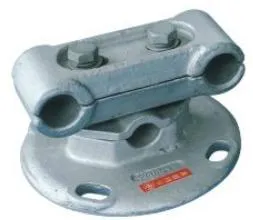
Three By Three By Two
Eighteen rows and no gaps — every combination of three jaws, three jaw spacings and two bases appears once. The model number reads straight off the table:
- MSG-4 / 5 / 6 — the jaw, Φ 22, 28 and 34 mm, covering 185
240, 300400 and 500~630 mm². - /120, /200, /400 — the spacing L between the two jaws.
- −225 — the large base. No suffix means the 140 mm base.
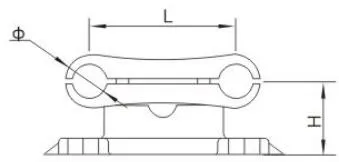
Φ and H repeat unchanged across all three L values and both bases: 22/44, 28/47, 34/53. The clamping geometry is fixed by the jaw, so the length and the base are free choices on top of it.
L Is The Spacing, Not The Length
L is measured between the centres of the two jaws — 120, 200 or 400 mm. It is not the overall length of the fitting, and it is not the conductor span.
That matters when you compare with the single-clamp sheets: a MDG has no L at all, because there is only one jaw. Here L does the job of setting how far apart the two parallel busbars are held.
The three values are widely spaced — 120, 200, 400 — with nothing in between. If a layout needs the two conductors 300 mm apart, there is no catalogue part; that is a special.
The Weight Runs Backwards Between 120 And 200
Longthening the bar by 200 mm adds weight, as it should. Shortening it by 80 mm also removes 0.09 to 0.16 kg — which is where the arithmetic stops making sense:
| Jaw / base | L 120 | L 200 | L 400 |
|---|---|---|---|
| 4 / 140 | 1.64 | 1.55 | 2.75 |
| 5 / 140 | 1.84 | 1.68 | 3.11 |
| 6 / 140 | 1.91 | 1.82 | 3.48 |
| 4 / 225 | 2.14 | 2.05 | 3.75 |
| 5 / 225 | 2.34 | 2.18 | 3.98 |
| 6 / 225 | 2.41 | 2.32 | 4.18 |
Every one of the six pairs is lighter at L 200 than at L 120. The bar is 80 mm longer and the part is up to 160 g lighter. Then from 200 to 400 — a 200 mm step, only two and a half times the first — the weight rises by 1.20 to 1.86 kg.
A 200 mm extension cannot be worth 1.7 kg while an 80 mm extension saves 0.16 kg — the L 120 size is the one where the column does not follow the length, so it is weighed before it is priced.
The L 200 and L 400 rows are consistent with each other and quote as printed. The L 120 is the row where the column does not follow the length, so we put one on a scale before the freight is fixed.
C Steps At The Base — With One Exception
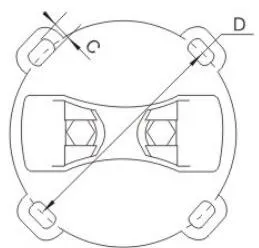
C is the width of the mounting slots, and it steps with the base exactly as it does on the single-clamp sheets:
- 140 base → C 14 mm — an M12 slot. All nine rows agree.
- 225 base → C 18 mm — an M16 slot. Eight rows agree. One does not.
MSG-4/120-225 prints C 14 while its two neighbours on the same 225 base print 18: that part is built on the 140-type base flange with a 225 footprint, which is why the 4 size does not take the 5 and 6 hardware.
Either way, do not assume an M16 fixing on that model. If you are ordering MSG-4/120-225 against a drilled support, confirm the slot width with us first — an 18 mm bolt will not pass a 14 mm slot.
The practical pattern to remember: on this family the small base is M12 and the large base is M16, so the fixing size is set by the base and never by the conductor.
Twice The Fitting, Roughly Half Again The Weight
Compare the same jaw on comparable bases:
- MDG-4 (Φ22, 127~140 base) — 0.96 kg, one jaw.
- MSG-4/200 (Φ22, 140 base) — 1.55 kg, two jaws.
The second jaw adds about 0.6 kg, not a doubling. The base casting is shared between the single and double versions, so the second conductor costs far less than the first.
Technical Parameters
| Model | Conductor Cross-Section (mm²) | Main Dimensions (mm) | Reference Weight (kg) | ||||
|---|---|---|---|---|---|---|---|
| Ø | H | D | L | C | |||
| MSG-4/120 | 185~240 | 22 | 44 | 140 | 120 | 14 | 1.64 |
| MSG-5/120 | 300~400 | 28 | 47 | 140 | 120 | 14 | 1.84 |
| MSG-6/120 | 500~630 | 34 | 53 | 140 | 120 | 14 | 1.91 |
| MSG-4/200 | 185~240 | 22 | 44 | 140 | 200 | 14 | 1.55 |
| MSG-5/200 | 300~400 | 28 | 47 | 140 | 200 | 14 | 1.68 |
| MSG-6/200 | 500~630 | 34 | 53 | 140 | 200 | 14 | 1.82 |
| MSG-4/400 | 185~240 | 22 | 44 | 140 | 400 | 14 | 2.75 |
| MSG-5/400 | 300~400 | 28 | 47 | 140 | 400 | 14 | 3.11 |
| MSG-6/400 | 500~630 | 34 | 53 | 140 | 400 | 14 | 3.48 |
| MSG-4/120-225 | 185~240 | 22 | 44 | 225 | 120 | 14 | 2.14 |
| MSG-5/120-225 | 300~400 | 28 | 47 | 225 | 120 | 18 | 2.34 |
| MSG-6/120-225 | 500~630 | 34 | 53 | 225 | 120 | 18 | 2.41 |
| MSG-4/200-225 | 185~240 | 22 | 44 | 225 | 200 | 18 | 2.05 |
| MSG-5/200-225 | 300~400 | 28 | 47 | 225 | 200 | 18 | 2.18 |
| MSG-6/200-225 | 500~630 | 34 | 53 | 225 | 200 | 18 | 2.32 |
| MSG-4/400-225 | 185~240 | 22 | 44 | 225 | 400 | 18 | 3.75 |
| MSG-5/400-225 | 300~400 | 28 | 47 | 225 | 400 | 18 | 3.98 |
| MSG-6/400-225 | 500~630 | 34 | 53 | 225 | 400 | 18 | 4.18 |
Related Pages
The single-jaw version of the same body: MDG single flexible busbar fixed clamp. The heavy-duty pair: MDG-N/51 and MSG-N/51.
Note: A complete 3 × 3 × 2 matrix. L is the centre distance between the two jaws, 120, 200 or 400 mm, with nothing in between. Weight is lower at L 200 than at L 120 on all six pairs, which cannot be right — ask us to weigh an L 120 before quoting. C is 14 mm on the 140 base and 18 mm on the 225 base, except MSG-4/120-225 which prints 14.