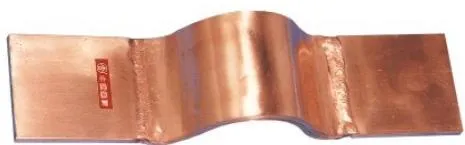
MST Copper Busbar Expansion Joint Busbar to Equipment
Models: MST-4×40 – MST-12.5×125 · Busbar: 40×4 – 125×12.5 mm · Sections: 3
Fourteen Rows, Same As The Aluminium Sheet
Compare this table with the MS aluminium joint and every cell is identical — the same fourteen sizes, the same A / L1 / L2 / B, the same three L2 brackets of 170, 190 and 220 mm.
The geometry is shared. L1 is an end plate at both ends and L2 the laminated middle, so overall length is 2 × L1 + L2, from 290 mm on MST-4×40 to 500 mm on MST-12.5×125.
What is not shared is the metal.
The Table Does Not Say “Copper”
There is no material column, no weight column and no resistivity column. The only place the copper appears is the title.
That is a bigger gap than it sounds, because the two metals are 3.3 : 1 apart in density and further apart in price. Take the largest size — 500 mm long, 125 wide, 12.5 thick:
- Solid copper at 8.9 g/cm³ — 6.95 kg
- Solid aluminium at 2.7 g/cm³ — 2.11 kg
The laminated middle is not solid, so neither figure is the real weight, but the ratio between them survives the correction. The copper part is roughly three times the mass and several times the cost of the aluminium part that shares its drawing.
So an MST cannot be priced from an MS. Not by weight, not by length, not by multiplying the aluminium figure — the copper content is the whole cost and the sheet does not carry it. Ask us for a quoted weight on the size you need and we will weigh it.
Busbar To Equipment Changes The Ends
The title draws a distinction the table does not: this joint runs between a busbar and a piece of equipment, where the MS runs busbar to busbar.
In practice that means one end plate is drilled to the terminal pattern of the device — a breaker, a transformer bushing plate, a switchgear terminal — rather than to a matching busbar. The catalogue prints no hole positions, no hole diameters and no hole count for either end.
A joint that does not match the terminal it bolts to is a wasted purchase, so before ordering an MST against an existing installation, send us the device terminal drawing. We will confirm the end plate against it. Do not infer the drill pattern from the A and B dimensions — two 100 × 10 terminals from different makers do not necessarily share a hole layout.
The Model Number Runs Thickness × Width
MST-12.5×125 is B = 12.5, A = 125. The model prints thickness before width.
That is the reverse of the MG transition plate notation, where MG-125×12.5 means width × thickness for the same conductor. Both conventions are in this catalogue and they are not interchangeable.
Same Sizes As The Aluminium Sheet
All fourteen, in the same width × thickness pairs:
- 40×4, 50×5 — the two small joints, both on the 170 mm laminate.
- 60×6 and 63×6.3 — two entries 3 mm apart on width, sharing L1 80 and L2 190.
- 80 in 6, 8 and 10 mm — three thicknesses, one laminate length.
- 100 in 8 and 10 mm.
- 120, 125 in 10 and 12 mm, plus 12.5×125 at the top — five entries covering three widths, all with L1 140 and L2 220.
Nothing here is available in a size the aluminium sheet lacks, and the aluminium sheet has nothing this one lacks. The two ranges are the same shape in two metals.
Technical Parameters

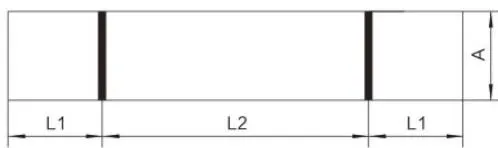
| Model | Main Dimensions (mm) | |||
|---|---|---|---|---|
| A | L1 | L2 | B | |
| MST-4×40 | 40 | 60 | 170 | 4 |
| MST-5×50 | 50 | 70 | 170 | 5 |
| MST-6×60 | 60 | 80 | 190 | 6 |
| MST-6.3×63 | 63 | 80 | 190 | 6.3 |
| MST-6×80 | 80 | 90 | 190 | 6 |
| MST-8×80 | 80 | 90 | 190 | 8 |
| MST-10×80 | 80 | 90 | 190 | 10 |
| MST-8×100 | 100 | 115 | 220 | 8 |
| MST-10×100 | 100 | 115 | 220 | 10 |
| MST-10×120 | 120 | 140 | 220 | 10 |
| MST-10×125 | 125 | 140 | 220 | 10 |
| MST-12×120 | 120 | 140 | 220 | 12 |
| MST-12×125 | 125 | 140 | 220 | 12 |
| MST-12.5×125 | 125 | 140 | 220 | 12.5 |
Related Pages
The aluminium joint on the identical fourteen rows: MS. Copper-to-aluminium versions: MSS, MSSB. Copper-aluminium transition plates: MG, MGB.
Note: The fourteen rows are identical to the aluminium MS sheet, so only the metal differs — and the table records neither material nor weight. Copper is 3.3 times the density, so MST cannot be priced from MS. The end plate that meets the equipment terminal has no printed drill pattern; send the terminal drawing before ordering. Model number is thickness × width.