MTL Tubular Busbar T Clamp
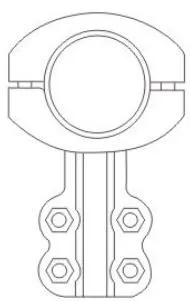
Models: 14 sizes · Reference Weight: 5.0–10.2 kg · Body: aluminium alloy, hardware hot-dip galvanised
Busbar OD First, Down-lead Second
The model is MTL-<busbar OD>-<down-lead section>: MTL-70-400 is a clamp for a 70 mm tubular busbar taking an LGJ-400 down-lead.
| Column | Meaning |
|---|---|
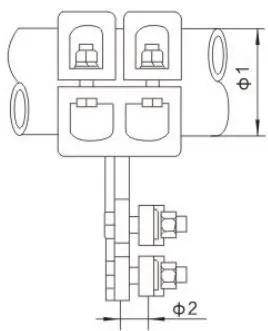
| Ø1 | Tubular busbar outside diameter — equals the model’s first number |
| Ø2 | Down-lead groove diameter |
| Weight | 5.0 – 10.2 kg |
Ø1 repeats the model number, which makes it easy to check a quotation: if the Ø1 column does not match the first number of the model, something has been transcribed.
Most Busbars Get One Down-lead Choice
Read down the second number and the range is much narrower than it looks:
- 70 mm busbar — LGJ-50, LGJ-240 or LGJ-400 (the only diameter with three options)
- 100 mm busbar — LGJ-240 or LGJ-400
- 130 mm busbar — LGJ-300 or LGJ-400
- 80, 90, 110, 120, 150, 170, 200 mm — LGJ-400 only
So fourteen rows cover eight bushings, and LGJ-400 is the only down-lead available at every busbar size. If your design calls for LGJ-240 off a 150 mm busbar, there is no row — that is a special.
Weight Is Driven by the Busbar, Not the Down-lead
Within one busbar diameter the down-lead barely matters:
| Model | Weight |
|---|---|
| MTL-70-50 | 5.0 kg |
| MTL-70-240 | 5.6 kg |
| MTL-70-400 | 5.8 kg |
A 50 mm² down-lead to a 400 mm² down-lead is an eight-fold change in conductor for 0.8 kg. The body is one casting sized to the busbar; the down-lead is a keeper and a saddle on the side of it.
Across busbar sizes the weight climbs steadily: 5.8 kg at 70 mm to 10.2 kg at 200 mm. A copper-equivalent fitting at 200 mm would be far heavier — this is an aluminium body, which is what you want on a tubular busbar where any added mass hangs on the bus support.
Clamp Orientation
MTL is a bolted T: the busbar passes through the body and the down-lead is clamped in a saddle on the underside. That means the down-lead leaves vertically downward, which suits:
- Busbar-to-equipment drops in an outdoor switchyard
- Jumper take-offs on a tubular bus
- Connections to a current transformer or a disconnect below the bus
If the down-lead has to leave at an angle or run horizontally, the fitting is a different one — the MTLY series uses a different body, and the MG/MR T connector is available in 0°, 30° and 90° versions.
Technical Parameters
| Model | Tubular Busbar O.D. (mm) | Down-Lead Conductor | Main Dimensions (mm) | Reference Weight (kg) | |
|---|---|---|---|---|---|
| ϕ1 | ϕ2 | ||||
| MTL-70-50 | 70 | LGJ-50 | 70 | 10 | 5.0 |
| MTL-70-240 | 70 | LGJ-240 | 70 | 22 | 5.6 |
| MTL-70-400 | 70 | LGJ-400 | 70 | 28 | 5.8 |
| MTL-80-400 | 80 | LGJ-400 | 80 | 28 | 6.4 |
| MTL-90-400 | 90 | LGJ-400 | 90 | 28 | 6.7 |
| MTL-100-240 | 100 | LGJ-240 | 100 | 22 | 7.0 |
| MTL-100-400 | 100 | LGJ-400 | 100 | 28 | 7.2 |
| MTL-110-400 | 110 | LGJ-400 | 110 | 28 | 7.5 |
| MTL-120-400 | 120 | LGJ-400 | 120 | 28 | 7.9 |
| MTL-130-300 | 130 | LGJ-300 | 130 | 25 | 8.1 |
| MTL-130-400 | 130 | LGJ-400 | 130 | 28 | 8.2 |
| MTL-150-400 | 150 | LGJ-400 | 150 | 28 | 8.8 |
| MTL-170-400 | 170 | LGJ-400 | 170 | 28 | 9.5 |
| MTL-200-400 | 200 | LGJ-400 | 200 | 28 | 10.2 |
Related Clamps
Lighter MTLY body: MTLY tubular busbar T clamp. Equal-diameter busbar tee: MTM tubular busbar T connector. Angled 0/30/90° versions: MG/MR T connector. Busbar support and expansion: MGG fixed support clamp.
Note: Only eight busbar diameters and only LGJ-400 at most of them. State busbar OD and down-lead designation.