MSSB Copper Aluminum Busbar Expansion Joint Explosion Welding
Models: MSSB-4×40 – MSSB-12.5×125 · Busbar: 40×4 – 125×12.5 mm · Sections: 4

The Same Fourteen Rows, A Fourth Time
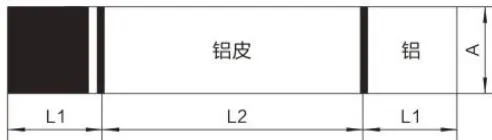
This is the fourth sheet in the group to print the same fourteen sizes with the same A / L1 / L2 / B values — identical to MS, MST and the second table on MSS.
But this part is copper at one end and aluminium at the other, so it cannot be dimensioned by L1 and L2 alone. Something has to describe the copper end. This sheet does not.
The Copper End Is Missing From This Sheet
The MSS sheet covers the same product and prints two more columns:
- L3 — a fixed 35 mm aluminium transition piece behind the copper plate, the same on all fourteen sizes.
- L4 — the copper plate itself, running from 65 mm on the small joints to 135 mm on the 120 and 125 mm ones.
Read that together and the MSS is four segments — copper L4, aluminium L3, laminated L2, aluminium L1 — with an overall length of 330 to 530 mm.
On this sheet you get two of those four segments. L3 and L4 appear nowhere, and there is no note explaining the omission.
What That Costs You
Without L3 and L4 you cannot determine, from this page:
- the overall length of the joint,
- how much copper is in it — which, given copper is 3.3 times the density of aluminium, is most of its weight and essentially all of its material cost,
- which end is which — the drawing convention for a copper-aluminium joint puts copper on one side only, and a joint installed backwards is a galvanic couple, not a transition.
An MSSB is laid out and priced from the MSS drawing, where L3 and L4 are complete: the two parts are the same shape made by two different processes, and the mechanical sheet is the one with the full dimension set. Ask for it and it goes out with the quotation.
Explosion Welding Is The Only Stated Difference
The title distinguishes this from MSS by the joining process. As with the transition plates, no column records it — no joint resistance, no pull strength, no temperature limit. The bond between copper and aluminium is explosion welded here and brazed on the MSS sheet; the envelope is the same.
Choose on the process and on the sheet that documents the copper end, not on the size table, which is common to four pages.
Sizes And The Code Order
The model prints thickness × width, so MSSB-12.5×125 is 12.5 mm thick on a 125 mm busbar — the reverse of the MG transition plate notation.
The fourteen sizes are the familiar set: 40×4, 50×5, 60×6, 63×6.3, three 80 mm joints in 6 / 8 / 10, two 100 mm in 8 / 10, and five at the top covering 120 and 125 mm in 10, 12 and 12.5 mm.
The two extra sizes on the MG brazing sheet — 80×15 and 90×10 — do not exist here, and neither do they exist on MS, MST or MSS.
Technical Parameters

| Model | Main Dimensions (mm) | |||
|---|---|---|---|---|
| A | L1 | L2 | B | |
| MSSB-4×40 | 40 | 60 | 170 | 4 |
| MSSB-5×50 | 50 | 70 | 170 | 5 |
| MSSB-6×60 | 60 | 80 | 190 | 6 |
| MSSB-6.3×63 | 63 | 80 | 190 | 6.3 |
| MSSB-6×80 | 80 | 90 | 190 | 6 |
| MSSB-8×80 | 80 | 90 | 190 | 8 |
| MSSB-10×80 | 80 | 90 | 190 | 10 |
| MSSB-8×100 | 100 | 115 | 220 | 8 |
| MSSB-10×100 | 100 | 115 | 220 | 10 |
| MSSB-10×120 | 120 | 140 | 220 | 10 |
| MSSB-10×125 | 125 | 140 | 220 | 10 |
| MSSB-12×120 | 120 | 140 | 220 | 12 |
| MSSB-12×125 | 125 | 140 | 220 | 12 |
| MSSB-12.5×125 | 125 | 140 | 220 | 12.5 |
Related Pages
The same part with the copper end dimensioned, and brazed: MSS copper aluminum busbar expansion joint. The single-metal joints on the same rows: MS aluminium, MST copper. Transition plates: MG, MGB.
Note: The fourteen rows match MS, MST and MSS cell for cell, but this sheet stops at L1 and L2. The copper plate L4 (65 to 135 mm) and the 35 mm aluminium transition L3 are printed only on the MSS sheet, so the overall length of 330 to 530 mm cannot be derived here. Use the MSS drawing to lay one out. Model number is thickness × width.