MG Copper Aluminum Transition Plate
Models: MG-50×5 – MG-125×12.5 · Busbar: 50×5 – 125×12.5 mm · Reference Weight: 0.2–2.4 kg
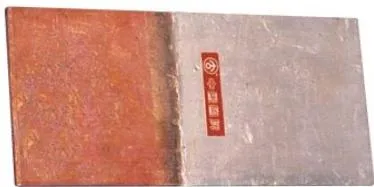
The Model Number Is The Busbar
MG-125×12.5 is a plate that joins a 125 mm wide by 12.5 mm thick busbar. The model number is not a size code to be looked up — it is the busbar cross-section, printed in the order width × thickness.
That makes ordering simple and it makes mistakes easy: the same two numbers appear on the expansion joint sheets in the opposite order, so a 125×12.5 there is a different product notation. Read the prefix first.
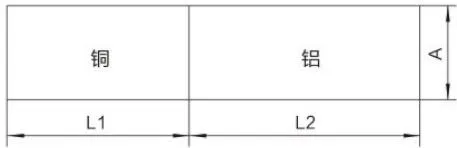
L1 Is Copper, L2 Is Aluminium
The plate is not symmetrical. The drawing labels the two halves copper on the left and aluminium on the right, and the table dimensions them separately:
- L1 — the copper half.
- L2 — the aluminium half.
- A — plate width, equal to the busbar width.
- B — plate thickness, equal to the busbar thickness.
So a single plate runs from a copper busbar on one side to an aluminium busbar on the other, with the metallurgical seam somewhere in the middle of its length.
L1 is A + 5 mm on every size except the smallest, where it is A exactly (50 wide, 50 copper). L2 is the longer half: 60, 85, 100, 120 and 140 mm as the width steps up. The copper half is deliberately short — copper is the expensive half, and every millimetre of it is paid for.
The Weight Column Adds Up — Which Is Useful
Because the two halves are dimensioned, you can compute the weight from first principles: copper at 8.9 g/cm³ on the L1 side, aluminium at 2.7 g/cm³ on the L2 side.
A × L1 × B × 8.9 + A × L2 × B × 2.7
| Model | Computed | Printed |
|---|---|---|
| MG-63×6.3 | 0.33 | 0.3 |
| MG-80×10 | 0.82 | 0.8 |
| MG-100×10 | 1.26 | 1.3 |
| MG-125×12.5 | 2.40 | 2.4 |
Every row lands within a rounding step of what the catalogue prints. That is worth knowing for two reasons.
First, it confirms the geometry. If L1 and L2 were two views of the same length rather than two halves of one plate, the computed weight would come out at half or double the printed figure. It does not — so the plate really is L1 + L2 long, half copper and half aluminium.
Second, it tells you where the money is. On every size the copper half carries 72 to 75 % of the mass on roughly half the length — on a 125×8 that is 1.16 kg of copper against 0.38 kg of aluminium. Since copper costs several times more per kilogram than aluminium, essentially the whole material cost of this part sits in L1. That is the reason a transition plate undercuts a solid copper plate, and the reason a quote moves when the copper index moves.
Three Thicknesses Per Width, Mostly
Not every width is offered in every thickness:
- 50 — 5 mm only.
- 63 — 6.3, 8 and 10 mm.
- 80 — 6.3, 8 and 10 mm.
- 100 — 8 and 10 mm.
- 125 — 8, 10 and 12.5 mm.
The 12.5 mm plate exists only at 125 mm wide, and the 50 mm plate only at 5 mm. If your busbar is 100 × 12.5, there is no MG plate for it — that is a different size bracket and needs either a wider plate trimmed down or a special.
Technical Parameters
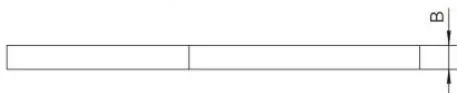
| Model | Applicable Busbar (mm2) | Main Dimensions (mm) | Reference Weight (kg) | |||
|---|---|---|---|---|---|---|
| A | L1 | L2 | B | |||
| MG-50×5 | 50×5 | 50 | 50 | 60 | 5 | 0.2 |
| MG-63×6.3 | 63×6.3 | 63 | 68 | 85 | 6.3 | 0.3 |
| MG-63×8 | 63×8 | 63 | 68 | 85 | 8 | 0.4 |
| MG-63×10 | 63×10 | 63 | 68 | 85 | 10 | 0.5 |
| MG-80×6.3 | 80×6.3 | 80 | 85 | 100 | 6.3 | 0.5 |
| MG-80×8 | 80×8 | 80 | 85 | 100 | 8 | 0.7 |
| MG-80×10 | 80×10 | 80 | 85 | 100 | 10 | 0.8 |
| MG-100×8 | 100×8 | 100 | 105 | 120 | 8 | 1.0 |
| MG-100×10 | 100×10 | 100 | 105 | 120 | 10 | 1.3 |
| MG-125×8 | 125×8 | 125 | 130 | 140 | 8 | 1.5 |
| MG-125×10 | 125×10 | 125 | 130 | 140 | 10 | 1.9 |
| MG-125×12.5 | 125×12.5 | 125 | 130 | 140 | 12.5 | 2.4 |
Related Pages
The same twelve rows with the joint made by brazing, which also prints two sizes this sheet omits: MG brazing. The explosion-welded version: MGB. Busbar expansion joints: MS, MST, MSS.
Note: The model number is width × thickness of the busbar. L1 is the copper half and L2 the aluminium half of one plate, so overall length is L1 + L2. L1 is A + 5 mm except on the 50 mm size. Computed weight at 8.9 and 2.7 g/cm³ reproduces the printed column on every row.