JCB Type Transformer Clamp
Models: JCB-50 – JCB-91 · Conductor: 4.8–20 mm OD · Bolts: M12–M20
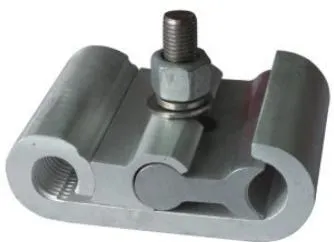
One Table, Five Products
This is not a list of 27 clamps. It is one clamp family laid out against five fixing bolts.
The left columns give the conductor — area and outside diameter, for JKLYJ, LJ, TJ, LGJ — and the five right-hand columns are headed M12, M14, M16, M18, M20. A cell holds the model of the clamp that fits that conductor on that bolt.
So a single conductor row can offer up to five different clamps. The bolt is the variable you choose second, after the conductor.
The First Digit Is The Bolt
The model numbers are not arbitrary:
- JCB-5x — M12
- JCB-6x — M14
- JCB-7x — M16
- JCB-8x — M18
- JCB-9x — M20
The first digit is the bolt size and the second the clamp body. Read JCB-73 and you have the third body on an M16 stud, and JCB-83 is the same body on M18.
Check it against any row: LJ(TJ)-70 gives JCB-53, JCB-62, JCB-72 and JCB-82 — second digits 3, 2, 2, 2. The body numbers shift slightly between columns because the lug geometry changes with the stud, but the first digit holds throughout.
This is the one clamp family in the catalogue where the model number can be decoded. Use it: if a drawing calls for an M16 terminal on an LGJ-120, you can go straight to the 7x column without scanning four others.
The M20 Column Counts Down
Every column ascends as the conductor grows — 51, 52, 53, 54, 55, 56 on M12; 61 to 67 on M14; 71 to 77 on M16; 81 to 87 on M18.
The M20 column does the opposite:
| Conductor | OD | M20 model |
|---|---|---|
| LJ(TJ)-95 | 12.5 | JCB-95 |
| LGJ-95 | 13.6 | JCB-95 |
| LJ(TJ)-120 | 14.3 | JCB-95 |
| LGJ-120 | 15.7 | JCB-94 |
| LJ(TJ)-150 | 15.8 | JCB-94 |
| JKLYJ-185 | 16.2 | JCB-93 |
| LGJ-150 | 17.1 | JCB-93 |
| LJ(TJ)-185 | 17.5 | JCB-93 |
| JKLYJ-240 | 18.4 | JCB-92 |
| LGJ-185 | 18.9 | JCB-92 |
| LJ(TJ)-240 | 20.0 | JCB-91 |
The largest conductor takes the smallest number. On every other bolt the last clamp is the highest-numbered; on M20 it is JCB-91.
Read the M20 column from the bottom up: the largest conductor takes the smallest number. JCB-91 is the M20 part for a 20 mm conductor and JCB-95 is the entry clamp for a 12.5 mm one. The count runs backwards there because the body grows with the jaw, and the number was assigned by the conductor list rather than by the body.
The First Three Rows Have One Bolt Only
JKLYJ-16, LJ-16, JKLYJ-25, LJ-25 and JKLYJ-35 print a single entry, all in the M12 column, and the other four cells are empty.
So a small conductor on a transformer terminal is M12 only. A specification calling for an M16 stud on a 25 mm² tail cannot be met from this sheet — that is a different clamp, not a different column.
From LJ(TJ)-35 upward the M14, M16 and M18 columns all fill. The M20 column stays empty until LJ(TJ)-95, the first conductor over 12 mm.
The progressive filling is worth noting for procurement: the smallest conductors have no choice and the largest have five, so a stock list built on the top of the range covers far fewer part numbers per conductor than one built on the bottom.
One Clamp, Several Conductors
JCB-53 appears against LGJ-50, JKLYJ-70, LJ(TJ)-70, LGJ-70 and JKLYJ-95 — five conductors, one clamp, on the M12 bolt.
That is why the conductor column pairs some designations: LJ(TJ)-35 means the clamp serves both LJ-35 and TJ-35, and LJ(TJ)-240 both. The bracket is the catalogue saying “one part, two conductors”.
So do not key your stock list from conductor to model and expect one-to-one. Go the other way: from the model to the list of conductors it covers, which is longer.
Technical Parameters
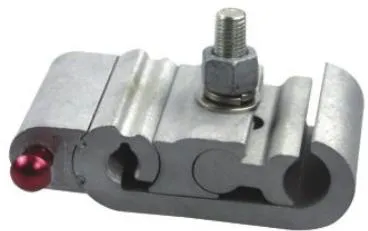
| Applicable Conductor (mm2) | Conductor OD (mm) | Applicable Bolt | ||||
|---|---|---|---|---|---|---|
| M12 | M14 | M16 | M18 | M20 | ||
| JKLYJ-16 | 4.8 | JCB-50 | ||||
| LJ-16 | 5.1 | JCB-50 | ||||
| JKLYJ-25 | 6.0 | JCB-50 | ||||
| LJ-25 | 6.5 | JCB-50 | ||||
| JKLYJ-35 | 7.0 | JCB-51 | ||||
| LJ(TJ)-35 | 7.5 | JCB-51 | JCB-61 | JCB-71 | JCB-81 | |
| LGJ-35 | 8.2 | JCB-51 | JCB-61 | JCB-71 | JCB-81 | |
| JKLYJ-50 | 8.3 | JCB-52 | JCB-61 | JCB-71 | JCB-81 | |
| LJ(TJ)-50 | 9.0 | JCB-52 | JCB-61 | JCB-71 | JCB-81 | |
| LGJ-50 | 9.6 | JCB-53 | JCB-62 | JCB-72 | JCB-82 | |
| JKLYJ-70 | 10.0 | JCB-53 | JCB-62 | JCB-72 | JCB-82 | |
| LJ(TJ)-70 | 10.8 | JCB-53 | JCB-62 | JCB-72 | JCB-82 | |
| LGJ-70 | 11.4 | JCB-53 | JCB-62 | JCB-72 | JCB-82 | |
| JKLYJ-95 | 11.6 | JCB-53 | JCB-62 | JCB-72 | JCB-82 | |
| LJ(TJ)-95 | 12.5 | JCB-54 | JCB-63 | JCB-73 | JCB-83 | JCB-95 |
| JKLYJ-120 | 13.0 | JCB-54 | JCB-63 | JCB-73 | JCB-83 | JCB-95 |
| LGJ-95 | 13.6 | JCB-54 | JCB-63 | JCB-73 | JCB-83 | JCB-95 |
| LJ(TJ)-120 | 14.3 | JCB-54 | JCB-63 | JCB-73 | JCB-83 | JCB-95 |
| JKLYJ-150 | 14.6 | JCB-54 | JCB-63 | JCB-73 | JCB-83 | JCB-95 |
| LGJ-120 | 15.7 | JCB-55 | JCB-64 | JCB-74 | JCB-84 | JCB-94 |
| LJ(TJ)-150 | 15.8 | JCB-55 | JCB-64 | JCB-74 | JCB-84 | JCB-94 |
| JKLYJ-185 | 16.2 | JCB-55 | JCB-65 | JCB-75 | JCB-85 | JCB-93 |
| LGJ-150 | 17.1 | JCB-55 | JCB-65 | JCB-75 | JCB-85 | JCB-93 |
| LJ(TJ)-185 | 17.5 | JCB-55 | JCB-65 | JCB-75 | JCB-85 | JCB-93 |
| JKLYJ-240 | 18.4 | JCB-56 | JCB-66 | JCB-76 | JCB-86 | JCB-92 |
| LGJ-185 | 18.9 | JCB-56 | JCB-66 | JCB-76 | JCB-86 | JCB-92 |
| LJ(TJ)-240 | 20.0 | JCB-56 | JCB-67 | JCB-77 | JCB-87 | JCB-91 |
Related Pages
Meter-box taps: JCD meter box clamp. Service clamps: JKG and JKL. Two-conductor branch clamps: JC clamp. Bolted T-taps: TL T clamp.
Note: The table is conductor against fixing bolt, not 27 separate clamps. First digit of the model = bolt size (5 for M12 through 9 for M20), second = body. The M20 column runs 95, 94, 93, 92, 91 as the conductor grows — the reverse of every other column — so JCB-91 is the largest M20 clamp and JCB-95 the smallest. Conductors up to JKLYJ-35 have an M12 entry only; M20 opens at LJ(TJ)-95.