MG Copper Aluminum Transition Plate Brazing
Models: MG-50×5 – MG-125×12.5 · Busbar: 50×5 – 125×15 mm · Reference Weight: 0.15–2.42 kg
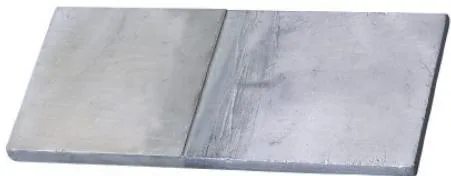
Fourteen Rows Against Twelve
This is the same plate as the MG transition plate with the copper and aluminium joined by brazing rather than a solid-phase weld. The geometry is identical — A width, B thickness, L1 copper half, L2 aluminium half — but the sheet carries two sizes the other one does not:
- MG-80×15 — 15 mm thick on an 80 mm busbar.
- MG-90×10 — a 90 mm busbar, which the other sheet skips entirely.
MG-80×15 at 1.23 kg is the heaviest plate below 100 mm wide on either sheet. If your busbar is 80 × 15 or 90 × 10, this is the only MG sheet that lists it.
Two Decimals, And They Hold Up
The most noticeable difference is the weight column: this sheet prints 0.15, 0.33, 0.42 where the other prints 0.2, 0.3, 0.4. Same parts, one decimal more.
That makes this the sheet to check the other against. Computing from the two halves — copper at 8.9 g/cm³ over L1, aluminium at 2.7 g/cm³ over L2 — reproduces these figures almost exactly:
| Model | L1 / L2 | Computed | This sheet | MG sheet |
|---|---|---|---|---|
| MG-50×5 | 50 / 60 | 0.15 | 0.15 | 0.2 |
| MG-63×8 | 68 / 85 | 0.42 | 0.42 | 0.4 |
| MG-80×8 | 85 / 100 | 0.66 | 0.66 | 0.7 |
| MG-100×10 | 105 / 120 | 1.26 | 1.26 | 1.3 |
| MG-125×12.5 | 130 / 140 | 2.40 | 2.42 | 2.4 |
Thirteen of the fourteen rows reconcile to within 0.01 kg. One does not, and one row is a copy-paste rather than a measurement — both below.
MG-100×8: The One Cell That Is Off
Computed for a 100 × 8 plate: copper 105 mm long gives 0.75 kg, aluminium 120 mm gives 0.26 kg, total 1.01 kg.
- This sheet prints 1.10.
- The MG sheet prints 1.0.
The calculation gives 1.01 kg. The one-decimal sheet rounds it to 1.0, this sheet prints 1.10, and that 0.10 kg is ten times the rounding error on any other row.
MG-100×8 is 1.0 kg, the correct rounding of 1.01. For freight the 0.09 kg matters little; for a copper-indexed price it does, so the offer carries the weighed figure.
MG-90×10 Is A 100 mm Plate With 10 mm Cut Off
Look at the dimensions: L1 105, L2 120 — byte for byte the same as every 100 mm row. And the printed weight, 1.26 kg, is byte for byte the weight of MG-100×10.
But a 90 mm wide plate with those same lengths weighs 1.13 kg: copper 90 × 105 × 10 gives 0.84 kg, aluminium 90 × 120 × 10 gives 0.29 kg.
So this row is built on the 100 mm blank and the weight was carried over without being reduced for the 10 mm trim. Quote MG-90×10 from the drawing rather than from the weight column — the part and the dimensions are right, and the kilogramme figure belongs to the 100 mm plate.
Technical Parameters
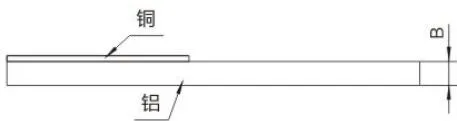
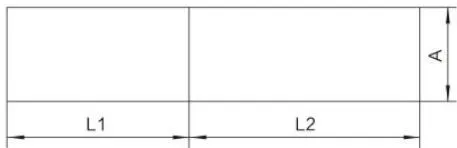
| Model | Applicable Busbar (mm2) | Main Dimensions (mm) | Reference Weight (kg) | |||
|---|---|---|---|---|---|---|
| A | L1 | L2 | B | |||
| MG-50×5 | 50×5.0 | 50 | 50 | 60 | 5 | 0.15 |
| MG-63×6.3 | 63×6.3 | 63 | 68 | 85 | 6.3 | 0.33 |
| MG-63×8 | 63×8.0 | 63 | 68 | 85 | 8 | 0.42 |
| MG-63×10 | 63×10.0 | 63 | 68 | 85 | 10 | 0.53 |
| MG-80×6.3 | 80×6.3 | 80 | 85 | 100 | 6.3 | 0.52 |
| MG-80×8 | 80×8.0 | 80 | 85 | 100 | 8 | 0.66 |
| MG-80×10 | 80×10.0 | 80 | 85 | 100 | 10 | 0.83 |
| MG-80×15 | 80×15.0 | 80 | 85 | 100 | 15 | 1.23 |
| MG-90×10 | 90×10.0 | 90 | 105 | 120 | 10 | 1.26 |
| MG-100×8 | 100×8.0 | 100 | 105 | 120 | 8 | 1.10 |
| MG-100×10 | 100×10.0 | 100 | 105 | 120 | 10 | 1.26 |
| MG-125×8 | 125×8.0 | 125 | 130 | 140 | 8 | 1.55 |
| MG-125×10 | 125×10.0 | 125 | 130 | 140 | 10 | 1.92 |
| MG-125×12.5 | 125×12.5 | 125 | 130 | 140 | 12.5 | 2.42 |
Related Pages
The twelve-row MG sheet: MG copper aluminum transition plate. The explosion-welded equivalent: MGB. Busbar expansion joints on the same principle: MSS and MSSB.
Note: Fourteen rows, two of them unique to this sheet: 80×15 and 90×10. The two-decimal weights reconcile with the copper and aluminium halves to 0.01 kg on thirteen rows; MG-100×8 prints 1.10 where the calculation gives 1.01. MG-90×10 reuses the 100 mm blank’s L1, L2 and weight, so its 1.26 kg is 0.13 kg too high.