OT Copper Open-End Terminal
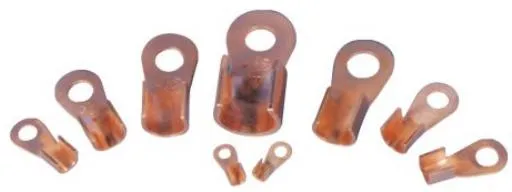
Models: OT-10A – OT-1000A (17 sizes)
OT is a copper ring terminal made from strip: a round palm with a bolt hole, and a barrel that is rolled into an open C-section rather than closed into a tube. The conductor is pressed in from the side and the barrel is closed over it. That one feature — the open barrel — is what the part is for, and it also sets the limit on where it can be used.
The A is amperes, not square millimetres
This is the most common misreading of an OT code, and it costs people an order. OT-100A is a 100 A terminal. It is not a 100 mm² terminal.
The series runs 10, 20, 30, 40, 50, 60, 80, 100, 150, 200, 250, 300, 400, 500, 600, 800, 1000 — the standard current steps of a control and distribution range, not the standard conductor steps. A 100 A terminal takes roughly 25 to 35 mm² of copper; a 100 mm² conductor would need something around OT-250A.
So the question “which OT for a 50 mm² cable” cannot be answered from the code alone. It is answered from R1.
R1 is the barrel bore — this is the column that fits the cable
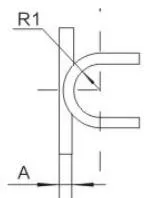
The drawing shows R1 as the inside radius of the C-section, which means the barrel bore is 2 × R1. That is the dimension to compare against your conductor:
| Model | R1 | Barrel bore (2×R1) | Copper that fits |
|---|---|---|---|
| OT-10A | 2.0 | 4.0 mm | 1.0 – 1.5 mm² |
| OT-30A | 3.2 | 6.4 mm | 4 – 6 mm² |
| OT-100A | 5.0 | 10.0 mm | 25 – 35 mm² |
| OT-300A | 7.0 | 14.0 mm | 70 – 95 mm² |
| OT-1000A | 15.5 | 31.0 mm | 400 – 500 mm² |
On an open barrel the fit is more forgiving than on a closed tube, because the C-section springs open as the conductor goes in and closes down when it is crimped. That is an advantage up to a point and a liability past it — see below.
Measure the conductor, not the nominal size. The same 35 mm² in Class 5 flexible cable is noticeably fatter across than Class 2 stranded, and on a 10 mm bore that difference is the whole clearance.
Φ is the bolt hole, and it stops at M18
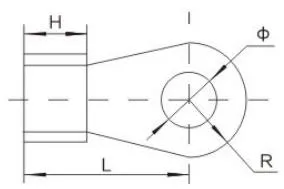
Φ is the ring hole, sized to the stud: 5.2 = M5, 6.2 = M6, 8.2 = M8, 10.2 = M10, 12.2 = M12, 14.2 = M14, 16.2 = M16, 18.2 = M18.
The largest in the range is M18, on the 800A and 1000A. There is no M20 or M22 in OT. Where the equipment stud is larger than M18, the answer is a different terminal — a DTM compression lug drilled to the stud, not an OT.
Note the pattern: the hole steps at every size, the barrel bore steps at every size, and the two do not step together. Rows where Φ stays the same across two or three sizes (OT-20A, 30A, 40A, 50A all at 6.2) are the same stud with a growing barrel.
A is the plate thickness
A runs from 0.8 mm at the 10A to 3.5 mm at the 1000A, and it is the honest measure of how much current the palm can carry across its own section. It is also why an OT cannot simply be scaled up in width: a 1000 A terminal needs a 3.5 mm plate, and that plate will not bend to sit flat on a small pad.
R is the outside radius of the round palm. Use it for clearance — the palm has to sit on the pad without touching the next pole or the case lip.
What an open barrel is good for, and what it is not
Good for
- A conductor that cannot be pushed through. A closed tube needs a straight, free end. An open barrel takes the conductor from the side, so a cable already bent into a terminal box, or one with no slack to straighten, still terminates.
- Field repair without a hydraulic head. A small OT closes with a hand crimper or pliers. That is the whole reason it exists in panel and control work.
- Small currents, thin plate, tight spaces. 0.8 mm plate on the 10A bends to the pad; nothing else in the range does.
Not good for
- Anything above about 100 A where the joint matters. An open barrel that is closed by hand has no defined compression, no die mark and no way to inspect the result. On a 300 A joint that is not a termination, it is a hope.
- Vibration. The C-section can relax. Where the joint is on a machine, a vehicle or a conductor that moves, use a closed barrel.
- Aluminium conductor. The barrel is copper. A copper C-section clamped on aluminium is a galvanic joint with a gap in it — worse than a solid bimetal joint, not better.
- Anything an inspector will look at. Closed barrel with a die mark is the standard; OT is the exception you justify.
The dividing line in practice is around 100 A. Below it, OT is fast, cheap and adequate — that is most panel wiring, most control circuits, most small motor leads. Above it, move to DTM for copper or DLM for aluminium, and crimp with a hexagonal die.
Technical parameters
| Model | Main dimensions (mm) | |||||
|---|---|---|---|---|---|---|
| Φ | H | L | R | R1 | A | |
| OT-10A | 5.2 | 6.0 | 14.5 | 4.5 | 2.0 | 0.8 |
| OT-20A | 6.2 | 7.0 | 17.0 | 5.5 | 2.5 | 1.0 |
| OT-30A | 6.2 | 8.2 | 19.0 | 5.8 | 3.2 | 1.2 |
| OT-40A | 6.2 | 9.0 | 19.5 | 6.2 | 3.5 | 1.2 |
| OT-50A | 6.2 | 9.0 | 23.0 | 6.5 | 3.5 | 1.2 |
| OT-60A | 8.2 | 10.0 | 24.0 | 7.0 | 4.0 | 1.4 |
| OT-80A | 8.2 | 11.0 | 25.0 | 8.0 | 4.5 | 1.5 |
| OT-100A | 8.2 | 12.0 | 29.0 | 8.5 | 5.0 | 1.5 |
| OT-150A | 10.2 | 12.0 | 31.0 | 9.0 | 5.5 | 1.6 |
| OT-200A | 10.2 | 14.0 | 33.0 | 10.0 | 6.0 | 1.7 |
| OT-250A | 10.2 | 15.5 | 36.0 | 10.5 | 6.5 | 2.0 |
| OT-300A | 12.2 | 16.0 | 40.0 | 11.5 | 7.0 | 2.0 |
| OT-400A | 14.2 | 18.0 | 43.0 | 13.0 | 8.0 | 2.2 |
| OT-500A | 14.2 | 20.0 | 46.0 | 14.5 | 8.5 | 2.4 |
| OT-600A | 16.2 | 22.0 | 50.5 | 16.0 | 10.5 | 2.8 |
| OT-800A | 18.2 | 26.0 | 61.0 | 17.5 | 12.5 | 3.2 |
| OT-1000A | 18.2 | 33.0 | 66.0 | 20.5 | 15.5 | 3.5 |
Reading the columns
- Φ (mm) — ring hole for the bolt. 5.2 = M5 through 18.2 = M18.
- H (mm) — barrel length, the distance the conductor is held over.
- L (mm) — overall length, barrel mouth to the far edge of the palm, for clearance in the box.
- R (mm) — outside radius of the round palm.
- R1 (mm) — inside radius of the C-section. Bore = 2 × R1, and that is what the conductor has to fit.
- A (mm) — plate thickness, 0.8 to 3.5 mm.
Ordering
Tell us the conductor size or the current, and the stud. Those two answer R1 and Φ, and they are what the part is actually chosen by. The code alone does not fix either.
If the joint is going to be inspected, or is above about 100 A, say so — we will quote a closed barrel instead of an OT.
FAQ
Is OT-100A good for 100 mm² cable? No. The number is 100 amperes. A 100 mm² copper conductor needs a barrel bore around 13 mm, which is closer to OT-250A. Check R1 first.
What does the A in OT-10A stand for? Amperes. The series steps in the standard current ratings of a control range: 10, 20, 30, 40, 50, 60, 80, 100, 150, 200, 250, 300, 400, 500, 600, 800, 1000.
Can I crimp OT with a normal hexagonal die? No. The barrel is an open C-section, not a closed tube, so there is no tube for a hex die to surround. It is closed with a hand crimper or a dedicated open-barrel tool.
Why is the barrel open instead of a tube? So a conductor that cannot be pushed through — bent already, no slack, tight box — can still be terminated from the side. That is the entire benefit, and it is also why the joint is only as good as the closing tool.
Do you make OT in aluminium? No. OT is copper. For aluminium conductor on aluminium equipment use DLM; for aluminium cable on a copper pad use DTL.
What is the largest OT you make? OT-1000A, with an M18 hole and a 31 mm barrel bore. Above that the answer is a compression lug, not an open terminal.