DT Copper Terminal, DTM / DT-S / DTG
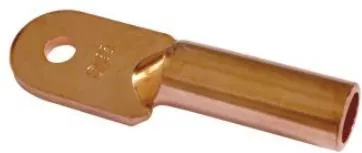
Models: DTM-10 to DTM-1000 (17 sizes), DT-10S to DT-500S (14 sizes), DTG-10 to DTG-800 (16 sizes)
DT is the copper compression lug, and it comes in three builds that share one crimping method: strip the conductor, push it into the barrel, close a hexagonal die. What changes is the palm — one hole or two — and the barrel — machined from solid bar or formed from copper tube.
The aluminium counterpart is a separate page: DL aluminium terminal. The two are different parts with different dimensions, not a colour choice.
The three copper series at a glance
| Series | Palm | Barrel | Sizes (mm²) | Hole Ø |
|---|---|---|---|---|
| DTM | single hole | solid bar, oil-sealed | 10 – 1000 | 8.4 – 21.0, square head above 500 |
| DT-S | two holes | solid bar, oil-sealed | 10 – 500 | 8.4 – 21.0 |
| DTG | single hole | copper tube, not sealed | 10 – 800 | 6.5 – 21.0, none published above 500 |
Pick the palm first, then the barrel. The size number means the same conductor in all three.
What the code tells you
The old catalogue prints DT, the standard prints DTM — same part, two names. The 2020 sample book writes DT-120; GB/T 14315 writes DTM-120, where the M means sealed. The trade dropped the M decades ago and kept the shorter code, which is why both turn up in the same tender package.
Where this bites is that the standard also has a plain DT, and it is not the same thing — DT is the unsealed tube version, which is sold here as DTG. So a two-letter code that looks identical points at two different lugs:
| On the paper | Standard designation | What it actually is | Table below |
|---|---|---|---|
| DT-120 (2020 sample book) | DTM-120 | sealed, solid bar | 1 |
| DT-120S | no standard code — S is trade shorthand | sealed, two-hole palm | 2 |
| DTG-120 or DT-(G)-120 | DT-120 | unsealed, copper tube | 3 |
DTM is DTM, DT is DTG. That is the whole rule. If a tender says DTM-120 you quote table 1. If it says DT-120 without the M, ask whether the lug is solid bar or tube before you price it, because the two differ by up to 20 mm in length and one of them has no oil seal.
DTM is the sealed single-hole lug. Machined from solid copper bar, barrel closed at the palm end. The code is DTM plus the conductor size — DTM-120 is 120 mm², single hole.
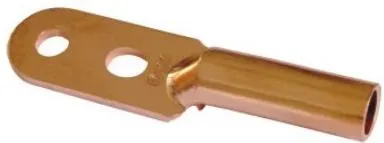
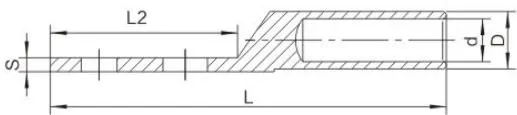
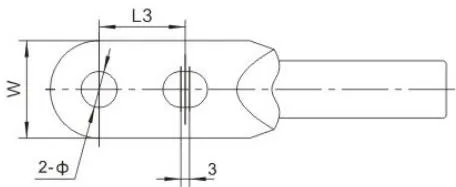
S means two holes, and it drops the M. The two-hole palm is catalogued as its own series, DT-S, so the model reads DT-120S, never DTM-120S. That is how the maker lists it and it is not a typo on this page. If a tender or a drawing says DT-120S, this is the part. The palm table adds two columns: L2 is palm length, L3 is the hole-centre spacing.
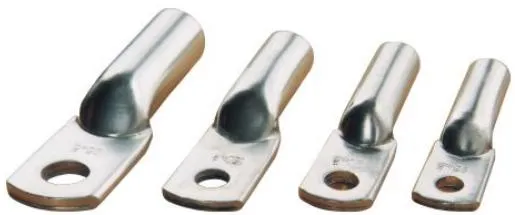
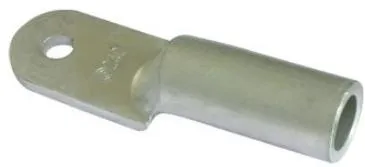
DTG means tube stock. Formed from copper tube rather than a solid forging. No oil seal, and much shorter for the same conductor.
“Oil-sealed” is about the barrel, not the palm. The barrel is closed so oil cannot migrate along the stranded conductor into the joint. That is why DTM and DT-S are the specified lugs on oil-immersed transformer leads and oil-filled cable terminations. If your terminal sits in or next to oil, say so on the enquiry — an unsealed lug wicks oil up the strands and bleeds it out at the palm, which is a slow, invisible fault.
Solid forging or tube — the difference shows in the length
DTG is pressed from tube, so there is no thick palm forging behind the barrel. Against the DTM of the same conductor:
| Size (mm²) | DTM length | DTG length | DTM hole Ø | DTG hole Ø |
|---|---|---|---|---|
| 10 | 66 | 50 | 8.4 | 6.5 |
| 25 | 70 | 60 | 8.4 | 6.5 |
| 70 | 95 | 80 | 12.5 | 10.5 |
| 120 | 112 | 96 | 14.5 | 12.5 |
| 240 | 136 | 120 | 16.5 | 16.5 |
| 500 | 190 | 170 | 21.0 | 21.0 |
Two things follow. The tube lug is 16 mm shorter at 120 mm² and still 20 mm shorter at 500 — useful where the terminal box is shallow. And its palm hole is smaller on every size up to 240 — 6.5 against 8.4 on the small sizes — because the tube wall limits how much metal sits around the hole.
Where the hole is a number, a list, or your drawing
This series shows all three situations, and it is worth knowing which one you are in before you ask for a price.
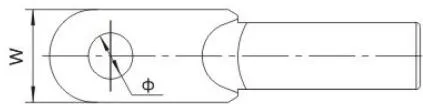
A number — DTM-10 to DTM-500. One hole per size, Ø 8.4 through 21.0. The catalogue figure is the hole; if your stud is bigger, go up a size or change the palm.
Square head — DTM-630, DTM-800, DTM-1000. The Ø column carries no number at all. At this size the palm is a square block and the hole is drilled to your stud. This is the one place in the range where the answer to “what hole can I have” is genuinely tell us what you need. DTG-630 and DTG-800 are the same: hole to order.
Your drawing — the two-hole palms. L3 is fixed by the catalogue, so the hole spacing is not free; but palm length, the direction the palm points relative to the barrel, and a 90° rotation of the pair are all die-level changes. Give a drawing and we quote against it.
The two-hole palm takes a smaller hole, and that is not a mistake
On DT-300S and DT-400S the hole is 16.5, while DTM-300 and DTM-400 — the single-hole version of the same conductor — are drilled 21.0. Same cable, smaller hole on the palm that carries two of them.
The reason is arithmetic. Two holes need metal between them, and that metal comes out of the same palm width that would otherwise have gone around one larger hole. So do not assume “same size, same hole” — read the column. The same effect appears on the aluminium side at DL-300S against DLM-300.
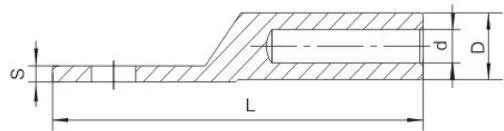
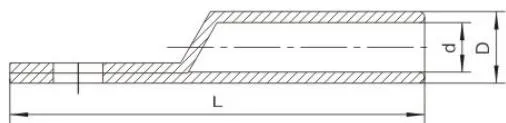
The bore d is never a choice. It is set by the conductor, and it is the one dimension that cannot be adjusted afterwards.
Copper on aluminium conductor — no
Copper and aluminium in contact with moisture form a galvanic cell. The aluminium side corrodes and the joint resistance climbs, slowly and invisibly, until it runs hot.
Where you must join the two metals, use a welded bimetallic terminal rather than two metals pressed together:
- DTL copper-aluminium transition terminal — the standard range
- DTLB explosion-welded — welded over the full face
- DT-F waterproof in all copper and DTL-F in bimetal, both with a sealing sleeve at the mouth
And if the conductor itself is aluminium, the lug is DLM, not DTM.
Standards
Made to GB/T 14315-2008 — compression terminal lugs and ferrules for power cable conductors up to 35 kV, copper 10–630 mm². Test methods GB/T 9327-2008, international counterpart IEC 61238-1.
- DC resistance across the joint, no higher than an equal length of conductor — the pass/fail figure.
- Temperature rise — the joint must not run hotter than the conductor at rated current.
- Thermal cycling — resistance inside limits after repeated cycles.
- Mechanical — pull-out, plus short-circuit withstand on the larger sizes.
The sizes above 630 are made to drawing rather than to a row in that standard.
Installation
- Strip to the barrel depth — the palm end, not past it. Bare conductor outside the barrel is a corrosion site and a hot spot.
- Clean the conductor. Advisory on copper; on aluminium it is not optional.
- Insert fully. The single-hole DTM has no peep hole; mark the strip length on the insulation first.
- Crimp from the palm end outward, one hexagonal crimp per 15–20 mm of barrel, each overlapping the previous by a third. Starting at the mouth pushes the conductor back out.
- Die closure — a regular hexagon with the die faces meeting. A rounded oval means the wrong die or a short stroke.
- Seal the mouth outdoors and in buried joints.
Where these joints fail
- Bore matched to the nominal mm² instead of the conductor diameter. Flexible Class 5/6 cable is fatter than Class 2 for the same figure; the crimp collapses the outer strands.
- DTG where oil is present. No seal, so oil migrates up the strands.
- Wrong die. Oval crimp, partial contact, or a split barrel from over-compression.
- Two-hole palm bolted with one bolt. The palm rotates, contact area halves at the second hole.
- Copper lug on aluminium. Slow, invisible galvanic corrosion.
FAQ
DTM or DTG? Same joint, two ways of making it. DTM is machined and sealed from solid copper bar — heavier, longer, oil-tight. DTG is pressed from tube — shorter and lighter for the same size, no oil seal, smaller palm hole. For plain copper cable in a dry panel either is correct; the choice is usually terminal-box clearance, weight and the die set you already carry. If the terminal sits in oil, it has to be DTM. For a flared barrel mouth on the tube version, see the DTGB terminal.
What does the S stand for? Two-hole palm, and the code it sits on is DT-S, so DT-120S without the M. L3 is the hole spacing, L2 the palm length. If a drawing says DT-120S, the single-hole DTM-120 is not what is being asked for.
Can you open the hole up? On DTM-10 to DTM-500, usually not beyond the catalogue figure: the palm width is what limits it and the strip between hole and palm edge thins out. Going up one size is normally cheaper than a special palm. On DTM-630 and above the hole is drilled to order anyway, so there is nothing to open up.
Tin plating? Yes — worth it outdoors, on the coast, in humid plant rooms, and anywhere the palm lands on a different metal.
And a version for a circuit breaker terminal? Three of them, with the palm dropped below the barrel axis so the tongue seats on a pad set back inside the case: DTC in copper, DTLC in bimetal, and DTLZ as a 5 mm blade clamped under the breaker’s own screw.
Technical Parameters
1. DTM — copper terminal, single hole, oil-sealed
| Model | Main Dimensions (mm) | |||||
|---|---|---|---|---|---|---|
| Ø | D | d | L | W | S | |
| DTM-10 | 8.4 | 9 | 5.5 | 66 | 16 | 2.2 |
| DTM-16 | 8.4 | 10 | 6.0 | 67 | 16 | 2.5 |
| DTM-25 | 8.4 | 11 | 7.0 | 70 | 18 | 3.0 |
| DTM-35 | 10.5 | 12 | 8.5 | 79 | 20 | 3.0 |
| DTM-50 | 10.5 | 14 | 9.6 | 87 | 23 | 3.5 |
| DTM-70 | 12.5 | 16 | 12.0 | 95 | 26 | 4.0 |
| DTM-95 | 12.5 | 18 | 13.0 | 105 | 28 | 4.5 |
| DTM-120 | 14.5 | 20 | 15.0 | 112 | 30 | 5.0 |
| DTM-150 | 14.5 | 22 | 16.0 | 118 | 34 | 5.5 |
| DTM-185 | 16.5 | 25 | 18.0 | 125 | 38 | 6.0 |
| DTM-240 | 16.5 | 27 | 20.0 | 136 | 42 | 7.0 |
| DTM-300 | 21.0 | 30 | 23.0 | 160 | 48 | 8.0 |
| DTM-400 | 21.0 | 34 | 26.0 | 165 | 54 | 9.0 |
| DTM-500 | 21.0 | 38 | 29.0 | 190 | 64 | 9.5 |
| DTM-630 | Square Head | 45 | 34.0 | 220 | 78 | 10.0 |
| DTM-800 | Square Head | 50 | 38.0 | 260 | 100 | 10.5 |
| DTM-1000 | Square Head | 55 | 42 | 275 | 100 | 11 |
L2 and L3 do not apply to a single-hole palm. From DTM-630 up the palm is a square block and the hole is drilled to your stud.
2. DT-S — copper terminal, two-hole palm
| Model | Main Dimensions (mm) | |||||||
|---|---|---|---|---|---|---|---|---|
| Ø | D | d | L | L2 | L3 | W | S | |
| DT-10S | 8.4 | 9 | 5.5 | 80 | 40 | 20 | 16 | 2.5 |
| DT-16S | 8.4 | 10 | 6.0 | 82 | 40 | 20 | 16 | 2.5 |
| DT-25S | 8.4 | 11 | 7.0 | 86 | 42 | 20 | 18 | 2.5 |
| DT-35S | 10.5 | 12 | 8.5 | 93 | 45 | 20 | 20 | 3.0 |
| DT-50S | 10.5 | 14 | 9.6 | 100 | 47 | 20 | 23 | 3.0 |
| DT-70S | 12.5 | 16 | 12.0 | 115 | 55 | 25 | 26 | 3.5 |
| DT-95S | 12.5 | 18 | 13.0 | 123 | 57 | 25 | 28 | 3.5 |
| DT-120S | 14.5 | 20 | 15.0 | 132 | 63 | 30 | 30 | 4.0 |
| DT-150S | 14.5 | 22 | 16.0 | 140 | 65 | 30 | 34 | 4.8 |
| DT-185S | 14.5 | 25 | 18.0 | 152 | 73 | 35 | 37 | 5.5 |
| DT-240S | 14.5 | 27 | 20.0 | 160 | 74 | 35 | 40 | 5.7 |
| DT-300S | 16.5 | 30 | 23.0 | 170 | 77 | 40 | 45 | 7.0 |
| DT-400S | 16.5 | 34 | 26.0 | 178 | 77 | 40 | 50 | 7.5 |
| DT-500S | 21.0 | 38 | 29.0 | 205 | 90 | 45 | 60 | 9.0 |
L2 is the palm length, L3 the hole-centre spacing. DT-300S and DT-400S are drilled 16.5 where the single-hole DTM of the same size is 21.0.
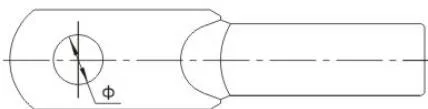
3. DTG — copper terminal, tube stock
| Model | Main Dimensions (mm) | |||
|---|---|---|---|---|
| Ø | D | d | L | |
| DTG-10 | 6.5 | 8 | 5.0 | 50 |
| DTG-16 | 6.5 | 9 | 6.0 | 55 |
| DTG-25 | 6.5 | 10 | 7.0 | 60 |
| DTG-35 | 8.5 | 12 | 8.0 | 66 |
| DTG-50 | 8.5 | 14 | 10.0 | 72 |
| DTG-70 | 10.5 | 16 | 11.5 | 80 |
| DTG-95 | 10.5 | 18 | 13.5 | 87 |
| DTG-120 | 12.5 | 20 | 15.0 | 96 |
| DTG-150 | 12.5 | 22 | 16.0 | 103 |
| DTG-185 | 16.5 | 25 | 18.0 | 115 |
| DTG-240 | 16.5 | 27 | 20.0 | 120 |
| DTG-300 | 17.0 | 31 | 24.0 | 135 |
| DTG-400 | 17.0 | 34 | 26.0 | 150 |
| DTG-500 | 21.0 | 38 | 30.0 | 170 |
| DTG-630 | — | 45 | 35.0 | 210 |
| DTG-800 | — | 50 | 40.0 | 270 |
Shorter and lighter than the standard DTM of the same size. Ø is not published for the two largest sizes — quote to your stud.
Note: Dimensions may vary slightly with manufacturing tolerance. Where the Ø column reads Square Head the palm is a square block and the hole is drilled to your stud; on every other size the Ø shown is the catalogue hole. The bore d is set by the conductor and is not a custom dimension.