DT-F Waterproof Copper Terminal
Models: DT-F-25 – DT-F-500 (12 sizes)
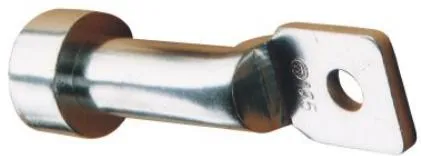
A DT-F is an ordinary copper compression lug with one addition: the barrel mouth carries a sealing sleeve. The crimp is made first, in the usual way, and the sleeve is then closed onto the conductor insulation — so the place water normally enters a lug, the gap between the barrel wall and the insulation, is shut.
Everything behind the crimp is the same as any other copper lug: tin-plated copper, one palm hole, one die. What you are paying for is the seal, and it is worth paying for in exactly one situation: where the joint will be wet and nobody will look at it again for ten years.
Where a plain lug fails
A crimped joint is watertight in the direction people expect — the crimp itself is a cold weld, and water does not pass through it. It fails at the end of the barrel, where the stripped conductor enters. That gap is open. Water sits in it, the strands at the mouth oxidise, and the oxide works its way in along the conductor under every load cycle. Copper goes green and then brittle; aluminium goes to white powder and the joint resistance climbs until it runs hot.
Indoors, in a dry switchroom, this takes long enough that nobody cares. Outdoors the list of places it matters is short and specific:
- Cable pits and manholes, which fill with water and stay full.
- Pole-mounted cabinets and kiosks in humid or coastal air, where condensation forms every night.
- Irrigation, pump stations and fish farms — genuinely wet, not just damp.
- Salt fog within a few kilometres of the coast, where chlorides attack the strand ends.
- Any joint that will be taped and buried and therefore never inspected.
If the joint is inside a dry panel, the DT-F buys you nothing. Buy a DTM and put the money elsewhere.
Why the sleeve diameter repeats
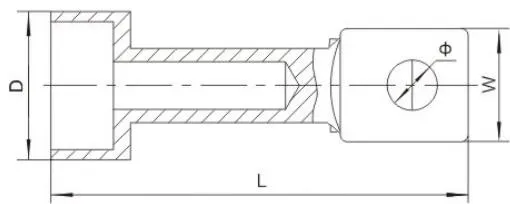
Look at D in the table: it is 37 mm on every size from 25 to 150 mm², and 40 mm on 185 to 500. Twelve sizes, two sleeve diameters.
That is not a filing error. The sleeve is a moulded part with a limited shrink range, and one sleeve covers a band of barrel sizes. It matters to you in two ways:
- A store stocking DT-F keeps two sleeve part numbers, not twelve.
- If you are replacing a lug on an existing cable, the sleeve diameter tells you which band the lug belongs to before you measure the barrel.
The other three columns behave the way you would expect: Φ is the palm hole, W the palm width, L the overall length including the sleeve.
| Column | Meaning | Range across the 12 sizes |
|---|---|---|
| Φ | palm hole diameter | 11 mm (25–95) → 13 mm (120–240) → 17 mm (300–500) |
| D | sleeve diameter at the mouth | 37 mm → 40 mm |
| L | overall length, sleeve included | 110 → 184 mm |
| W | palm width | 26 → 44 mm |
Two things worth noticing in that column of numbers. The hole takes a M10 bolt up to 95 mm², M12 from 120 to 240, and M16 at 300 and above — so the palm is sized for the busbar, not for the cable, and a 500 mm² lug still bolts down with one M16. And L is not monotonic with size: DT-F-70 and DT-F-95 are both 114 mm, DT-F-120 and DT-F-150 are both 126 mm. The sleeve, not the barrel, sets the length, so neighbouring sizes share a body.
Technical parameters — DT-F, all copper
| Model | Main dimensions (mm) | |||
|---|---|---|---|---|
| Φ | D | L | W | |
| DT-F-25 | 11 | 37 | 110 | 26 |
| DT-F-35 | 11 | 37 | 110 | 26 |
| DT-F-50 | 11 | 37 | 112 | 30 |
| DT-F-70 | 11 | 37 | 114 | 30 |
| DT-F-95 | 11 | 37 | 114 | 30 |
| DT-F-120 | 13 | 37 | 126 | 32 |
| DT-F-150 | 13 | 37 | 126 | 32 |
| DT-F-185 | 13 | 40 | 134 | 36 |
| DT-F-240 | 13 | 40 | 136 | 40 |
| DT-F-300 | 17 | 40 | 141 | 40 |
| DT-F-400 | 17 | 40 | 178 | 44 |
| DT-F-500 | 17 | 40 | 184 | 44 |
Note: dimensions may vary slightly with manufacturing tolerance. Confirm against the drawing before you cut steel.
Copper or copper-aluminium
DT-F has a copper barrel, so it takes a copper conductor and lands on a copper or tinned pad. Where the conductor is aluminium, the bimetal version is the DTL-F — aluminium barrel, copper palm, welded at the shoulder, same 12 sizes. Ordering the wrong one is not a small mistake: an aluminium conductor crimped into a copper barrel is a galvanic cell with the electrolyte already present, which is the specific failure the seal was supposed to prevent.
What the seal does not cover
Be clear about the boundary, because it is the thing people get wrong. The sleeve seals the barrel-to-insulation joint. It does not seal the palm-to-busbar face.
That face is bare tin-plated copper pressed against whatever the busbar is, and it is just as exposed. On a wet installation it needs its own treatment: neutral grease between the faces, then tape or a boot over the finished joint. A DT-F with a dry, ungreased palm bolted to a bare aluminium bar will corrode at the palm exactly as fast as any other lug — the sleeve never touched that part.
Fitting
The sequence is crimp, then seal. Not the other way round:
- Strip to the barrel depth and no more — the sleeve closes onto insulation, and bare conductor under the sleeve gives it nothing to grip.
- Crimp with the standard hex die for the size. The seal has no effect on the crimp.
- Close the sleeve onto the insulation, evenly all round, no folds.
- Grease and tape the palm face before bolting.
If step 3 is skipped the part is a plain copper lug with a loose sleeve on it, which is worse than a plain lug because it traps water instead of draining.
Related terminals
- DTM in copper and DLM in aluminium — the unsealed single- and two-hole lugs, 10–1000 mm².
- DTL-F — the same sealed lug in bimetal, for an aluminium conductor.
- DTL — unsealed copper-aluminium transition terminals.
- SC — copper tube lugs to the older British dimension set.
FAQ
Is it reusable? No. The sleeve is closed onto the insulation, and cutting it off damages it. A re-crimped barrel is not a joint either. Cut the lug off and start again.
Can I use it on a XLPE cable? Yes — the sleeve is about water, not about oil. Nothing in the cable construction restricts it.
What if I need a two-hole palm? Not in this range. DT-F is single-hole throughout. A two-hole sealed lug is made to drawing; send the stud spacing.
Does the sleeve take the current? No. It is not a conductor, and it must not be treated as insulation either. The barrel carries the current and the crimp is the joint.