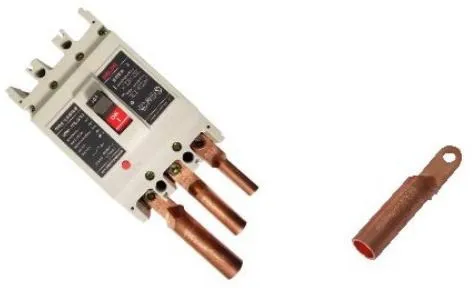
DTC Copper Circuit Breaker Terminal
Models: DTC-10 – DTC-95 (7 sizes)
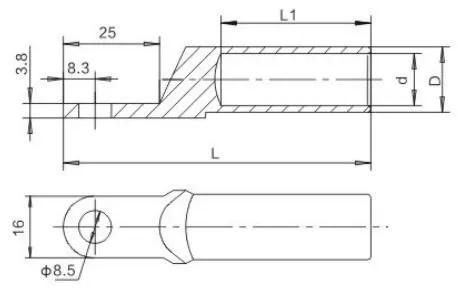
A cable lug is designed around the cable. This part is designed around the terminal block of the breaker: the palm is a fixed 25 × 16 mm tongue, 3.8 mm thick, with one Ø8.5 hole 8.3 mm from the end, and it sits below the barrel axis rather than on it. Seven conductor sizes share that one palm. The only thing that changes across the range is the barrel.
That is the whole idea. On most moulded-case breakers the terminal pad is set back inside the case and the barrel has to hang outside it. With the palm dropped below the axis the tongue lies flat on the pad and the barrel clears the housing; with a straight lug the barrel comes up against the case and the palm never seats properly.
Which of the three you want
| Code | Metal | Fixing | mm² |
|---|---|---|---|
| DTC | copper | bolted, Ø8.5 | 10–95 |
| DTLC | bimetal | bolted, Ø8.5 | 10–95 |
| DTLZ | bimetal | blade, clamped | 10–50 |
DTC is the copper one and it is the default. DTLC is the same body in bimetal — aluminium barrel, copper palm — for an aluminium cable on a copper pad. DTLZ drops the bolt hole altogether: its palm is a 5 mm blade that goes under the breaker’s own terminal screw, which is what you need on the small frames where there is no pad to bolt to. They are not interchangeable — check what the breaker gives you before you pick.
The palm is the design, not the barrel
- 25 mm long, 16 mm wide, 3.8 mm thick — on every size from 10 to 95 mm².
- One hole, Ø8.5, centre 8.3 mm from the palm end, sized for an M8 stud. This is the breaker’s figure, not the cable’s: it does not grow with the conductor.
- The palm sits below the barrel axis. That drop is what lets the tongue sit on a pad recessed behind the case lip; it is the shape you are buying, and it is why a straight lug will not do the job.
Because the palm is common, a project that runs 25, 50 and 95 mm² out of the same panel uses one bolt, one torque setting and one pad pattern for all three. The spares you keep are barrels, not complete terminals. And when a cable is upsized on site, the pad does not have to be re-drilled — only the lug changes.
The barrel is where the range lives:
- d (mm) — bore, 5.5 to 13.5. This is set by the conductor and it is not negotiable.
- D (mm) — outside diameter over the barrel, 8 to 17. This is the dimension that picks the die, not the mm² figure.
- L1 (mm) — barrel length, 20 to 39. Strip to this, less 1 to 2 mm.
- L (mm) — overall length, 54 to 80.
Note that the bore runs generous against the nominal size — 10 mm² on a 5.5 mm bore. That is deliberate: it takes Class 5 and Class 6 flexible cable without dressing the bundle in, and it tolerates the odd oversize strand lay.
Copper on copper, or stop and think
DTC is copper throughout, so it belongs on a copper conductor onto a copper or tinned pad. That is the normal case in a low-voltage panel, and it is the only case where DTC is the right answer without a second thought.
Put an aluminium cable in a DTC and you have created a galvanic cell inside the barrel, where nobody looks again: the aluminium becomes the anode, an oxide film forms, resistance climbs, the joint runs hot, and the heat accelerates it. The palm side is no better — copper on an aluminium pad does the same thing in the open air.
That is what DTLC is for. Same palm, same Ø8.5, same dropped tongue — but the barrel is aluminium, welded to the copper palm, so the cable sits in aluminium and the pad sees copper. It is the standard transition direction, the same one the DTL terminal uses: aluminium barrel, copper palm.
Installation
- Strip to L1, less 1 to 2 mm. The palm end is closed, so an over-strip has nowhere to go and will hold the palm off the pad.
- Insert fully and mark the strip length first — there is no peep hole on the barrel.
- Crimp from the palm end outward, one hexagonal crimp per 15–20 mm of barrel, each overlapping the previous by a third. Starting at the mouth pushes the conductor back out.
- Die closure — a full hexagon with the die faces meeting. A rounded oval means the wrong die or a short stroke.
- Bolt down with an M8 and a flat washer, to the breaker manufacturer’s torque, not to “tight”.
- Seal the barrel mouth outdoors, in humid plant rooms and anywhere the panel is washed down.
Standards
Made to GB/T 14315-2008 — compression terminal lugs and ferrules for power cable conductors up to 35 kV, copper 10–630 mm², aluminium 16–630 mm². Test methods GB/T 9327-2008, international counterpart IEC 61238-1: DC resistance across the joint no higher than an equal length of conductor, temperature rise no higher than the conductor at rated current, and resistance still inside limits after thermal cycling.
These are low-voltage parts — breaker terminals, not switchgear bushings. If the joint is on the medium-voltage side, the fitting is a different one entirely.
FAQ
DTC or DTLC? Look at the cable, not the breaker. Copper cable → DTC. Aluminium cable → DTLC. The palm end is identical, so the breaker does not care.
DTC or DTM? DTM is the general-purpose cable lug: straight barrel, single-hole palm, made to sit on a flat busbar or equipment pad with room around it. DTC is the breaker version, and the difference is the offset palm plus the fixed 25 × 16 tongue. If you have clearance, DTM is cheaper and easier to find; if the pad is recessed behind a case lip, DTM will not seat.
Can I have a bigger palm hole? On this series, no. Ø8.5 for M8 is the breaker-side standard and the tongue is only 16 mm wide — opening it to Ø11 leaves under 3 mm of metal at the edge. A bigger stud means a different breaker, and a different fitting.
Seven sizes but one palm — is the 95 mm² really the same tongue? Yes, and that is the point. The 95 mm² barrel is 17 mm across against 8 mm on the 10 mm², and the palm is unchanged. Check the palm, then the bore, then the barrel clearance inside the breaker.
Do you make a version for a breaker with no pad? That is the DTLZ — a 5 mm blade clamped under the terminal screw, no bolt hole.
Technical Parameters
| Model | Main Dimensions (mm) | |||
|---|---|---|---|---|
| D | d | L | L1 | |
| DTC-10 | 8 | 5.5 | 54 | 20 |
| DTC-16 | 9 | 6 | 57 | 23 |
| DTC-25 | 10 | 7 | 60 | 27 |
| DTC-35 | 12 | 8.5 | 65 | 29 |
| DTC-50 | 13 | 9.6 | 70 | 32 |
| DTC-70 | 15 | 12 | 75 | 37 |
| DTC-95 | 17 | 13.5 | 80 | 39 |
Palm, all seven sizes: 25 × 16 × 3.8 mm, one hole Ø8.5 with its centre 8.3 mm from the end, palm set below the barrel axis.
Note: Dimensions may vary slightly with manufacturing tolerance. The palm is common to the range and is not made to order; the bore d is set by the conductor and cannot be adjusted afterwards.