DTGS Copper Terminal with Inspection Port
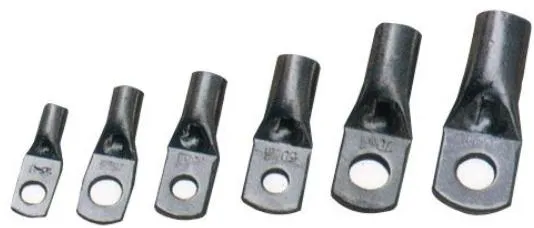
Models: DTGS-1.5 – DTGS-1000 (21 sizes)
DTGS is the small-end of the copper compression range: it starts at 1.5 mm², where control cable, CT circuits, trip circuits and panel wiring live, and it runs all the way to 1000 mm² without changing pattern. It has an inspection port like DTGA, and unlike DTGA it prints a choice of palm hole against every size instead of one fixed figure.
Why 1.5 mm² matters
Most copper lug ranges start at 4 or 6 mm². That is fine for power cable and useless for a substation panel, where the wire is 1.5 or 2.5 mm² and the stud is M4 or M5. Fitters solve that with a crimp ferrule and a washer, or with a terminal block, and both are worse than a lug that fits.
DTGS-1.5 and DTGS-2.5 are that lug. Barrel bore 1.8 mm and 2.5 mm, outside diameter 3.5 and 4.0 mm, overall length 21 mm, palm hole from 4.2 mm — which is M4. The palm is small enough to sit on a relay terminal without fouling the neighbouring pole.
The three smallest sizes share L = 21.0 mm and D rises from 3.5 to 4.8 mm. Below 10 mm² the lug barely changes shape; what changes is the bore.
The palm hole is a list, and that is the point
Look down the Ø column and every row carries two to four figures: DTGS-25 offers 6.2, 8.2, 10.5; DTGS-35 offers 6.2, 8.2, 10.5, 12.5; DTGS-185 offers 16.5 only.
That is not a printing artefact and it is not one palm drilled three times. It is the range of palm holes you can order on that size, drilled to the stud you name. The pattern across the series is worth reading, because it tells you where the palm is under pressure:
| Model group | Hole options | Read it as |
|---|---|---|
| DTGS-1.5 – DTGS-4 | 2 – 3 | small palm, room to choose |
| DTGS-6 – DTGS-35 | 3 – 4 | widest choice in the range |
| DTGS-50 – DTGS-95 | 2 – 3 | choice starts to narrow |
| DTGS-185, DTGS-240 | 16.5 only | one stud, no option |
| DTGS-300 – DTGS-500 | 16.5 or 20.5 | palm grows, second option returns |
| DTGS-630 – DTGS-1000 | one option | heavy palm, single stud |
The hole can only be as large as the metal around it allows. Where the barrel already fills the palm — 185 and 240 — there is nothing left to give, and the sheet offers one hole. Where the palm is deliberately wider than the barrel needs — 300 to 500 — a second option reappears.
What this saves you. One size code covers several stud sizes, so a store that stocks DTGS-35 with 10.5 mm holes covers an M10 job, and the same forging covers M8 and M12 as an order. Stock the barrel, drill the hole.
For the version where the hole is fixed per size and barrel depth is printed, see DTGA.
No L1 column — so how do you set the strip?
The DTGS sheet prints Ø, D, d and L and stops. Barrel depth is not on it, and that is the one thing a fitter needs to set a strip gauge.
Two ways through it:
- Use the inspection port. This is why the port and the missing L1 column sit on the same sheet, and it is not a coincidence. Push the conductor in until it shows in the port and crimp. The port is doing the job the dimension would have done.
- Take L1 from the DTGA sheet. Same barrel, same bore, same D and L for every common size, and that sheet prints L1 for all nineteen. DTGS-240 and DTGA-240 are the same barrel, so L1 = 37.0 mm carries across. Below 4 mm² there is no DTGA equivalent and the port is the answer.
Technical parameters
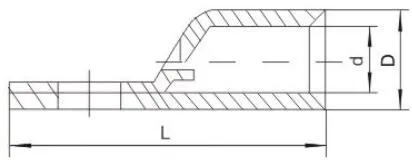
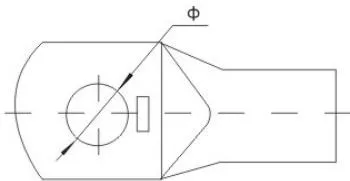
| Model | Main dimensions (mm) | |||
|---|---|---|---|---|
| Ø | D | d | L | |
| DTGS-1.5 | 4.2, 5.2 | 3.5 | 1.8 | 21.0 |
| DTGS-2.5 | 4.2, 5.2, 6.2 | 4.0 | 2.5 | 21.0 |
| DTGS-4 | 5.2, 6.2 | 4.8 | 3.1 | 21.0 |
| DTGS-6 | 5.2, 6.2, 8.2 | 5.5 | 3.8 | 24.0 |
| DTGS-10 | 6.2, 8.2 | 6.8 | 4.8 | 25.5 |
| DTGS-16 | 6.2, 8.2, 10.5 | 7.5 | 5.5 | 30.5 |
| DTGS-25 | 6.2, 8.2, 10.5 | 9.0 | 7.0 | 34.0 |
| DTGS-35 | 6.2, 8.2, 10.5, 12.5 | 10.5 | 8.2 | 38.0 |
| DTGS-50 | 8.2, 10.5, 12.5 | 12.5 | 9.8 | 45.0 |
| DTGS-70 | 8.2, 10.5, 12.5 | 14.5 | 11.5 | 50.0 |
| DTGS-95 | 10.5, 12.5 | 17.5 | 13.8 | 55.5 |
| DTGS-120 | 12.5, 16.5 | 19.5 | 15.5 | 63.0 |
| DTGS-150 | 12.5, 16.5 | 20.5 | 16.5 | 71.0 |
| DTGS-185 | 16.5 | 23.5 | 18.8 | 78.0 |
| DTGS-240 | 16.5 | 26.5 | 21.0 | 92.0 |
| DTGS-300 | 16.5, 20.5 | 30.0 | 24.0 | 102.0 |
| DTGS-400 | 16.5, 20.5 | 34.0 | 26.5 | 113.0 |
| DTGS-500 | 16.5, 20.5 | 38.0 | 30.0 | 123.0 |
| DTGS-630 | 20.5 | 45.0 | 35.0 | 135.0 |
| DTGS-800 | 22.5 | 50.0 | 39.0 | 170.0 |
| DTGS-1000 | 22.5 | 56.0 | 44.0 | 200.0 |
Reading the columns
- Ø (mm) — palm hole options for that size. Name the hole or the stud when ordering; the default is the middle of the printed list.
- D (mm) — barrel outside diameter. This selects the die, and the die carries the same code as the lug.
- d (mm) — barrel bore. Match to the measured outside diameter of the conductor. On 1.5 and 2.5 mm² the difference between a Class 2 and a Class 5 conductor is the difference between a fit and a fight — say which you have.
- L (mm) — overall length, palm end to barrel mouth.
On the 800 and 1000 sizes L steps to 170 and 200 mm while D reaches 50 and 56 mm. Those are not terminal-box parts; they are for cable head and switchgear work where a long barrel and a hydraulic head are the norm.
Which of the four DTG lugs
| Code | Barrel mouth | Inspection port | L1 on sheet | Smallest size | Sizes |
|---|---|---|---|---|---|
| DTGA | plain | yes | yes | 4 | 4 – 1000 |
| DTGY | plain | no | yes | 4 | 4 – 630 |
| DTGS | plain | yes | no | 1.5 | 1.5 – 1000 |
| DTGB | flared | not stated | no | 1.5 | 1.5 – 1000 |
DTGS and DTGB are the two that go down to 1.5 mm². If the wire is finer than 4 mm² and flexible, DTGB’s flared mouth is the easier insertion; if it is a panel wire crimped on a bench, DTGS is enough.
Ordering
Send the model, the palm hole (or the stud), the quantity, and the conductor class for anything below 10 mm². The port comes with the part.
For aluminium conductor use an aluminium or bimetal lug instead — the DLM range for aluminium on aluminium, the DTL range for aluminium cable on a copper pad.
FAQ
What is the difference between DTGS and DTGA? Both have the inspection port. DTGA is 4–1000 with a fixed palm hole per size and prints barrel depth L1. DTGS is 1.5–1000 with a choice of palm hole per size and does not print L1. Below 4 mm² only DTGS exists.
Why is there no L1 on this sheet? The port does the job instead. Insert until the conductor shows in the port. Above 4 mm² you can also borrow L1 from the DTGA sheet — identical barrel.
Can I order DTGS-35 with a 6.2 mm hole? Yes. 6.2 is the first figure in that row, which means it is an offered drilling, not a tolerance. Name the hole on the order.
Can I get DTGS-185 with a hole bigger than 16.5? Not on this forging. The row offers 16.5 only, because the barrel at that size already fills the palm. A larger hole needs the next size up or a special palm.
Does DTGS come in aluminium? No. DTGS is copper. For the aluminium equivalent see the DLM range, and for a bimetal joint see DTL.
Is the 1.5 mm² size really a lug and not a ferrule? It is a lug — flat palm, one hole, crimped with a hex die. It is what a panel builder uses where a ferrule into a terminal block would need a second component and a second torque check.