DTGA Copper Terminal with Inspection Port
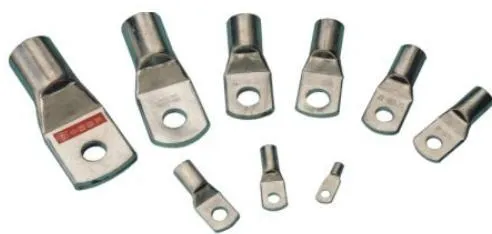
Models: DTGA-4 – DTGA-1000 (19 sizes)
DTGA is the copper tube compression lug with an inspection port — a small hole through the barrel wall that lets the fitter see where the conductor has stopped before the crimp closes. Three things separate it from the rest of the DTG family: the port, a barrel depth column (L1) that the DTGS and DTGB sheets do not carry, and a single fixed palm hole for each size rather than a list of options.
It is the SC lug, size for size
The catalogue prints the SC model beside every DTGA row, and the numbers behind the two columns are identical — same bore, same outside diameter, same length, same palm hole. DTGA-240 and SC-240 are the same part with and without the port.
| DTGA | SC | D | d | L | Ø |
|---|---|---|---|---|---|
| DTGA-25 | SC-25 | 9.0 | 7.0 | 34.0 | 8.2 |
| DTGA-95 | SC-95 | 17.5 | 13.8 | 55.5 | 12.5 |
| DTGA-240 | SC-240 | 26.5 | 21.0 | 92.0 | 16.5 |
| DTGA-630 | SC-630 | 45.0 | 35.0 | 135.0 | 20.5 |
The full correspondence runs both ways on the sheet: SC-4 with DTGA-4 through to SC-1000 with DTGA-1000, nineteen pairs.
Why this is worth knowing. If a customer already has SC-240 on the drawing, on the bill of materials, or on the shelf, DTGA-240 drops straight in — nothing in the terminal box changes, the same die crimps it, the same M16 stud goes through. The only difference is the port. It is a substitution that needs no drawing revision, and it is the cheapest way to add a quality check to an existing job.
What the inspection port actually does
It is a witness hole, not a vent. There are two moments it earns its keep:
- Before the crimp — the conductor is pushed in and the fitter looks at the port. If metal is visible in it, the conductor has reached the full barrel depth; if it is still dark, the conductor is short and the crimp would have produced a joint carrying current through part of its length only. That check takes a second and it catches the single most common field error on a compression lug.
- After the crimp — compound or displaced metal at the port shows the barrel has closed on a full conductor rather than on air. A crimp over a short conductor looks perfectly normal from outside; the port is the only place it shows.
On a plain barrel the same check is done by measuring the strip length against L1 beforehand and hoping the fitter held it. That works on a bench with a jig. It works less well on a pole in the rain.
The palm hole is fixed, not a list
Look at the Ø column: one figure per size, not a row of options. DTGA-4 through DTGA-10 are drilled 6.2 (M6), 16 and 25 at 8.2 (M8), 35 and 50 at 10.5 (M10), 70 through 120 at 12.5 (M12), 150 through 400 at 16.5 (M16), 500 and 630 at 20.5 (M20), 800 and 1000 at 22.5 (M22).
The whole range tops out at M22. A 1000 mm² lug on a 22 mm stud is not a mistake — the palm is sized by the equipment terminal, not by the cable, and equipment terminals at that current class are still M20 or M22. It is the barrel that grows.
If your stud is not the catalogue figure, the hole is drilled to order: same forging, different drill, short lead time. What you cannot do is open it up past what the palm can carry — see SC terminal for why the bore is not the part to enlarge.
L1 is the strip length
This is the one DTG sheet that prints barrel depth, and it is the most useful column on it. L1 runs from 6.4 mm at the 4 size to 89 mm at the 1000, and it is the number you set the strip gauge to.
- Strip to L1, no more. Bare conductor left outside the barrel mouth corrodes and runs hot, and on a copper lug in a humid substation that is a two-year failure waiting.
- Strip to L1, no less. A conductor short of the full depth leaves a void at the palm end, which is exactly where the current has to turn the corner.
- Measure the insulation, not the strands. The strip dimension is where the insulation ends, and the insulation sits a fraction proud of the metal it covers.
Technical parameters
| Model | Main dimensions (mm) | Equivalent | ||||
|---|---|---|---|---|---|---|
| Ø | D | d | L | L1 | ||
| DTGA-4 | 6.2 | 4.8 | 3.1 | 21.0 | 6.4 | SC-4 |
| DTGA-6 | 6.2 | 5.5 | 3.8 | 24.0 | 9.0 | SC-6 |
| DTGA-10 | 6.2 | 6.8 | 4.8 | 25.5 | 10.0 | SC-10 |
| DTGA-16 | 8.2 | 7.5 | 6.5 | 30.5 | 12.0 | SC-16 |
| DTGA-25 | 8.2 | 9.0 | 7.0 | 34.0 | 14.0 | SC-25 |
| DTGA-35 | 10.5 | 10.5 | 8.2 | 38.0 | 14.0 | SC-35 |
| DTGA-50 | 10.5 | 12.5 | 9.8 | 45.0 | 18.0 | SC-50 |
| DTGA-70 | 12.5 | 14.5 | 11.5 | 50.0 | 18.6 | SC-70 |
| DTGA-95 | 12.5 | 17.5 | 13.8 | 55.5 | 23.5 | SC-95 |
| DTGA-120 | 12.5 | 19.5 | 15.5 | 63.0 | 24.0 | SC-120 |
| DTGA-150 | 16.5 | 20.5 | 16.5 | 71.0 | 26.0 | SC-150 |
| DTGA-185 | 16.5 | 23.5 | 18.8 | 78.0 | 33.0 | SC-185 |
| DTGA-240 | 16.5 | 26.5 | 21.0 | 92.0 | 37.0 | SC-240 |
| DTGA-300 | 16.5 | 30.0 | 24.0 | 102.0 | 39.5 | SC-300 |
| DTGA-400 | 16.5 | 34.0 | 26.5 | 113.0 | 46.0 | SC-400 |
| DTGA-500 | 20.5 | 38.0 | 30.0 | 123.0 | 50.0 | SC-500 |
| DTGA-630 | 20.5 | 45.0 | 35.0 | 135.0 | 58.0 | SC-630 |
| DTGA-800 | 22.5 | 50.0 | 39.0 | 170.0 | 73.0 | SC-800 |
| DTGA-1000 | 22.5 | 56.0 | 44.0 | 200.0 | 89.0 | SC-1000 |
One figure to check against the drawing. The printed sheet gives d = 1.8 against DTGA-10, which is the bore of the 1.5 size and will not take a 10 mm² conductor — the same 1.8 appears on the DTGB-10 row. Measured against the series (DTGS-10 is 4.8, and 10 mm² stranded is about 4.5 mm across) the working bore is 4.8, and that is the figure in the table above. Confirm it on the acknowledgement before the die is made.
Reading the columns
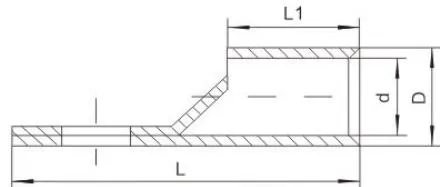
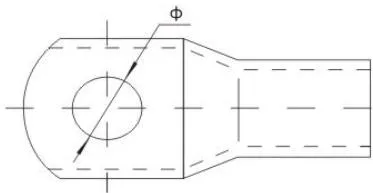
- Ø (mm) — palm hole, fixed per size. Common stud series: 6.2 = M6, 8.2 = M8, 10.5 = M10, 12.5 = M12, 16.5 = M16, 20.5 = M20, 22.5 = M22.
- D (mm) — barrel outside diameter. This selects the die, and the die carries the same size code as the lug.
- d (mm) — barrel bore. Match it to the measured outside diameter of the stranded conductor, not the nominal square millimetres. On Class 5 and Class 6 flexible cable the same nominal size is fatter and the bore that fits a rigid conductor will be too tight.
- L (mm) — overall length, palm end to barrel mouth, for clearance inside the terminal box.
- L1 (mm) — barrel depth and strip length, 6.4 to 89 mm across the range.
Which of the four DTG lugs
All four share D, d and L size for size, so the barrel and the die are decided once. What differs is the mouth and the port.
| Code | Barrel mouth | Inspection port | L1 on sheet | Sizes |
|---|---|---|---|---|
| DTGA | plain | yes | yes | 4 – 1000 |
| DTGY | plain | no | yes | 4 – 630 |
| DTGS | plain | yes | no | 1.5 – 1000 |
| DTGB | flared | not stated | no | 1.5 – 1000 |
- Need the port and a size from 1.5 to 4 mm² — those sizes do not exist in DTGA, they are in DTGS.
- Need the port above 630 mm² — DTGA carries 800 and 1000, DTGS also does, DTGY stops at 630.
- Need a flared mouth for flexible cable — DTGB, and accept that the sheet does not promise a port with it.
- Do not need the port and want the lowest unit cost — DTGY.
Ordering
Send the model, the quantity, and — if the stud is not the catalogue figure — the stud size or the equipment drawing. The port is not something to specify: it is part of the part.
For the bimetal version of this joint, where the cable is aluminium and the pad is copper, see the DTL copper-aluminium terminal.
FAQ
Is the inspection port the same as a peep hole? Yes. The catalogue calls it an inspection port; fitters call it a peep hole or a witness hole. It is a hole through the barrel wall so you can see the conductor before crimping.
Can I get DTGA with a two-hole palm? Not from the catalogue. The palm on this series is single-hole throughout. A two-hole palm is a different forging — send the stud spacing and we will quote it as a special.
Can I get DTGA with a flared mouth and a port? The catalogue does not offer that combination on one sheet. DTGB is the flared one and its sheet does not state a port. Ask specifically and we will confirm against the drawing rather than assume.
Why does DTGA stop being useful above 630 mm²? It does not — DTGA runs to 1000. What stops at 630 is DTGY, the version without the port. Above 630 the sheet offers DTGA, DTGS and DTGB, all three to 1000.
Is DTGA the same as SC? Same dimensions, size for size, nineteen pairs on the sheet. DTGA has the inspection port, SC is the plain version of the same body. Either substitutes for the other without touching the drawing.