DTGY Copper Terminal, Plain Barrel
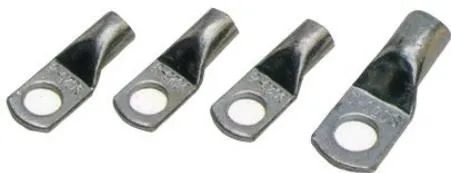
Models: DTGY-4 – DTGY-630 (17 sizes)
DTGY is the plainest lug in the copper range: a copper tube, a flat palm, one hole, no inspection port. It is also, size for size, the same part as DTGA with the port left out — D, d, L, L1 and the palm hole match on every size both sheets carry. What you are choosing is one hole in the barrel wall and the cost of drilling it.
What you give up, and what you do not
What you give up is the visual check. On DTGA a fitter pushes the conductor in and looks at the port to see it has reached the bottom of the barrel. On DTGY there is nothing to look at.
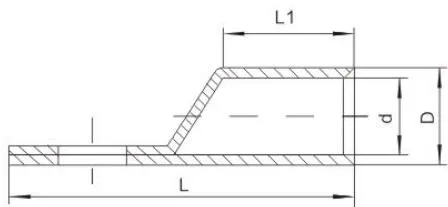
What you do not give up is the dimension that makes the check unnecessary. DTGY prints L1 — barrel depth, 6.4 mm at the 4 size up to 58 mm at the 630. Set the strip gauge to L1, strip to the gauge, insert to the shoulder, crimp. Done on a bench that is as reliable as a port, and faster.
The port earns its money where the bench does not exist: on a pole, in a trench, in a cable box where the light is bad and the fitter is working by feel. That is a decision about where the joint is made, not about the lug.
Controlling quality without a window
If you buy DTGY for cost, these are the four checks that replace the port — all of them standard practice, none of them expensive:
- Strip to L1 with a gauge, not by eye. A strip gauge costs less than one re-termination. This single step removes most of what the port would have caught.
- Mark the conductor. A wrap of tape or a paint mark at L1 from the end; after insertion the mark should sit at the barrel mouth. Ten seconds, no tooling.
- Use the die’s stop. Hex compression dies for this series index on the barrel shoulder. With the conductor against the stop the insertion depth is fixed by the tool, and the port becomes redundant.
- Pull-test a sample per batch. For 240 mm² and above, a tensile pull on one lug per batch is the only check that proves the joint rather than the insertion. It is also the check an inspector will ask for.
Same dimensions as DTGA
This is the useful part. DTGA and DTGY are the same forging from the same forming die; the difference is a drilled witness hole. Every dimension both sheets print is identical:
| Size | D | d | L | L1 | Ø |
|---|---|---|---|---|---|
| DTGY-25 | 9.0 | 7.0 | 34.0 | 14.0 | 8.2 |
| DTGY-95 | 17.5 | 13.8 | 55.5 | 23.5 | 12.5 |
| DTGY-240 | 26.5 | 21.0 | 92.0 | 37.0 | 16.5 |
| DTGY-630 | 45.0 | 35.0 | 135.0 | 58.0 | 20.5 |
So DTGY and DTGA substitute for each other without touching the drawing, the die or the stud. A store can hold DTGY as the volume item and DTGA for the site work, and the two are interchangeable at the point of use. The same holds against the SC lug, which shares the dimensions as well.
Where DTGY stops is 630 mm². Above that only DTGA, DTGS and DTGB are offered, all three to 1000.
When not to save the money
- Live-line and hot work. A joint made in gloves at height is exactly where a witness hole pays for itself.
- Aluminium conductor. Nothing on this sheet changes the metal. A copper barrel on an aluminium conductor is a galvanic joint whatever the mouth looks like — use DTL or DLM.
- Flexible Class 5 and 6 cable. The plain mouth is the hard mouth. If the strands fight the bore, the answer is DTGB with the flared mouth, not a cheaper plain one.
Technical parameters
| Model | Main dimensions (mm) | ||||
|---|---|---|---|---|---|
| Ø | D | d | L | L1 | |
| DTGY-4 | 6.2 | 4.8 | 3.1 | 21.0 | 6.4 |
| DTGY-6 | 6.2 | 5.5 | 3.8 | 24.0 | 9.0 |
| DTGY-10 | 6.2 | 6.8 | 4.8 | 25.5 | 10.0 |
| DTGY-16 | 8.2 | 7.5 | 6.5 | 30.5 | 12.0 |
| DTGY-25 | 8.2 | 9.0 | 7.0 | 34.0 | 14.0 |
| DTGY-35 | 10.5 | 10.5 | 8.2 | 38.0 | 14.0 |
| DTGY-50 | 10.5 | 12.5 | 9.8 | 45.0 | 18.0 |
| DTGY-70 | 12.5 | 14.5 | 11.5 | 50.0 | 18.6 |
| DTGY-95 | 12.5 | 17.5 | 13.8 | 55.5 | 23.5 |
| DTGY-120 | 12.5 | 19.5 | 15.5 | 63.0 | 24.0 |
| DTGY-150 | 16.5 | 20.5 | 16.5 | 71.0 | 26.0 |
| DTGY-185 | 16.5 | 23.5 | 18.8 | 78.0 | 33.0 |
| DTGY-240 | 16.5 | 26.5 | 21.0 | 92.0 | 37.0 |
| DTGY-300 | 16.5 | 30.0 | 24.0 | 102.0 | 39.5 |
| DTGY-400 | 16.5 | 34.0 | 26.5 | 113.0 | 46.0 |
| DTGY-500 | 20.5 | 38.0 | 30.0 | 123.0 | 50.0 |
| DTGY-630 | 20.5 | 45.0 | 35.0 | 135.0 | 58.0 |
One figure to check against the drawing. The printed sheet gives d = 1.8 against DTGY-10 — the bore of the 1.5 size, which will not take a 10 mm² conductor. The same 1.8 appears on the DTGA-10 and DTGB-10 rows, while DTGS-10 prints 4.8, and 10 mm² stranded measures about 4.5 mm across. The table above carries 4.8. Confirm it on the acknowledgement before the die is made.
Reading the columns
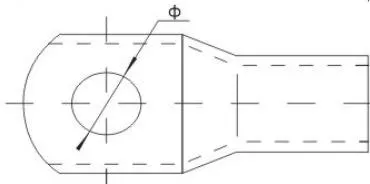
- Ø (mm) — palm hole, fixed per size: 6.2 = M6, 8.2 = M8, 10.5 = M10, 12.5 = M12, 16.5 = M16, 20.5 = M20. Drilled to order if your stud is not the catalogue figure.
- D (mm) — barrel outside diameter. This selects the die; the die carries the same size code as the lug.
- d (mm) — barrel bore. Match the measured outside diameter of the conductor, not the nominal square millimetres. On flexible Class 5 and 6 cable the same nominal size is fatter.
- L (mm) — overall length, palm end to barrel mouth.
- L1 (mm) — barrel depth and strip length. On this sheet it is the compensating control for having no port: use it.
Which of the four DTG lugs
| Code | Barrel mouth | Inspection port | L1 on sheet | Smallest size | Sizes |
|---|---|---|---|---|---|
| DTGA | plain | yes | yes | 4 | 4 – 1000 |
| DTGY | plain | no | yes | 4 | 4 – 630 |
| DTGS | plain | yes | no | 1.5 | 1.5 – 1000 |
| DTGB | flared | not stated | no | 1.5 | 1.5 – 1000 |
The short version: DTGY is the cost choice, DTGA is the same part with a window, DTGS is the one that goes down to 1.5 mm², DTGB is the one with the flared mouth. All four share the barrel, so the die and the bore decision are made once.
Ordering
Send the model, the palm hole or the stud, and the quantity. If the conductor is flexible, say so — it decides between this and DTGB, and it is not something we can tell from the size code.
FAQ
Does DTGY have an inspection port? No. That is the only difference between it and DTGA, which shares every dimension on both sheets. If you need the port, order DTGA; the price difference is one drilling operation.
How do I know the conductor is fully inserted without a port? Set the strip to L1, insert against the die stop, or mark the conductor at L1 and check the mark at the mouth. All three are standard, and together they are as reliable as looking.
Why does DTGY stop at 630 while DTGA goes to 1000? The catalogue does not offer the plain no-port version above 630. Above that the range is DTGA, DTGS and DTGB, all three to 1000 mm².
Is DTGY cheaper than DTGA? Yes — one less operation per piece. On small quantities it is noise; on a container of small sizes it is a real number, which is why it exists.
Can I use DTGY on aluminium cable? No. It is a copper barrel and a copper palm. Use DLM for aluminium conductor on aluminium equipment, or DTL for aluminium cable on a copper pad.