DTL-2 Copper-Aluminum Terminal (Export Type)
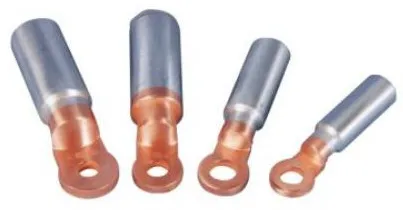
Models: DTL-2-16 – DTL-2-630 (14 sizes)
DTL-2 is the export pattern of the bimetal lug. Same conductor range as the domestic DTL, different proportions: a body that stays short right through the small sizes, a long palm, and a noticeably heavier transition section.
Part of the DTL copper-aluminium terminal family.
What makes it an export pattern
Read the L column down the table and it barely moves: 90 mm from 16 mm² to 95 mm². The domestic DTL grows from 70 to 112 mm over the same span. Then DTL-2 jumps to 118–130 mm for 120–300 and 200 mm at 500.
That flat 90 mm body is the point. Terminal boxes on imported switchgear, breakers and metering equipment tend to place the stud close to the cable entry, and a lug that grows with the conductor will not reach it. Holding the body fixed and letting the palm take the difference is how this pattern fits.
Two other numbers follow from it:
- D is much larger than on the domestic lug. 16 mm against 10 mm at the 16 mm² size, 47 mm against 42 mm at 500. The transition section is heavier, which is what an export specification usually asks for on mechanical grounds.
- L1 — the barrel section — is short relative to the palm. 42 mm of barrel on a 90 mm body at 16 mm², rising to 90 mm at 500/630. The palm takes the rest.
Because D is larger, the die is different. A domestic DTL die will not close on a DTL-2. Check the D column of the table you are ordering from before you plan the crimping.
The palm hole is only two sizes
This is the trap in the DTL-2 range. Read the Ø column:
- Ø 8.5 for DTL-2-16, 25 and 35 — one hole, M8 clearance, for all three.
- Ø 12.8 for everything from DTL-2-50 to DTL-2-400 — one hole, M12 clearance, for 50 mm² and for 400 mm² alike.
- Square Head for 500 and 630, where the palm is a square block drilled to your stud.
So the hole does not scale with the conductor. If you are landing 300 mm² on an M16 stud, the catalogue palm is drilled 12.8 and will need a drilling change — which is a normal request and a short lead time, because it is a drill change on an existing palm, not a new die.
The rule for how far it can be opened is the same as everywhere in this family: at least half the hole diameter of metal between hole and palm edge. Beyond that the palm deforms under bolt preload and the joint loosens however hard you torque it. The table does not carry a palm width W for this series, so send the stud size and we will tell you what the palm takes.
Reading the table
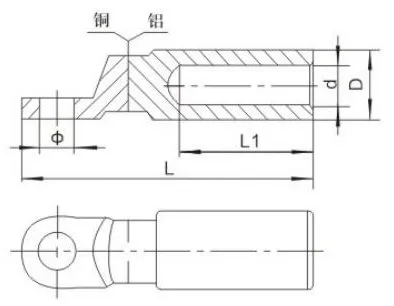
- Ø (mm) — palm hole, as above: 8.5, 12.8, or Square Head.
- D (mm) — outside diameter over the transition; selects the die.
- d (mm) — bore, set by the conductor diameter. Flexible cable is fatter than rigid at the same rating.
- L (mm) — overall length.
- L1 (mm) — the barrel section, i.e. the crimp zone.
Standards and testing
GB/T 14315-2008, with test methods from GB/T 9327-2008 / IEC 61238-1: resistance ratio against an equal length of conductor, temperature rise, resistance after thermal cycling, mechanical pull-out.
On a bimetal joint the cycling test is the one that finds a weak transition — the interface opens under repeated expansion and the resistance steps up there. A cold resistance check will not show it.
Installation
- Strip to the barrel section L1 — insulation finishing at the mouth.
- Brush the conductor and bore; contact paste on the aluminium side.
- Insert fully.
- Crimp with the DTL-2 die (matched to D), working from the transition end toward the mouth, roughly one crimp per 15–20 mm, overlapping by a third. On the 42 mm barrel of the small sizes that is two to three crimps.
- Confirm hexagonal closure with the die faces meeting.
- Seal the mouth on outdoor and buried joints.
Where these joints fail
- A domestic die used on DTL-2. D is larger; the crimp comes out oval or under-compressed.
- Assuming the palm hole scales. It does not — 12.8 mm covers 50 to 400 mm².
- Stripping past L1. Bare aluminium outside the barrel corrodes and runs hot.
- No seal outdoors. Water wicks down the strands into the barrel; the weld is fine, the cable end is not.
FAQ
Why is the body only 90 mm on a 95 mm² lug? Because the pattern is built for terminal boxes where the stud sits close to the cable entry. The palm is longer instead; measure the palm reach, not the overall length, when checking fit.
Is DTL-2 compatible with DTL tooling? No. D is larger at every size. Use the die matched to the D in the table.
Can the hole be drilled to my stud? Yes, and on this series it usually has to be — the catalogue offers two hole sizes across fourteen models.
What is the difference between DTL-2 and CAU? Both are export patterns. The CAU has a wider palm and its own dimension set; where your pad is wide or the palm has to span a lug-to-lug gap, take the CAU.
Technical Parameters
| Model | Main Dimensions (mm) | ||||
|---|---|---|---|---|---|
| Ø | D | d | L | L1 | |
| DTL-2-16 | 8.5 | 16 | 5.5 | 90 | 42 |
| DTL-2-25 | 8.5 | 16 | 6.5 | 90 | 42 |
| DTL-2-35 | 8.5 | 16 | 8.5 | 90 | 42 |
| DTL-2-50 | 12.8 | 20 | 9.0 | 90 | 43 |
| DTL-2-70 | 12.8 | 20 | 11.0 | 90 | 43 |
| DTL-2-95 | 12.8 | 20 | 12.5 | 90 | 43 |
| DTL-2-120 | 12.8 | 25 | 13.7 | 118 | 60 |
| DTL-2-150 | 12.8 | 25 | 15.5 | 118 | 60 |
| DTL-2-185 | 12.8 | 32 | 17.0 | 120 | 60 |
| DTL-2-240 | 12.8 | 32 | 19.5 | 120 | 60 |
| DTL-2-300 | 12.8 | 34 | 22.5 | 130 | 62 |
| DTL-2-400 | 12.8 | 41 | 26.5 | 145 | 70 |
| DTL-2-500 | Square Head | 47 | 29.5 | 200 | 90 |
| DTL-2-630 | Square Head | 47 | 34.0 | 200 | 90 |
Note: L1 is the barrel (crimp) section, not the palm. The palm hole is drilled to your stud — on this series that is the normal order rather than an exception, since the catalogue offers only Ø 8.5 and Ø 12.8. Square Head means a square palm block drilled to your stud. Dimensions may vary slightly with manufacturing tolerance.