DTLC Copper-Aluminium Circuit Breaker Terminal
Models: DTLC-10 – DTLC-95 (7 sizes)
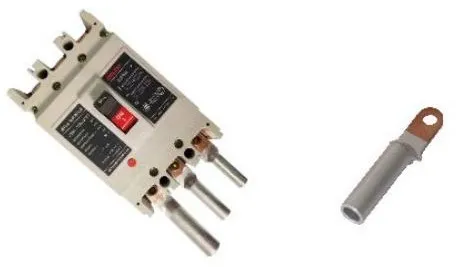
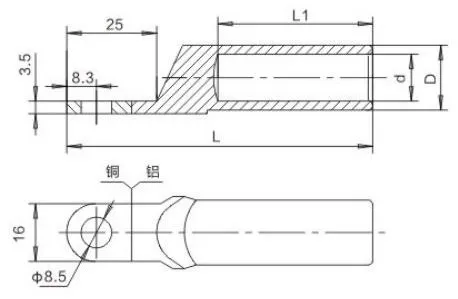
DTLC is the DTC breaker terminal built in bimetal: aluminium barrel, copper palm, welded at the shoulder. The palm end is identical — 25 × 16 mm tongue, one Ø8.5 hole 8.3 mm from the end, set below the barrel axis — so the breaker cannot tell the difference. What changes is what goes into it: this is the version for an aluminium cable.
That direction matters, and it is worth saying plainly because the reverse type exists. On DTLC the conductor sits in aluminium and the pad sees copper. That is the standard transition direction, the same one the DTL terminal uses. A part with the metals the other way round — copper barrel, aluminium palm — is the reverse type, and putting it on an aluminium cable gives you aluminium against copper inside the barrel, which is exactly the joint this fitting exists to avoid.
Why the barrel changes and the palm does not
An aluminium conductor will not sit in a copper barrel. Moisture in the gap turns the interface into a galvanic cell: aluminium becomes the anode, an oxide film forms, resistance climbs, the joint runs hot, and the heat accelerates the whole thing. So the barrel has to be aluminium — and it then has to be welded to a copper palm, because the breaker pad is copper or tinned.
Two things follow, and both show up in the table:
- The barrel gets bigger on the outside. DTLC-10 is Ø10 over the barrel where DTC-10 is Ø8. Aluminium needs more wall for the same crimp force, and the die changes with it.
- The barrel gets longer. L1 runs 32 to 43 mm against 20 to 39 mm on DTC. Aluminium has lower shear strength than copper and a higher and harder oxide, so the crimp has to be longer to develop the same pull-out. Plan the strip length on that, not on the copper figure.
The palm absorbs none of this. It is 3.5 mm thick against 3.8 mm on the all-copper version — 0.3 mm, which is the only visible difference at the pad — and the hole, the width and the dropped tongue are unchanged. So a store that keeps DTC and DTLC side by side has one palm pattern, one bolt and one torque figure for both.
Reading the table
- d (mm) — bore. It is sized for the aluminium conductor and it is not the same figure as the copper DTC of the same nominal size: 5 mm against 5.5 mm at 10 mm². Quote the conductor class as well as the mm².
- D (mm) — outside diameter over the aluminium barrel, 10 to 18. This picks the die, and it is a different die set from the copper range.
- L1 (mm) — barrel length, 32 to 43. This is the crimp length, and it is deliberately longer than the copper equivalent.
- L (mm) — overall length, 60 to 85. Check it against the space in front of the breaker — DTLC is 5 to 6 mm longer than DTC at the same size.
Working with the aluminium end
Aluminium is where these joints fail, and it is almost never the fitting’s fault:
- Brush the conductor and the bore immediately before crimping, and apply contact paste. Aluminium oxide re-forms within minutes in humid air and it is an insulator.
- Crimp to full die closure, not to a “feel”. Aluminium needs more deformation than copper to break the oxide and fill the barrel.
- Do not heat the shoulder. The weld between the aluminium barrel and the copper palm is the part you are buying. A torch to straighten a palm, or a die run up onto the neck, ruins it. If the palm needs adjusting, it needs a new terminal.
- Re-torque the M8 after the first thermal cycle. Aluminium creeps under bolt preload; copper does not to the same degree.
Installation
- Strip to L1, less 1 to 2 mm. The strip length is longer than on a copper lug of the same size — measure, do not assume.
- Clean, brush, paste — mandatory here, not advisory.
- Insert fully and mark the strip length first; there is no peep hole.
- Crimp from the palm end outward, one hexagonal crimp per 15–20 mm of barrel, each overlapping the previous by a third.
- Bolt down with an M8 to the breaker manufacturer’s torque and re-check it after load.
- Seal the barrel mouth — on an aluminium joint, outdoors, always.
Standards
Made to GB/T 14315-2008 — compression terminal lugs and ferrules for power cable conductors up to 35 kV, aluminium 16–630 mm² (this series starts at 10 mm², which is below that table’s aluminium floor and is quoted against the drawing). Test methods GB/T 9327-2008, international counterpart IEC 61238-1, including the thermal-cycling test that separates a real aluminium crimp from a plausible one.
Low-voltage parts: breaker terminals, not switchgear bushings.
FAQ
DTLC or DTC? The cable decides. Aluminium cable → DTLC. Copper cable → DTC. Both bolt to the same pad with the same M8, and neither is cheaper to get wrong.
DTLC or DTL? Same metals, different palm. The DTL is the general-purpose transition lug with a straight barrel and a flat palm for a busbar or equipment pad. DTLC is the breaker version: offset palm, 25 × 16 tongue, Ø8.5 hole, sized to clear a recessed terminal block. If you have clearance around the pad, DTL does the job for less.
Is the palm aluminium too? No. Copper palm, aluminium barrel. The aluminium is only where the aluminium cable goes. A part with an aluminium palm is the reverse type and belongs to a different application.
Can I use it the other way round — copper cable into the aluminium barrel? No. That is copper in aluminium, the same galvanic cell in the other direction. For a copper cable there is no reason to leave the all-copper DTC.
What about a breaker with no pad to bolt to? The DTLZ — bimetal, same direction, but a 5 mm blade clamped under the terminal screw instead of a bolted palm.
Technical Parameters
| Model | Main Dimensions (mm) | |||
|---|---|---|---|---|
| D | d | L | L1 | |
| DTLC-10 | 10 | 5 | 60 | 32 |
| DTLC-16 | 10 | 5.5 | 60 | 32 |
| DTLC-25 | 11 | 7 | 65 | 32 |
| DTLC-35 | 12 | 8.5 | 70 | 33 |
| DTLC-50 | 14 | 9.5 | 75 | 35 |
| DTLC-70 | 16 | 12 | 80 | 39 |
| DTLC-95 | 18 | 13 | 85 | 43 |
Palm, all seven sizes: 25 × 16 × 3.5 mm, copper, one hole Ø8.5 with its centre 8.3 mm from the end, palm set below the barrel axis. Barrel: aluminium, welded at the shoulder.
Note: Dimensions may vary slightly with manufacturing tolerance. The bore d is set by the aluminium conductor and cannot be adjusted afterwards; quote the conductor class with the size.