MGZ1 Type Terminal Ball, Damping Type
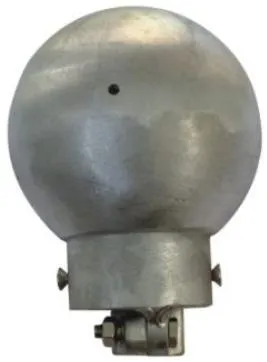
Models: 10 sizes · Reference Weight: 4.3–46.5 kg · Function: terminal ball with a damping conductor
The Ball Plus an Absorber
This is the MGZ terminal ball with a short length of ACSR carried into the tube — the same idea as the MGF1 damped cap, on a much heavier fitting.
A ball on the end of a 250 mm tube is 42 kg on a cantilever. It does not need extra mass for damping; what it needs is something to stop the assembly oscillating, and the conductor inside the tube is that.
0.4 to 4.0 kg Over the Plain Ball
| Bore | MGZ | MGZ1 | Difference |
|---|---|---|---|
| 70 mm | 3.8 kg | 4.3 kg | +0.5 kg |
| 120 mm | 4.8 kg | 5.2 kg | +0.4 kg |
| 150 mm | 7.4 kg | 8.0 kg | +0.6 kg |
| 170 mm | 12.5 kg | 15.0 kg | +2.5 kg |
| 200 mm | 23.5 kg | 26.0 kg | +2.5 kg |
| 250 mm | 42.5 kg | 46.5 kg | +4.0 kg |
A steady 0.4 to 0.6 kg through the small sizes, then 2.5 to 4.0 kg from 170 mm up. The step at 170 mm is where the conductor grip goes from 31 to 35 mm and the conductor from LGJ-500 to LGJ-630.
Four Conductors Across Ten Sizes
| Busbar | Conductor | Grip φ2 |
|---|---|---|
| 70, 80 mm | LGJ-240 | 22 mm |
| 90, 100 mm | LGJ-300 | 25 mm |
| 120, 130, 150 mm | LGJ-500 | 31 mm |
| 170, 200, 250 mm | LGJ-630 | 35 mm |
Four bands, cleanly stepped. If your specification names a different conductor, say so — the ball is bored to φ2.
Two Rows Assume a Different Wall
φ1 is the tube bore, and two rows disagree with the plain ball about what that is:
| Model | MGZ1 prints | MGZ prints | Wall implied |
|---|---|---|---|
| 80 mm | 80/70 | 80/72 | 5 mm vs 4 mm |
| 150 mm | 150/134 | 150/136 | 8 mm vs 7 mm |
Every other row matches. We print both pages as they are and flag the two: if you are ordering the 80 or 150 mm ball, tell us the wall you actually have and we will bore the spigot to it.
Technical Parameters
| Model | Tubular Busbar I.D./O.D. (mm) | Damping Conductor | Main Dimensions (mm) | Reference Weight (kg) | ||||
|---|---|---|---|---|---|---|---|---|
| ϕ1 | ϕ2 | SR | H | M | ||||
| MGZ₁-70 | 70/64 | LGJ-240 | 64 | 22 | 69 | 15 | 8 | 4.3 |
| MGZ₁-80 | 80/70 | LGJ-240 | 70 | 22 | 70 | 15 | 8 | 4.4 |
| MGZ₁-90 | 90/80 | LGJ-300 | 80 | 25 | 80 | 20 | 8 | 4.8 |
| MGZ₁-100 | 100/90 | LGJ-300 | 90 | 25 | 80 | 25 | 10 | 5.0 |
| MGZ₁-120 | 120/110 | LGJ-500 | 110 | 31 | 90 | 25 | 10 | 5.2 |
| MGZ₁-130 | 130/116 | LGJ-500 | 116 | 31 | 90 | 25 | 10 | 5.3 |
| MGZ₁-150 | 150/134 | LGJ-500 | 134 | 31 | 150 | 30 | 10 | 8.0 |
| MGZ₁-170 | 170/156 | LGJ-630 | 156 | 35 | 170 | 30 | 10 | 15.0 |
| MGZ₁-200 | 200/180 | LGJ-630 | 180 | 35 | 200 | 30 | 12 | 26.0 |
| MGZ₁-250 | 250/230 | LGJ-630 | 230 | 35 | 250 | 40 | 12 | 46.5 |
Related Pages
Plain ball: MGZ terminal ball. Damped cap for smaller tubes: MGF1. Counterweight: MGZP. Supports: MGG, MGG1.
Note: φ1 is the tube bore. The 80 and 150 mm rows assume a wall 1 mm heavier than the plain ball does — confirm your tube. Damping adds 0.4 to 4.0 kg.