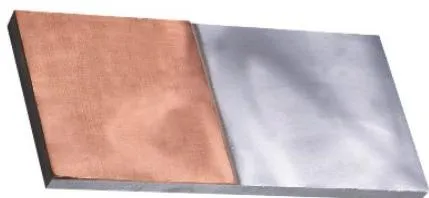
MGB Copper Aluminum Transition Plate Explosion Welding
Models: MGB-50×5 – MGB-125×12.5 · Busbar: 50×5 – 125×12.5 mm · Reference Weight: 0.2–2.4 kg
Twelve Rows, Identical To The MG Sheet
Set this table beside the MG transition plate and every cell matches: the same twelve sizes, the same A / L1 / L2 / B, and the same weight to the last decimal — 0.2, 0.3, 0.4, 0.5, 0.5, 0.7, 0.8, 1.0, 1.3, 1.5, 1.9, 2.4.
That is not a coincidence and it is not a copying error in the ordinary sense. The plate envelope is identical because the process does not change the shape — L1 is copper, L2 is aluminium, A is the width and B the thickness either way.
But it does mean nothing in this table can tell you that you are looking at the explosion-welded part. The model prefix is the only difference on the page.
So What Does Explosion Welding Change?
The bond between the copper and the aluminium — and that is all.
- Brazing (the MG brazing sheet) joins the two metals with a filler alloy that melts at a lower temperature than either parent metal. The joint is a thin layer of a third material.
- Explosion welding drives the two plates together at an angle under a detonation wave. No filler, no heat-affected melt zone; the bond is a full-density metallurgical weld across the whole interface.
For a transition plate carrying busbar current in a substation, the practical consequences are in the joint’s resistance and its behaviour under fault current and thermal cycling, not in its dimensions. A brazed joint has a filler layer with its own resistivity and its own melting point; an explosion-welded one does not.
None of that appears in any column here. The catalogue gives you a size and a weight. It does not give you a joint resistance, a pull strength or a temperature limit for either process — so the choice between MG, MGB and the brazing sheet has to be made on the process, not on the data.
And The Plain MG Sheet Never Names Its Process
There is a gap worth pointing out. Three sheets cover this plate:
- MG — the base sheet, twelve rows.
- MG brazing — fourteen rows, weights to two decimals.
- MGB explosion welding — twelve rows, identical to MG.
The base MG sheet is the only one that does not say in its title how the joint is made. Its data is identical to MGB’s, which suggests it is the same part, but a catalogue title is not a process specification.
Order plain MG- stock against the process on your specification. If it names brazing, order MG; if it names explosion welding, order this sheet. MG-… on its own does not commit to either.
Which Sizes You Get
The same twelve as the MG sheet, in the same width × thickness notation:
- 50 — 5 mm only.
- 63 and 80 — 6.3, 8 and 10 mm.
- 100 — 8 and 10 mm.
- 125 — 8, 10 and 12.5 mm.
The two sizes that exist only on the brazing sheet — 80×15 and 90×10 — are not available as MGB. If a design needs either one and the specification calls for explosion welding, that is a special, not a catalogue order.
Technical Parameters
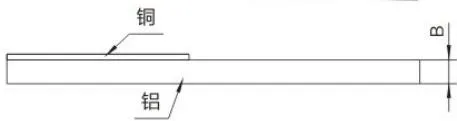
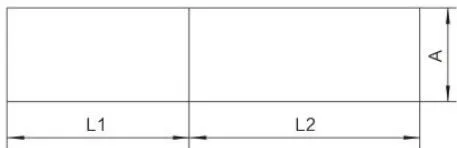
| Model | Applicable Busbar (mm2) | Main Dimensions (mm) | Reference Weight (kg) | |||
|---|---|---|---|---|---|---|
| A | L1 | L2 | B | |||
| MGB-50×5 | 50×5 | 50 | 50 | 60 | 5 | 0.2 |
| MGB-63×6.3 | 63×6.3 | 63 | 68 | 85 | 6.3 | 0.3 |
| MGB-63×8 | 63×8 | 63 | 68 | 85 | 8 | 0.4 |
| MGB-63×10 | 63×10 | 63 | 68 | 85 | 10 | 0.5 |
| MGB-80×6.3 | 80×6.3 | 80 | 85 | 100 | 6.3 | 0.5 |
| MGB-80×8 | 80×8 | 80 | 85 | 100 | 8 | 0.7 |
| MGB-80×10 | 80×10 | 80 | 85 | 100 | 10 | 0.8 |
| MGB-100×8 | 100×8 | 100 | 105 | 120 | 8 | 1.0 |
| MGB-100×10 | 100×10 | 100 | 105 | 120 | 10 | 1.3 |
| MGB-125×8 | 125×8 | 125 | 130 | 140 | 8 | 1.5 |
| MGB-125×10 | 125×10 | 125 | 130 | 140 | 10 | 1.9 |
| MGB-125×12.5 | 125×12.5 | 125 | 130 | 140 | 12.5 | 2.4 |
Related Pages
The twelve-row base sheet: MG copper aluminum transition plate. The brazed version with two extra sizes: MG brazing. Expansion joints in the same materials: MSS, MSSB, MS.
Note: Every dimension and every weight is identical to the MG sheet — only the bond differs, and no column records it. The base MG sheet does not name its own process, so confirm which one you are buying. The 80×15 and 90×10 sizes exist only on the brazing sheet.