MS Aluminum Busbar Expansion Joint Busbar to Busbar
Models: MS-4×40 – MS-12.5×125 · Busbar: 40×4 – 125×12.5 mm · Sections: 3
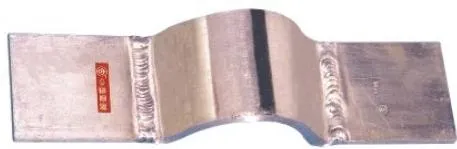
L1 Appears Twice
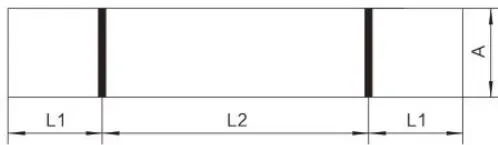
The drawing dimensions this joint as three segments, not two:
- L1 — a solid end plate, at both ends.
- L2 — the laminated middle, in the elevation it is drawn as a stack of thin sheets between two weld seams.
- A — width, the busbar width.
- B — thickness, the busbar thickness.
So the overall length is 2 × L1 + L2, not L1 + L2. On the smallest size that is 2 × 60 + 170 = 290 mm; on the largest, 2 × 140 + 220 = 500 mm.
This is the single most common mistake when laying one out. A 125 × 12.5 joint is half a metre long, and a panel designed around “L1 + L2 = 360 mm” will not close.
The end plates are solid because they are where the joint is bolted to the incoming busbar. The middle is laminated because that is the part that has to flex — thin sheets bend where a solid bar of the same cross-section would fatigue at the seam.
Three Width Classes Set L2
L2 does not vary with thickness at all. It is set purely by the width bracket:
| Busbar width A | L1 | L2 | Overall |
|---|---|---|---|
| 40, 50 | 60, 70 | 170 | 290, 310 |
| 60, 63, 80 | 80, 80, 90 | 190 | 350, 350, 370 |
| 100 | 115 | 220 | 450 |
| 120, 125 | 140, 140 | 220 | 500 |
Three widths, three L2 values, nothing in between. A 50 mm joint and a 40 mm joint share the same 170 mm laminated section; an 80 mm joint and a 60 mm joint share 190 mm.
L1 is A + 20 mm on the three smallest widths, then tightens to A + 10 on the 80 and A + 15 on the 100 and 125. The end plate does not grow in proportion to the width.
The Model Number Runs The Other Way
MS-12.5×125 has A = 125 and B = 12.5 — so the model prints thickness × width.
That is the reverse of the transition plate sheets, where MG-125×12.5 means width × thickness for the same physical busbar. Two families, the same two numbers, opposite order.
Read the prefix before you read the numbers. A 125×12.5 is a wide thin busbar on this sheet and a different notation entirely on the MG sheet, and a clerk working from a verbal order will get it backwards about half the time.
60×6 And 63×6.3 Are Two Separate Products
Between them there is 3 mm of width and 0.3 mm of thickness — and they share L1 80 mm and L2 190 mm. Both are real catalogue entries.
The same thing happens at the top: 10×120, 10×125, 12×120, 12×125 and 12.5×125 are five entries covering three widths and three thicknesses, all with L1 140 and L2 220. A 120 mm joint and a 125 mm joint are the same part trimmed 5 mm narrower.
That matters for stock and for price: the 5 mm difference does not change the tooling, only the cut. If you need 125 and only 120 is in stock, ask — but do not substitute on your own, because the bolt pattern into the busbar has to line up.
No Weight Column
This sheet prints no weight for any of the fourteen rows. Aluminium is light enough that it hardly matters for freight, but it does matter for a quotation built on a per-kilogramme rate, and it matters more on the copper sheets in this group.
We will not invent a figure the catalogue does not carry. Ask with the enquiry and we will weigh a sample of the size you need.
Technical Parameters

| Model | Main Dimensions (mm) | |||
|---|---|---|---|---|
| A | L1 | L2 | B | |
| MS-4×40 | 40 | 60 | 170 | 4 |
| MS-5×50 | 50 | 70 | 170 | 5 |
| MS-6×60 | 60 | 80 | 190 | 6 |
| MS-6.3×63 | 63 | 80 | 190 | 6.3 |
| MS-6×80 | 80 | 90 | 190 | 6 |
| MS-8×80 | 80 | 90 | 190 | 8 |
| MS-10×80 | 80 | 90 | 190 | 10 |
| MS-8×100 | 100 | 115 | 220 | 8 |
| MS-10×100 | 100 | 115 | 220 | 10 |
| MS-10×120 | 120 | 140 | 220 | 10 |
| MS-10×125 | 125 | 140 | 220 | 10 |
| MS-12×120 | 120 | 140 | 220 | 12 |
| MS-12×125 | 125 | 140 | 220 | 12 |
| MS-12.5×125 | 125 | 140 | 220 | 12.5 |
Related Pages
The copper version, busbar to equipment: MST. Copper-to-aluminium joints on the same 14 rows: MSS and MSSB. Transition plates rather than joints: MG, MGB.
Note: L1 is the end plate and appears at both ends, so overall length is 2 × L1 + L2, from 290 to 500 mm. L2 is set by the width bracket only: 170, 190 and 220 mm. The model number prints thickness × width, the reverse of the MG sheets. No weight is printed.