TL Equal Diameter T Clamp
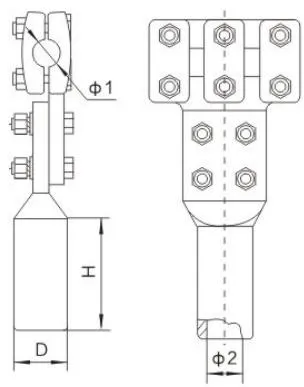
Models: 8 sizes · Reference Weight: 7.0–11.3 kg · Body: aluminium alloy, hardware hot-dip galvanised
The Slash Means Both Legs
The model is written as TL-<main>/<branch>. When the two legs are the same conductor the number simply repeats: TL-600K/600K, TL-1000N/1000N, TL-1440N/1440N. That is the whole family on this page — eight equal-diameter fittings, no reducing sizes.
Equal-diameter T clamps exist for one job: joining two identical conductors at a tee without a reducing adaptor. A substation jumper, a loop into an equipment terminal, a tap where the branch is the same conductor as the run. If your branch is smaller than the run, use the TL letter-type clamp instead — those tables carry the full reducing matrix.
The one non-equal row is the exception that proves it: TL-1000N/500N takes NRLH58GT-1000 on the main and NRLH58GJ-500 on the branch, and it is the only row where the two bores are far apart (43 mm and 32.5 mm). It is on this page because it shares the body with TL-1000N/1000N.
Ø2 Is the Real Conductor, Ø1 Is the Bore
Read the two diameter columns together and the gap is constant:
| Model | Ø1 | Ø2 | Gap | Body width D |
|---|---|---|---|---|
| TL-400N/400N | 28 | 29.5 | 1.5 | 55 |
| TL-500N/500N | 31 | 32.5 | 1.5 | 60 |
| TL-1000N/1000N | 43 | 43.5 | 0.5 | 76 |
| TL-1440N/1440N | 52 | 53.5 | 1.5 | 80 |
| TL-600K/600K | 52 | 53.0 | 1.0 | 76 |
| TL-900K/900K | 50 | 51.0 | 1.0 | 74 |
Ø1 is the clamp bore, Ø2 is the conductor outside diameter it is cut for. The 0.5–1.5 mm gap is the clearance that lets the conductor sit in the groove before the keepers close. It is not a tolerance — it is designed in, and it is why you must give us the conductor designation rather than just the model number on these fittings.
D, the body width, tracks Ø1: 55 mm at a 28 mm bore, 80 mm at 52 mm. Body width is what decides whether the fitting clears a nearby phase or a busbar support, so read D from the row when laying out a substation.
LGKK-900 Is Thinner Than LGKK-600
This catches people out on every expanded-conductor job. The LGKK-900 clamp is bored at 50 mm; the LGKK-600 clamp is bored at 52 mm. The larger conductor takes the smaller bore.
That is correct, and it is not a printing error — the same 52 / 50 pair appears in our SJ twin spacer and TLS double conductor clamp tables, three independent catalogues agreeing. LGKK is an expanded-diameter conductor: the 900 mm² construction reaches its section with a different layer build than the 600, and ends up 2 mm smaller across.
The practical consequence: an LGKK-600 clamp will not grip LGKK-900, and an LGKK-900 clamp will be loose on LGKK-600. If a project changes conductor size mid-order, the clamps have to be re-issued, not re-used.
H Is Constant Until It Isn’t
Seven of the eight fittings sit at H = 180 mm, whatever the conductor. Then:
- TL-1000N/1000N goes to 220 mm
- TL-1440N/1440N goes to 240 mm
Both of those are the same-conductor rows at the top of the range, where the body has to grow to carry two 43 mm or two 52 mm bores side by side. The 1000N/500N row stays at 180 mm because only one leg is that large.
Weight follows the body: 7.0 kg at 400 mm² up to 11.3 kg at 1440 mm², with the 1000N/500N at 8.8 kg sitting sensibly between the 500 and 1000 equal-diameter rows. Nothing anomalous here — this family is consistent across all eight rows, which is unusual enough on this product group that it is worth saying.
Technical Parameters
| Model | Applicable Conductor (mm2) | Main Dimensions (mm) | Reference Weight (kg) | |||
|---|---|---|---|---|---|---|
| Ø1 | Ø2 | H | D | |||
| TL-600K/600K | LGKK-600 | 52 | 53.0 | 180 | 76 | 9.8 |
| TL-900K/900K | LGKK-900 | 50 | 51.0 | 180 | 74 | 9.4 |
| TL-1400/1400 | LGJQT-1400 | 52 | 53.0 | 180 | 76 | 10.5 |
| TL-400N/400N | NRLH58GJ-400 | 28 | 29.5 | 180 | 55 | 7.0 |
| TL-500N/500N | NRLH58GJ-500 | 31 | 32.5 | 180 | 60 | 8.5 |
| TL-1000N/500N | NRLH58GT-1000/58GJ-500 | 43 | 32.5 | 180 | 60 | 8.8 |
| TL-1000N/1000N | NRLH58GJ-1000 | 43 | 43.5 | 220 | 76 | 9.0 |
| TL-1440N/1440N | NRLH58GJ-1440 | 52 | 53.5 | 240 | 80 | 11.3 |
Related Clamps
Reducing taps in the same body style: TL letter-type single conductor clamp and the bolted U-bolt / clamp-plate types. For a pressed joint at these sections, the TY hydraulic T clamp covers LGJ up to 800 mm² and the N grades to 630.
Note: State the full conductor designation — LGKK-600 and LGKK-900 are not interchangeable even though both are “LGKK”. Dimensions vary within casting tolerance.