FD Vibration Damper
Models: FD-1 – FD-6 and FG-35 – FG-100 · Conductor: ACSR 35–630 mm², steel strand 35–100 mm² · Reference Weight: 1.5–8.6 kg
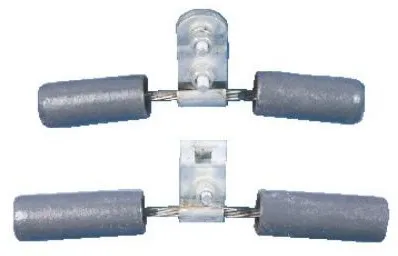
Two Families, Two Units, One Table
The first six rows and the last four are not one series. They are two clamp families that share a page:
- FD-1 to FD-6 are sized by the ACSR area in mm² — LGJ 35/6 up to 630/45.
- FG-35 to FG-100 are sized by the galvanised steel strand area in mm² — GJ-35 to GJ-100.
The table prints both headers, Steel Strand and ACSR, and fills only one per row. That is why the numbers look wrong: 350 mm² of ACSR and 100 mm² of steel strand carry the same damper.
Do not read across the two blocks. A steel strand of 100 mm² is a 12–13 mm cable and behaves nothing like a 400 mm² ACSR bundle; the damper is tuned to the strand’s mass and stiffness per unit length, not to its cross-section area. Pick your family by conductor type first, then by size.
Diagram 1 and Diagram 2 Are the Weight Count
The Diagram column prints 1 or 2, and it maps onto the weight:
| Diagram 1 | Diagram 2 | |
|---|---|---|
| FD | FD-1 · 1.5 kg | FD-2 to FD-6 · 2.4 to 8.6 kg |
| FG | FG-35, FG-50 · 1.8 and 2.4 kg | FG-70, FG-100 · 4.2 and 5.9 kg |
Diagram 1 is a single-weight damper; Diagram 2 is a two-weight resonant damper with a longer messenger. That is the whole difference between FD-1 and FD-2 — 1.5 kg against 2.4 kg, 300 mm against 370 mm, and one weight against two.
For anything above 50 mm² ACSR the answer is Diagram 2. The single-weight FD-1 exists for short spans and small conductors where a two-weight damper would over-damp.
Same Length, 1.4 kg Apart
FD-5 and FD-6 are both 550 mm long. FD-5 is D 67 / H 70 at 7.2 kg; FD-6 is D 70 / H 75 at 8.6 kg.
Three millimetres on the weight diameter and five on the height is where the 1.4 kg lives: the damper’s mass is the tuned element, so the 500–630 mm² conductor needs a heavier head and there is no way to get it from a shorter body. L is the same because the messenger length is set by the clamp, not by the conductor size.
The same reasoning makes FG-100 (100 mm² steel strand) 5.9 kg — heavier than FD-4 at 240 mm² ACSR (5.6 kg). Steel strand is a stiffer, lighter cable that vibrates at a higher frequency, so it takes a heavier, shorter damper to tune to it.
Technical Parameters
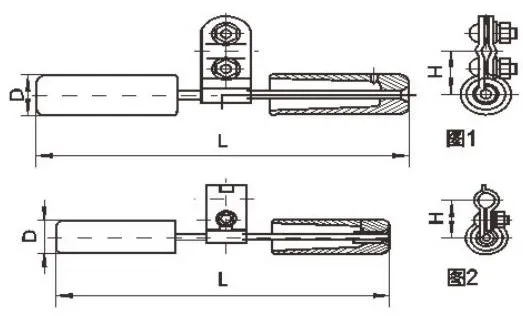
| Model | Applicable Conductor( mm2 ) | Diagram | Main Dimensions(mm) | Reference Weight(kg) | |||
|---|---|---|---|---|---|---|---|
| Steel Strand | ACSR | L | D | H | |||
| FD-1 | 35~50 | 1 | 300 | 40 | 40 | 1.5 | |
| FD-2 | 70~95 | 2 | 370 | 46 | 55 | 2.4 | |
| FD-3 | 120~150 | 2 | 450 | 56 | 65 | 4.5 | |
| FD-4 | 185~240 | 2 | 500 | 62 | 70 | 5.6 | |
| FD-5 | 300~400 | 2 | 550 | 67 | 70 | 7.2 | |
| FD-6 | 500~630 | 2 | 550 | 70 | 75 | 8.6 | |
| FG-35 | 35 | 1 | 300 | 42 | 50 | 1.8 | |
| FG-50 | 50 | 1 | 350 | 46 | 50 | 2.4 | |
| FG-70 | 70 | 2 | 400 | 56 | 60 | 4.2 | |
| FG-100 | 100 | 2 | 500 | 62 | 65 | 5.9 | |
Related Pages
The aluminium-clamp version of the same head: FD-L vibration damper. Small conductors and steel strand: FDZ, FDY. Dampers with a matched armour rod set: FDNJ. Full selection table by conductor: FDN.
Note: FD rows are sized by ACSR area and FG rows by steel strand area — the two blocks are not comparable. Diagram 1 is a single weight, Diagram 2 a two-weight damper. The clamp is steel; the L-suffix version is aluminium.