JGHX High Voltage Cable Suspension Clamp
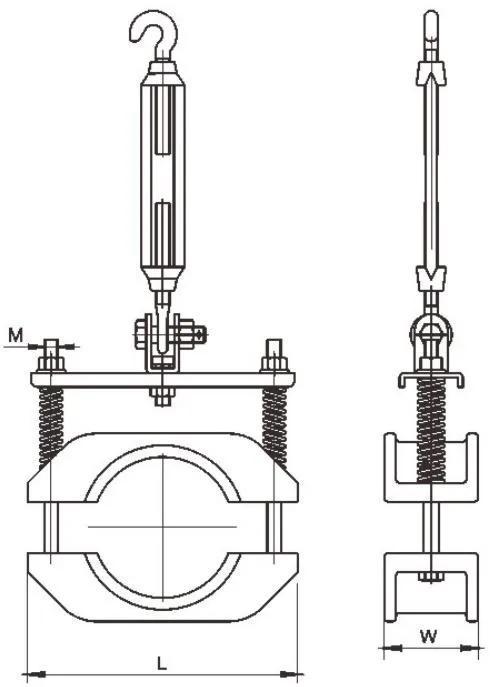
Models: JGHX-1 – JGHX-5 (5 sizes) · Cable: 80–160 mm outside diameter · Hardware: M 12
The JGHX holds a high-voltage cable — not a conductor — where it has to be supported on a route: up a shaft, along a tunnel wall, on a pole riser, or under a bridge. The cable hangs in the clamp and the clamp hangs from a tensioned steel wire rope, so the whole run is carried on a messenger rather than on the cable’s own sheath.
Two details make it a cable clamp rather than a conductor clamp: a spring in the clamping stack and a rubber pad between the body and the cable.
Technical Parameters
| Model | Applicable Cable Outer Diameter | Main Dimensions (mm) | ||
|---|---|---|---|---|
| L | W | M | ||
| JGHX-1 | 80~100 | 180 | 70 | 12 |
| JGHX-2 | 100~120 | 200 | 70 | 12 |
| JGHX-3 | 120~136 | 210 | 70 | 12 |
| JGHX-4 | 136~150 | 230 | 80 | 12 |
| JGHX-5 | 150~160 | 250 | 80 | 12 |
Why a Cable Needs a Spring
A conductor does not care much about being held rigidly. A cable does.
A high-voltage cable is a laminated object: conductor, insulation, metallic screen, bedding, armour if it has one, and an oversheath. Every one of those layers expands by a different amount when the cable heats under load, and the cable as a whole grows by a millimetre or two per hundred metres for every ten degrees of conductor temperature rise. On a run in a tunnel that is restrained at both ends, all of that movement arrives at the supports.
If the support is a rigid clamp, the movement becomes a shear force on the sheath. Do that a few thousand times and the sheath — which is the only thing keeping water out of the insulation — starts to crack where the clamp bit.
The spring takes the movement. It lets the clamping stack follow the cable as it grows and shrinks, so the sheath is held rather than pinched. That is the entire reason a cable support costs more than a conductor clamp of the same size.
Why a Rubber Pad
Two jobs, and the second one is easy to overlook:
- Mechanical — the pad is the interface between a metal body and a polymer oversheath, so it distributes the pressure and removes the hard point where the sheath would otherwise deform.
- Electrical — the clamp body is bonded to a steel messenger that runs the length of the route and is earthed. Without the pad, a cable clamp is a metal object touching the oversheath at every support, and any damage to that sheath becomes a path to earth through the messenger. The pad keeps the body insulated from the cable even when the sheath is scuffed.
The pad also makes the clamp tolerant of cable diameter variation, which is why the ranges in the table overlap sensibly and one size can cover 20 mm of cable.
Five Sizes, One Bolt
The five models run 80 to 160 mm cable outside diameter in bands of 16 to 20 mm. The dimensions that change are L (180 to 250 mm) and W (70 to 80 mm):
- L is the length of the clamp along the cable — it grows with the diameter because a bigger cable needs a longer seat to spread the pressure.
- W is the width across the clamp, which steps from 70 to 80 mm at the 136 mm size — the point where the body has to get wider rather than longer.
- M is the clamping screw, M 12 on all five models. So one spanner, one torque setting and one spare bolt size covers the whole range. On a tunnel route with hundreds of supports that is worth more than it sounds.
How It Is Hung
The clamp body carries a clevis at the top, and the clevis takes the messenger. The messenger is tensioned between anchors at the ends of the run, and the clamps hang from it at intervals with the cable resting in each one.
That arrangement means the cable’s weight is carried by the messenger and the clamp only has to keep the cable located. It is the standard way to support heavy cable over a span where the cable cannot carry itself — and it is why this clamp has no published load rating. The rating that matters is the messenger’s.
Where It Is Used
- Vertical risers in shafts and on poles, where the cable weight would otherwise pull on the termination.
- Tunnel and culvert runs, where the cable has to be held off the floor and away from the wall.
- Bridge crossings, where the cable runs under its own messenger.
- Substation cable trenches with a support steel.
Below 80 mm outside diameter, a cable is usually light enough to be cleated directly and this clamp is unnecessary.
Material & Finish
- Body: high-strength aluminium alloy — no magnetic hysteresis loss
- Pad: rubber
- Spring: steel
- Remaining hardware: steel, hot-dip galvanized
- Finish: hot-dip galvanized to ISO 1461 on the steel parts
- Certification: mill test certificates on request
The alloy body is an electrical decision as well as a weight one: a magnetic clamp around a single-core cable carrying several hundred amps would heat from hysteresis loss and put that heat into the cable it is supposed to be protecting.
Related Clamps
XJ bundled insulated suspension clamp — the overhead insulated version, for ABC bundles.
NXL insulated wedge strain clamp — the termination for an insulated conductor where the sheath is stripped.
XGH handbag clamp — bare conductor support on overhead lines.