XGH Handbag Type Suspension Clamp
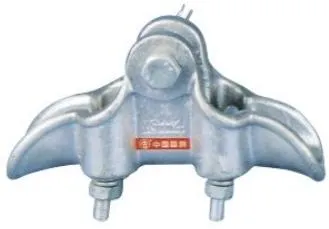
Models: XGH-2 – XGH-6 (6 sizes) · Conductor: 5.1–35 mm · Nominal Failure Load: 40–60 kN · Reference Weight: 1–3.6 kg
The handbag shape is the oldest suspension clamp there is and still the cheapest way to hang a conductor. The body is a cast bag with a deep groove; the conductor drops into it; a keeper over the top closes the bag and a U-bolt draws the two together. There is no separate yoke, no liner and no machined interface — which is exactly why the smallest size weighs one kilogram.
Six sizes cover 5.1 to 35 mm conductor. Ratings run 40 to 60 kN, and the aluminium alloy body means nothing here will rust.
Technical Parameters
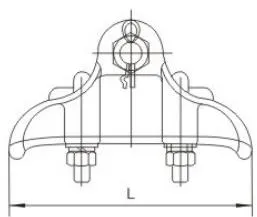
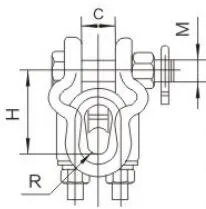
| Model | Applicable Conductor Diameter (Including Wrapping) (mm) | Main Dimensions (mm) | Nominal Failure Load (kN) | Reference Weight (kg) | ||||
|---|---|---|---|---|---|---|---|---|
| L | C | R | H | M | ||||
| XGH-2 | 5.1~12.5 | 166 | 25 | 8.0 | 52.5 | 16 | 40 | 1.0 |
| XGH-3 | 12.4~17.0 | 200 | 23 | 11.5 | 50.5 | 16 | 40 | 1.5 |
| XGH-3A | 12.4~17.0 | 180 | 22 | 10.0 | 50.0 | 16 | 50 | 1.5 |
| XGH-4 | 19.0~23.5 | 225 | 27 | 13.5 | 59.5 | 16 | 40 | 2.3 |
| XGH-5 | 24.2~28.0 | 260 | 32 | 16.0 | 70.0 | 16 | 60 | 3.0 |
| XGH-6 | 25.0~35.0 | 216 | 35 | 17.5 | 68.0 | 16 | 60 | 3.6 |
Where This Clamp Belongs
One kilogram for a clamp that takes a 12.5 mm conductor is the lightest thing in this catalogue, and it is not an accident of casting — it is the design. The handbag clamp has the fewest parts of any suspension fitting, so it is the right answer wherever the string is light and the quantity is large: 11 kV and 33 kV distribution, insulated ABC where a bare clamp is acceptable, shield wire, and the small end of a subtransmission line.
It is the wrong answer on a long span at high tension. There is no liner, so an ACSR conductor that walks in the groove under differential ice will fret against bare cast aluminium. Where that matters, the XGU-F abrasion resistant type is the same job with a liner, at nearly twice the weight.
R Is Not the Selection Key Here
On the XGU and XGT families, R is exactly half the upper conductor diameter plus 0.5 mm, and you can size a clamp from the conductor alone. XGH does not work that way. Its grooved radius runs one to two and a half millimetres above that figure:
| Model | Range | Upper ÷ 2 + 0.5 | R listed | Oversize |
|---|---|---|---|---|
| XGH-2 | 5.1~12.5 | 6.75 | 8.0 | +1.25 |
| XGH-3 | 12.4~17.0 | 9.0 | 11.5 | +2.5 |
| XGH-4 | 19.0~23.5 | 12.25 | 13.5 | +1.25 |
| XGH-5 | 24.2~28.0 | 14.5 | 16.0 | +1.5 |
| XGH-6 | 25.0~35.0 | 18.0 | 17.5 | −0.5 |
Two things follow. First, select by the conductor range column, not by R — the range is what the clamp is designed to hold. Second, the handbag body is deliberately roomier in the groove than a centre-pivoted clamp, because the conductor goes in from above and the keeper has to close over it. A groove cut to the conductor’s own radius would not let the bundle drop in.
The 3A Is Not a Bigger 3
XGH-3 and XGH-3A take the same 12.4 to 17.0 mm conductor, and they are different clamps:
| XGH-3 | XGH-3A | |
|---|---|---|
| Body length | 200 mm | 180 mm |
| Groove R | 11.5 | 10.0 |
| Height H | 50.5 | 50.0 |
| Rating | 40 kN | 50 kN |
| Weight | 1.5 kg | 1.5 kg |
The A is a shorter body on a tighter groove, and it is rated ten kilonewtons higher on the same mass. It is the row to take when a 17 mm conductor has to sit in a 50 kN string — which happens on shield wire and on short distribution ties where the tension is out of proportion to the diameter.
If you order “XGH-3” and need the 50 kN, you will get the 40 kN. Put the A on the order.
XGH-6 Is a Compact, Not a Stretch
The number sequence suggests the 6 should be the biggest and longest. It is the widest-grooved, not the longest:
- XGH-5 — 260 mm body, R 16.0, covers 24.2~28.0, 60 kN, 3.0 kg
- XGH-6 — 216 mm body, R 17.5, covers 25.0~35.0, 60 kN, 3.6 kg
The 6 is 44 mm shorter and 0.6 kg heavier, and it takes a 35 mm conductor that the 5 cannot. It is a compact body with a wide bag. The two overlap on 25.0 to 28.0 mm, so on a 26 mm conductor either works: take the 6 if you may later go up a size, the 5 if you want the longer body for a wider keeper face.
H also breaks its upward trend at the 6 — 68.0 mm against the 5’s 70.0. Two millimetres, but it is a real difference if you are copying a string drawing.
Two Numbers That Disagree Between Catalogue Sheets
The XGH data appears on two sheets in the factory catalogue and they do not agree on two cells. We print the defensible figure and flag the other:
- XGH-2 groove R — 8.0 mm on one sheet, 18.0 mm on the other. 18.0 cannot be right: a clamp whose conductor band stops at 12.5 mm cannot have a 36 mm groove. 8.0 is the correct figure.
- XGH-5 weight — 3.0 kg on one sheet, 4.4 kg on the other. The family runs 1.0, 1.5, 1.5, 2.3, 3.0, 3.6; 4.4 would put the 5 above the larger 6. 3.0 kg is the correct figure.
If a freight quote or a tower loading calculation has been built on 4.4 kg, it is 1.4 kg heavy per clamp.
Material & Finish
- Body and keeper: aluminium alloy
- Cotter pin: stainless steel
- Remaining hardware: steel, hot-dip galvanized
- Finish: hot-dip galvanized to ISO 1461 on the steel parts, minimum 65 μm
- Tolerance: ±0.5 mm on the groove and mounting interfaces, coating thickness checked to ISO 2178
- Certification: mill test certificates on request
Related Clamps
XG handbag clamp — the same shape with a numbered rating-and-diameter designation, from 40 to 80 kN.
XGU centre-pivoted — the step up in conductor support, with a groove cut to the conductor.
XGF aluminium alloy clamp — the general-purpose alloy clamp for the same small-conductor work.