XGT and XGJ Suspension Clamps
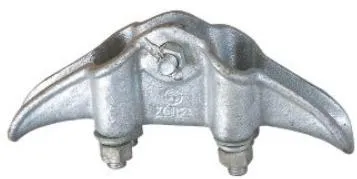
Models: XGT-1 – XGT-4A (8 sizes) · Conductor: 5–45 mm · Nominal Failure Load: 40–60 kN · Reference Weight: 3.3–9.8 kg
Two families share this page because they are the same idea at two scales. XGT is the heavy-duty version of the handbag clamp — the same conductor bands as the XGU but roughly twice the mass, with an aluminium alloy body and a hanger wide enough to take a heavy yoke. XGJ is the high-strength branch: seventy to three hundred kilonewtons, ten variants, and at the top of it a 1100 mm clamp that weighs 82 kg.
Both have aluminium alloy bodies and keepers, stainless cotter pins and hot-dip galvanized steel hardware.
XGT — Heavy Duty, Same Conductor Bands as XGU
Technical Parameters
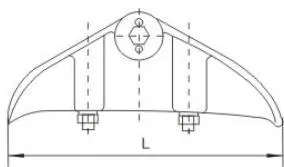
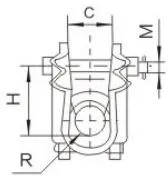
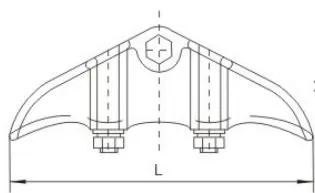
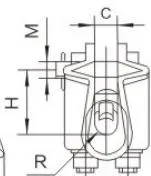
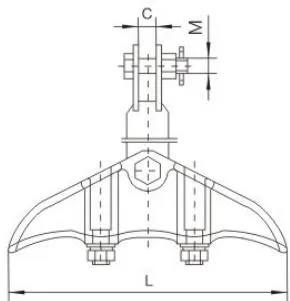
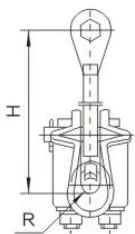
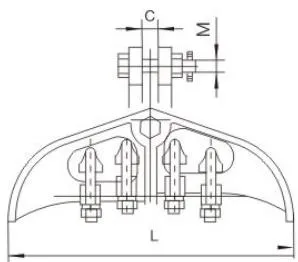
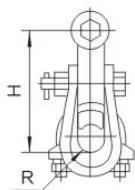
| Model | Applicable Conductor Diameter (Including Wrapping) (mm) | Main Dimensions (mm) | Nominal Failure Load (kN) | Reference Weight (kg) | ||||
|---|---|---|---|---|---|---|---|---|
| L | C | R | H | M | ||||
| XGT-1 | 5.0~7.0 | 180 | 18 | 4.0 | 60 | 18 | 40 | 3.3 |
| XGT-2 | 7.1~13.0 | 200 | 18 | 7.0 | 75 | 18 | 40 | 4.9 |
| XGT-3 | 13.1~21.0 | 220 | 27 | 11.0 | 75 | 16 | 40 | 5.6 |
| XGT-4 | 21.1~26.0 | 250 | 27 | 13.5 | 75 | 16 | 40 | 6.5 |
| XGT-5 | 23.0~33.0 | 300 | 38 | 17.0 | 81 | 16 | 60 | 8.7 |
| XGT-6 | 34.0~45.0 | 300 | 46 | 23.0 | 89 | 16 | 60 | 9.8 |
| XGT-2.1 | 7.0~13.0 | 200 | 20 | 7.0 | 135 | 16 | 40 | 4.3 |
| XGT-4A | 21.1~26.0 | 250 | 20 | 13.5 | 133 | 16 | 60 | 6.9 |
The conductor bands are identical to the XGU of the same number — 5.07.0, 7.113.0, 13.121.0, 21.126.0, 23.033.0, 34.045.0 — and R follows the same rule to the millimetre: half the upper conductor diameter plus 0.5 mm. All six sizes check exactly.
What differs is mass. XGT-4 is 6.5 kg where XGU-4 is 3.0 kg, and XGT-6 is 9.8 kg where the 70 kN XGU-6A is 6.1 kg. The extra weight is not in the groove. Look at C: the hanger width grows from 18 mm at XGT-1 to 46 mm at XGT-6, against a flat 18 mm across the whole XGU range. XGT is built to hang from a bigger pin and a heavier yoke plate, and to hold a wider face on the conductor under ice.
That last point is the honest reason to buy it: on a long span where the conductor walks in the groove under differential ice, a wider keeper face spreads the pressure and wears the wrapping less. If you are not on that kind of span, the XGU does the same job for half the weight.
The Two Long-Hanger Variants
XGT-2.1 and XGT-4A are not new sizes. They are the XGT-2 and XGT-4 bodies with an extended hanger:
| Model | Same as | Conductor | L | H | Weight | Rating |
|---|---|---|---|---|---|---|
| XGT-2.1 | XGT-2 | 7.0~13.0 | 200 | 135 (was 75) | 4.3 kg (was 4.9) | 40 kN |
| XGT-4A | XGT-4 | 21.1~26.0 | 250 | 133 (was 75) | 6.9 kg (was 6.5) | 60 kN (was 40) |
Both add roughly 58 to 60 mm to H, so the conductor hangs that much lower than on the standard body. Use them where the clamp has to clear a cross-arm, a damper or an adjacent phase, or where the string has to be built out. Note that XGT-4A is also rated 60 kN rather than 40 — the A variant is both longer and stronger, so do not order it expecting an XGT-4 with a longer neck.
The two sheets name their sizes differently — one a decimal suffix, the other a letter — and that is how they are printed. Write the full designation on the order either way, because XGT-2 and XGT-2.1 are not interchangeable at the string.
XGJ — The Strength Ladder
XGJ starts where the XGT stops. Ten variants, one to three hundred kilonewtons, and every one of them an aluminium alloy body with a steel keeper bolt.
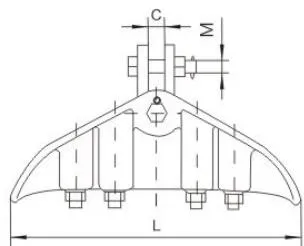
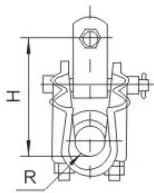
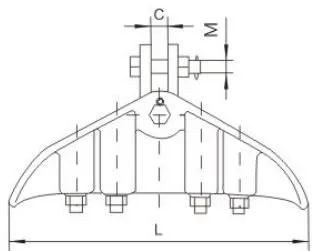
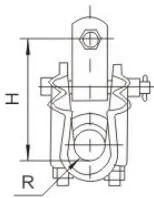
XGJ-2 — 100 kN on an 11 to 13 mm conductor
| Model | Applicable Conductor Diameter (Including Wrapping) (mm) | Main Dimensions (mm) | Nominal Failure Load (kN) | Reference Weight (kg) | ||||
|---|---|---|---|---|---|---|---|---|
| L | C | R | H | M | ||||
| XGJ-2 | 11~13 | 300 | 19 | 8 | 52 | 18 | 100 | 4.4 |
This row is worth stopping on. It is rated 100 kN and it fits an 11 to 13 mm conductor — that is a conductor with a breaking load in the thirties of kilonewtons being held by a clamp rated at a hundred. Nothing on a phase conductor justifies that. XGJ-2 is an earthwire or guy clamp: on an OPGW or a shield wire the diameter is small and the tension is high, and on a guy the whole design load arrives at one point.
If you have been quoted XGJ-2 for a phase conductor, ask why. R of 8 mm caps it at 13 mm, so it cannot be carrying anything large.
XGJ-3 and XGJ-4 — 70 kN, the standard high-strength pair
| Model | Applicable Conductor Diameter (Including Wrapping) (mm) | Main Dimensions (mm) | Nominal Failure Load (kN) | Reference Weight (kg) | ||||
|---|---|---|---|---|---|---|---|---|
| L | C | R | H | M | ||||
| XGJ-3 | 13.1~18.0 | 300 | 18 | 9 | 190 | 16 | 70 | 4.8 |
| XGJ-4 | 21.1~23.0 | 300 | 18 | 11 | 190 | 16 | 70 | 4.9 |
Both hang the conductor at H 190 mm, which is more than twice the XGT’s 75 mm at the same conductor size. That is a string built around a long drop, not a short one.
XGJ-5 family — one groove, three build levels
| Model | Applicable Conductor Diameter (Including Wrapping) (mm) | Main Dimensions (mm) | Nominal Failure Load (kN) | Reference Weight (kg) | ||||
|---|---|---|---|---|---|---|---|---|
| L | C | R | H | M | ||||
| XGJ-5 | 23~43 | 390 | 24 | 22 | 121 | 22 | 120 | 8.8 |
| XGJ-5A | 23~43 | 476 | 24 | 22 | 180 | 22 | 120 | 9.1 |
| XGJ-5B | 23~43 | 476 | 24 | 22 | 180 | 24 | 160 | 13.4 |
These three rows have the same conductor band (23~43 mm), the same groove R 22 and the same L for the A and B. What changes is the hanger and the hardware:
- XGJ-5 — 390 mm body, H 121, 8.8 kg, 120 kN
- XGJ-5A — 476 mm body (+86), H 180 (+59), 9.1 kg, still 120 kN. The A is a long-hanger build; the groove and the rating do not move.
- XGJ-5B — the same 476 mm body as the A, but a thicker pin (M 24 against M 22) and 160 kN. That extra 40 kN costs 4.3 kg — from 9.1 to 13.4.
The lesson is the one to carry across this whole page: R decides whether the clamp fits your conductor; the suffix decides the geometry and the rating. Five, 5A and 5B all take a 43 mm bundle.
XGJ-5Z and 6Z — the heavy builds
| Model | Applicable Conductor Diameter (Including Wrapping) (mm) | Main Dimensions (mm) | Nominal Failure Load (kN) | Reference Weight (kg) | ||||
|---|---|---|---|---|---|---|---|---|
| L | C | R | H | M | ||||
| XGJ-5Z | 36.0~43.0 | 400 | 26 | 22 | 202 | 24 | 120 | 16 |
| XGJ-6Z | 36.0~47.0 | 500 | 26 | 24 | 212 | 24 | 150 | 20 |
The Z rows carry the same R 22 and 24 as the 5 and 5A, on a much shorter body, and weigh nearly double — 16 kg against 8.8 for the 5Z, 20 kg against 13.4 for the 6Z. They are built for fittings that have to survive without maintenance, and the mass is the price.
Note the 6Z reaches 47 mm on R 24 while the 5Z stops at 43 on R 22. There is no Z row between them.
XGJ-6.1 and 7.1 — the crossing clamps
| Model | Applicable Conductor Diameter (Including Wrapping) (mm) | Main Dimensions (mm) | Nominal Failure Load (kN) | Reference Weight (kg) | ||||
|---|---|---|---|---|---|---|---|---|
| L | C | R | H | M | ||||
| XGJ-6.1 | 36~43 | 900 | 38 | 22 | 410 | 36 | 120 | 70 |
| XGJ-7.1 | 43~50 | 1100 | 38 | 25 | 410 | 36 | 300 | 82 |
These two are a different order of object. L of 900 and 1100 mm, H of 410 mm, M 36 mm pin, 70 and 82 kg. Nothing else on this page is close: the next heaviest clamp here is 20 kg.
They exist for river and valley crossings, where the span is measured in kilometres, the conductor tension runs to hundreds of kilonewtons, and the clamp is the fitting that decides whether the string survives galloping. XGJ-7.1 at 300 kN on a 43 to 50 mm conductor is the top of the range.
Handle them accordingly: 82 kg is a two-person lift on the ground and a crane job at height, and the 410 mm drop has to be in the string drawing before the tower is designed, not after.
Reading R on These Two Families
The two families use different conventions for the groove, and it is worth knowing which one you are looking at:
| XGT | XGJ | |
|---|---|---|
| Rule for R | upper diameter ÷ 2 + 0.5 | upper diameter ÷ 2, rounded |
| Example | XGT-6: 45 ÷ 2 + 0.5 = 23 ✓ | XGJ-5: 43 ÷ 2 = 21.5 → 22 ✓ |
| What it means | half a millimetre of clearance, so the wrapped conductor seats without being crushed | made to the conductor, no allowance, so the bundle does not move |
Neither is better. XGT is a suspension clamp by the usual definition — the conductor can creep under differential load, which is what keeps a suspension point from becoming a dead-end. XGJ is built for spans where you do not want the conductor moving at all, and the tighter groove is part of that.
Material & Finish
- Body and keeper: aluminium alloy
- Cotter pin: stainless steel
- Remaining hardware: steel, hot-dip galvanized
- Finish: hot-dip galvanized to ISO 1461 on the steel parts, minimum 65 μm
- Tolerance: ±0.5 mm on the groove and mounting interfaces, coating thickness checked to ISO 2178
- Certification: mill test certificates on request
Related Clamps
XGU suspension clamps — the 40 kN class for the same conductor bands at half the mass.
XGU-B — 70 kN to 48.7 mm, if you need the strength without the XGJ drop height.
XCS twin conductor clamp — if the span calls for a bundle rather than a larger single conductor.