XGF Corona-Free Handbag Suspension Clamp
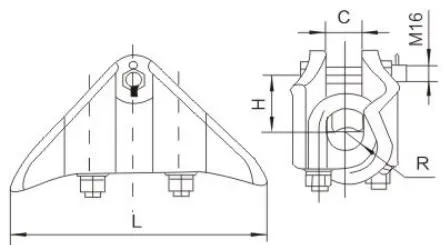
Models: XGF-6, XGF-53 (2 sizes) · Conductor: 36–51 mm · Nominal Failure Load: 70–80 kN · Reference Weight: 3.8–5.6 kg
At 330 kV and above the clamp stops being a mechanical part and becomes an electrical one. Every sharp corner, every protruding bolt head, every edge where the body narrows puts the surface gradient above the corona inception level, and the result is a continuous discharge that costs real power, generates audible noise and eventually erodes the fitting.
The XGF corona-free pattern is the answer to that, and you can see the design in one column of the table: C, the body width, is 44 and 56 mm. A standard handbag clamp of the same conductor size is 20 to 35 mm wide. The body is deliberately enormous and smooth, because a large radius on the outside is the cheapest way to bring the field down.
Technical Parameters
| Model | Applicable Conductor Diameter (mm) | Main Dimensions (mm) | Nominal Failure Load(kN) | Reference Weight (kg) | ||||
|---|---|---|---|---|---|---|---|---|
| H | C | M | R | L | ||||
| XGF-6 | 36~43 | 92 | 44 | 18 | 22.0 | 300 | 80 | 3.8 |
| XGF-53 | 43~51 | 100 | 56 | 16 | 26.5 | 350 | 70 | 5.6 |
Why a Wide Body Is an Electrical Decision
The field at the surface of a conductor or a fitting is highest where the radius of curvature is smallest. A corona-free clamp is shaped so that the radius on every external surface stays large enough that the field never crosses the inception value at the line’s operating voltage and altitude.
Two things follow from that, and both are visible here:
The body is wide and the edges are rounded. C of 44 and 56 mm is not structural — a 43 mm conductor does not need a 44 mm wide bag to hold it. It is there to keep the local radius large.
The hardware is inside the envelope. Note that M, the pin through the hanger, is 18 mm on the XGF-6 and 16 mm on the XGF-53 — smaller than you would expect on a clamp this size. In a corona-free design the pin is sized for the mechanical load and nothing more, because anything sticking out beyond the body outline becomes a discharge point.
If you fit a standard clamp to a 400 kV line, it will work mechanically and it will buzz. That is the whole difference between this page and the XG handbag range.
Two Sizes, and One Rating That Does Not Follow
XGF-6 covers 36 to 43 mm at 80 kN in 3.8 kg. XGF-53 covers 43 to 51 mm at 70 kN in 5.6 kg.
A larger clamp, rated lower. That is not a typo in the sheet, and it is worth understanding before you specify: the 53 is built for the bigger conductor and the wider body, and the rating step down is a consequence of the geometry rather than an oversight — a fatter bag with the same wall has less section where it matters. If your conductor is 43 to 51 mm and you need 80 kN, this clamp will not give it to you, and the answer is a twin conductor arrangement rather than a bigger single groove.
Both sizes overlap at exactly 43 mm. A 43 mm conductor fits either; take the 6 for the rating, the 53 for the roomier groove.
The Groove Is Cut to the Conductor
R on the XGF-6 is half the upper conductor diameter plus 0.5 mm — 43 ÷ 2 + 0.5 = 22.0, exact. That is conventional seating rather than the roomier cradle used on the XGF-X underslung type, and on EHV work it matters: a groove that is too roomy lets the conductor sit slightly off-centre, and an off-centre conductor in a corona-free clamp puts the field back where you were trying to move it from.
XGF-53 is less clear, and you should ask rather than assume. Its groove is R 26.5, which is exactly half of 53 — and 53 is the number in its model name. But the conductor range column stops at 51 mm. So the name and the groove both say the clamp takes a 53 mm conductor, while the range says 51. If you have a conductor between 51 and 53 mm, we will confirm the groove against the drawing before quoting; below 51 there is no question.
Where It Belongs
Transmission at 330 kV and above, and anywhere below that where the altitude or the pollution level has pushed the surface gradient up — a 220 kV line at 3000 m can need corona-free fittings just as much as a 500 kV line at sea level. Also on the jumper loops and the tension assemblies, not just the suspension points: corona does not care which fitting it starts on.
Below 220 kV the standard clamps are adequate and cost a third as much.
Material & Finish
- Body and keeper: aluminium alloy
- Cotter pin: stainless steel
- Remaining hardware: steel, hot-dip galvanized
- Finish: hot-dip galvanized to ISO 1461 on the steel parts, minimum 65 μm
- Tolerance: ±0.5 mm on the groove and mounting interfaces, coating thickness checked to ISO 2178
- Certification: mill test certificates on request
The surface finish matters more here than on any other clamp in this range. A galvanized steel part with a rough zinc spangle will discharge at a lower voltage than a smooth aluminium one, which is why the body and keeper on this pattern are alloy and the steel is confined to the pin and the bolt.
Related Clamps
XG handbag range — the standard pattern for the same conductor sizes, at a third of the width.
XGF-X underslung type — deep-drop cradle to 43 mm and 90 kN.
XCS twin conductor clamp — where 51 mm is not enough and the answer is two conductors.