XGU-A Suspension Clamp with Socket Clevis
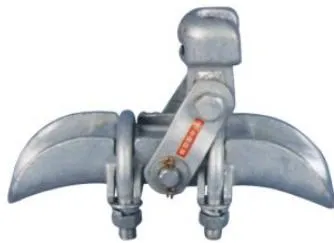
Models: XGU-5A – XGU-6A (2 sizes) · Conductor: 23–45 mm · Nominal Failure Load: 70 kN · Reference Weight: 5.7–6.1 kg
The A version is the 70 kN class of the XGU clamp with a ball socket built into the top of the hanger. The socket is a closed housing that receives the ball on the insulator cap and is locked through the side with a cotter pin. Because the socket is part of the clamp, the string does not need a separate ball-eye or socket adaptor between the insulator and the clamp — one fewer joint, one fewer cotter to fit at height, one fewer place for a wrong assembly to hide.
The body, keeper and U-bolts are the familiar XGU pattern: a groove sized to the conductor, a keeper holding the conductor down but not gripping it, and a body that turns about the pin so a line angle is taken out as a swivel rather than as a bend over the lip of the groove.
Technical Parameters
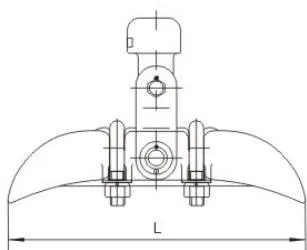
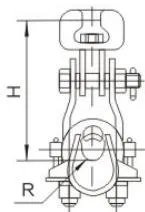
| Model | Applicable Conductor Diameter (Including Wrapping) (mm) | Main Dimensions (mm) | Nominal Failure Load (kN) | Reference Weight (kg) | ||
|---|---|---|---|---|---|---|
| L | R | H | ||||
| XGU-5A | 23~33 | 300 | 17 | 157 | 70 | 5.7 |
| XGU-6A | 34~45 | 300 | 23 | 163 | 70 | 6.1 |
Only Two Sizes, and That Is the Point
The A version covers 23 to 45 mm in two steps, both at 300 mm body length and both at 70 kN. There is no small-conductor A clamp, because a 7 mm conductor does not need a 70 kN string and nobody builds one.
Note where the range starts. XGU-5A begins at 23 mm, which is inside the plain XGU-4 band of 21.1 to 26 mm. A 25 mm conductor therefore fits both, and the choice between them is not about fit — it is about whether the string is built for 40 kN or 70 kN. Do not pick the smaller clamp because it is cheaper if the string is rated 70 kN; the clamp becomes the weak link and it becomes the weak link quietly.
R follows the same rule as everywhere else in this family: half the largest conductor diameter plus 0.5 mm. For 5A, 33 ÷ 2 + 0.5 = 17; for 6A, 45 ÷ 2 + 0.5 = 23. Both are exact.
A and B Are the Same Clamp With Different Tops
XGU-A and the XGU-B U-shackle version share the body, the L of 300 mm, the R values, the 70 kN rating and the conductor ranges. The only difference is the fitting at the top of the hanger, and it shows up in exactly two columns of the table:
- H runs 20 mm taller on the A — 157 against 137 for the 23
33 size, 163 against 143 for the 3445 size. That 20 mm is the socket housing sitting above the pin. - The A weighs 0.3 kg more — 5.7 against 5.4, and 6.1 against 5.8, at both sizes.
So on an existing tower, swapping a B for an A drops the conductor 20 mm and adds 0.3 kg at the insulator. On a new build that is irrelevant; on a tower you are re-stringing, check the clearance before you assume they are interchangeable. They are interchangeable at the pin, not at the sag.
How to Read H Here
H is the height of the assembly from the top of the attachment down to the conductor seat — the number you stack up when you are working out where the conductor actually sits relative to the cross-arm. It is not the socket depth and it is not the body height.
Across the two sizes it moves by only 6 mm, from 157 to 163, while the conductor they carry goes from 33 mm to 45 mm. That is deliberate: the body gets a wider groove without getting taller, so a string designed around the 5A does not need re-cutting for a 6A.
Material & Finish
- Body, keeper and clevis ball socket: malleable cast iron
- Cotter pin: stainless steel
- Remaining hardware: steel, hot-dip galvanized
- Finish: hot-dip galvanized to ISO 1461 on all iron and steel parts, minimum 65 μm
- Tolerance: ±0.5 mm on the groove and mounting interfaces, coating thickness checked to ISO 2178
- Certification: mill test certificates on request
The socket is cast iron with the rest of the hanger, so it is galvanized inside as well as out. That matters: the ball sits in the socket for the life of the line and a dry, unpainted socket is where fretting corrosion starts.
Related Clamps
XGU-B U-shackle version — same 70 kN body, clevis instead of socket, and the only one in the class that reaches 48.7 mm.
XGU-F abrasion resistant type — a liner in the groove for conductors that are expected to move, in both socket (AF) and U-shackle (BF) versions.
XGU center-pivoted — the 40 kN class for 5 to 26 mm conductor.