XGU-J Aluminum Alloy Suspension Clamp
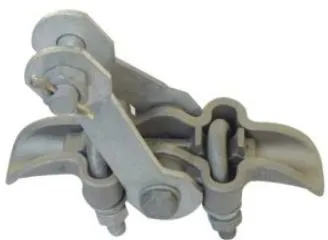
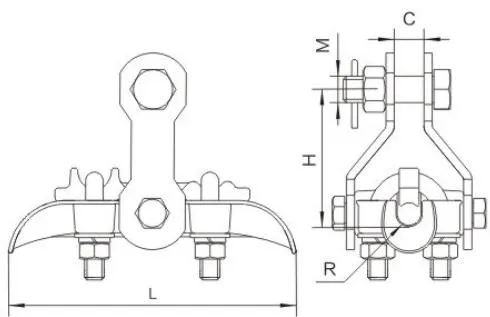
Models: XGU-1J – XGU-4J (4 sizes) · Conductor: 5–26 mm · Nominal Failure Load: 40 kN · Reference Weight: 1.07–1.62 kg
The J suffix means the body and the keeper are aluminium alloy instead of malleable cast iron. Everything else about how the clamp works is unchanged: it hangs from the insulator pin, the body turns about that pin, the conductor sits in a groove sized to its diameter, and a keeper holds it down without gripping it.
The conductor ranges, the groove radii, the drop height and the bolt pattern are all identical to the standard XGU. It is a straight substitution at the string. What changes is mass, and what the body does to the current in the conductor it is holding.
Technical Parameters
| Model | Applicable Conductor Diameter (Including Wrapping) (mm) | Main Dimensions (mm) | Nominal Failure Load (kN) | Reference Weight (kg) | ||||
|---|---|---|---|---|---|---|---|---|
| L | C | R | H | M | ||||
| XGU-1J | 5.0~7.0 | 175 | 18 | 4.0 | 82 | 16 | 40 | 1.07 |
| XGU-2J | 7.1~13.0 | 175 | 18 | 7.0 | 82 | 16 | 40 | 1.09 |
| XGU-3J | 13.1~21.0 | 198 | 18 | 11.0 | 102 | 16 | 40 | 1.25 |
| XGU-4J | 21.1~26.0 | 215 | 18 | 13.5 | 110 | 16 | 40 | 1.62 |
Side by Side With the Cast Iron Version
The two families are the same clamp in two metals, which makes the comparison unusually clean — every conductor size maps to exactly one row.
| Conductor range | Cast iron model | Weight | Alloy model | Weight | Saving |
|---|---|---|---|---|---|
| 5.0~7.0 mm | XGU-1 | 1.4 kg | XGU-1J | 1.07 kg | −24% |
| 7.1~13.0 mm | XGU-2 | 1.8 kg | XGU-2J | 1.09 kg | −39% |
| 13.1~21.0 mm | XGU-3 | 2.0 kg | XGU-3J | 1.25 kg | −38% |
| 21.1~26.0 mm | XGU-4 | 3.0 kg | XGU-4J | 1.62 kg | −46% |
Run the number on a real line and it stops being a detail. A 220 kV single circuit with two conductors per phase and 400 m spans has about 7.5 suspension points per conductor per kilometre — 15 clamps per kilometre across six conductors. At the top of the range that is 45 kg of cast iron clamp per kilometre against 24 kg of aluminium alloy. Twenty-one kilograms per kilometre comes off the tower load, and it comes off at the point where the tower is already carrying ice.
Why the Body Metal Matters
Cast iron is ferromagnetic. The conductor’s magnetic field passes through the body of the clamp, and on every half cycle the iron is magnetised and reversed. The energy that takes is dissipated as heat in the clamp itself, continuously, for the life of the line. Per clamp the figure is small; multiplied by the clamp count on an EHV corridor it is a number a loss account can see, which is why the type is called energy-saving rather than light-weight.
The aluminium alloy body removes that path entirely — it is non-magnetic, so there is no hysteresis loop to drive.
There is a second, quieter argument. An aluminium body against an aluminium conductor is the same metal, so there is no galvanic couple at the one place where the conductor is guaranteed to be scratched. On the cast iron version the separation is the galvanized keeper and the wrapping; that works, but it depends on the zinc staying intact for thirty years.
The Dimensions Are Not Quite the Same
R, H, C and M are identical, so the conductor sits at the same height on the same M 16 pin, and a string designed for one fits the other without recalculation.
L is where the two part company: 175 instead of 180, 175 instead of 200, 198 instead of 220, 215 instead of 250. Cast iron needs wall thickness to pour reliably, and the aluminium version does not, so the wings come in. The saving scales with size — 5 mm at the bottom of the range, 35 mm at the top — which is why the weight saving also scales.
One consequence worth knowing: XGU-1J and XGU-2J share the same 175 mm body. One pattern serves both grooves, and the 0.02 kg between them is the difference between a 4 mm and a 7 mm groove. If you are carrying both sizes, you are carrying one spare, not two.
Where the Aluminium Version Is the Wrong Choice
The alloy body is the right call on new EHV work in normal atmospheres. It is the wrong call in two situations.
Heavy chloride exposure — coastal within a few kilometres, or an industrial plume. Aluminium alloy pits under chloride; the galvanized iron body sacrifices its zinc instead and lasts longer. On those lines the 0.4 kg you save is not worth the inspection interval.
Above 40 kN. This family stops at four sizes and one rating. If the string needs 70 kN, go to the XGU-A or XGU-B, both of which are cast and both of which are heavier for it.
Material & Finish
- Body and keeper: aluminium alloy
- Cotter pin: stainless steel
- Remaining hardware: steel, hot-dip galvanized
- Finish: hot-dip galvanized to ISO 1461 on the steel parts, minimum 65 μm
- Tolerance: ±0.5 mm on the groove and mounting interfaces, coating thickness checked to ISO 2178
- Certification: mill test certificates on request
Related Clamps
The standard XGU centre-pivoted clamp in malleable cast iron, for the same conductor range. The XGU-F abrasion resistant type if the conductor is expected to move in the groove. For 23 to 48.7 mm conductor at 70 kN, the XGU-B U-shackle version.