LF Yoke Plate
Models: LF-21-110/400 – LF-64-120/450, plus LF-2140 – LF-4055 · Nominal Failure Load: 210–640 kN · Reference Weight: 5.5–26.6 kg · Spans: 400–600 mm
Two Code Systems on One Sheet
LF is the square yoke plate with the throat in the code, which is the reason to look at this family before any other: on the LJ and LXV sheets you cannot tell the depth from the part number, and here you can.
The family is printed as two tables, one by load and one by span:
| Form | Example | Reads as |
|---|---|---|
| Long | LF-21-110/400 | 210 kN, H 110, span 400 |
| Short | LF-2140 | 210 kN, span 400 — throat not in the code |
The long form is fully explicit: load, throat, span, all three. The short form drops the throat, so LF-2140 tells you nothing until you open the table — and the throat is exactly the dimension that decides the weight on this family. Prefer the long code when you quote.
The Matrix Has Holes
The long form does not cover a full grid, and the gaps are in the catalogue, not in the printing:
- LF-21 and LF-25 — 400, 450, 500, 600 (four each)
- LF-32 — 400, 500, 600. No 450.
- LF-42 — 500 and 600 only. No 400, no 450.
- LF-64 — 450 only, one size
If your layout needs LF-42 at 400 mm or LF-64 at 600 mm, it does not exist in this catalogue and what you are looking at is a special. Fourteen long-form rows, against sixteen a complete grid would need.
Four Millimetres and Forty Kilonewtons
LF-21 and LF-25 are the two 15 mm-class plates, and on this sheet the only dimension that separates them is the base hole:
| Model | Load | H | L | b | Φ | Weight |
|---|---|---|---|---|---|---|
| LF-21-120/500 | 210 kN | 120 | 500 | 16 | 20 | 12.2 kg |
| LF-25-120/500 | 250 kN | 120 | 500 | 16 | 24 | 12.3 kg |
Same throat, same span, same section. The 250 kN part has a 4 mm larger hole and nothing else.
That is not where the extra 40 kN comes from. The hole takes metal out, but the 4-Φ corner radius grows with the drilling, so the net width across the eyes rises while the hole grows. Net section is what carries the load, and on the Φ 24 plate it is the wider of the two — that is the 40 kN.
The weights agree with the second reading: 12.2 against 12.3 kg on a 16 mm plate is 0.8 per cent, which is the 4 mm of hole and nothing more.
Now set that against the other two spans:
| Span | LF-21 (210 kN) | LF-25 (250 kN) | Difference |
|---|---|---|---|
| 400 mm | 8.9 kg | 10.0 kg | +1.1 kg |
| 450 mm | 10.5 kg | 11.5 kg | +1.0 kg |
| 500 mm | 12.2 kg | 12.3 kg | +0.1 kg |
| 600 mm | 14.2 kg | 14.5 kg | +0.3 kg |
The same 40 kN step costs a kilogram at 400 mm and a tenth of a kilo at 500. If the pairs were genuinely different parts that difference would not swing by a factor of ten along one ladder. LF-25-120/500 at 12.3 kg is the row we would check first — it is the one cell where both families come out at the same weight.
Ask us for the drawing on any LF-25 before it goes into a loading table. The rating is what the catalogue sells; whether the plate behind it is 210 or 250 kN of steel is a question for the drawing.
H Is the Dimension That Costs
The short form proves what the throat does, and it is the clearest arithmetic on the sheet. Take the two 210 kN plates of the same span:
| Model | Load | H | b | L | Weight |
|---|---|---|---|---|---|
| LF-21-110/400 | 210 kN | 110 mm | 16 | 400 | 8.9 kg |
| LF-2140 | 210 kN | 70 mm | 16 | 400 | 5.5 kg |
Same load, same span, same 16 mm plate. Forty millimetres less throat and the plate loses 3.4 kg — more than a third of its weight. A 400 mm × 40 mm strip of 16 mm plate is 2.0 kg of steel; the other 1.4 kg is the wider outline that comes with the deeper throat, because the taper has to spread to reach the eyes. Either way: on this family H decides what you are buying. It sets how much plate sits above the bolt line, and it is the first thing to check against your string hardware.
The same short-form table carries the tallest plate in the family, LF-4055: 190 mm of throat on a 550 mm span, 26.6 kg — a 400 kN plate that outweighs the 420 kN LF-42-120/600 by eight kilos, on a lower rating. That is the throat again, not the load.
Technical Parameters
LF long form: load – throat – span
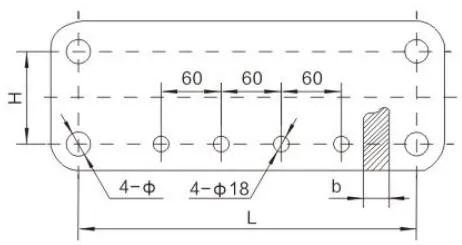
| General Design No. | Main Dimensions (mm) | Nominal Failure Load (kN) | Reference Weight (kg) | |||
|---|---|---|---|---|---|---|
| H | L | b | Φ | |||
| LF-21-110/400 | 110 | 400 | 16 | 20 | 210 | 8.9 |
| LF-21-120/450 | 120 | 450 | 16 | 20 | 210 | 10.5 |
| LF-21-120/500 | 120 | 500 | 16 | 20 | 210 | 12.2 |
| LF-21-120/600 | 120 | 600 | 16 | 20 | 210 | 14.2 |
| LF-25-120/400 | 120 | 400 | 16 | 24 | 250 | 10.0 |
| LF-25-120/450 | 120 | 450 | 16 | 24 | 250 | 11.5 |
| LF-25-120/500 | 120 | 500 | 16 | 24 | 250 | 12.3 |
| LF-25-120/600 | 120 | 600 | 16 | 24 | 250 | 14.5 |
| LF-32-120/400 | 120 | 400 | 18 | 26 | 320 | 11.6 |
| LF-32-120/500 | 120 | 500 | 18 | 26 | 320 | 14.2 |
| LF-32-120/600 | 120 | 600 | 18 | 26 | 320 | 16.7 |
| LF-42-120/500 | 120 | 500 | 20 | 26 | 420 | 15.8 |
| LF-42-120/600 | 120 | 600 | 20 | 26 | 420 | 18.6 |
| LF-64-120/450 | 120 | 450 | 28 | 33 | 640 | 22.0 |
LF short form: load and span only
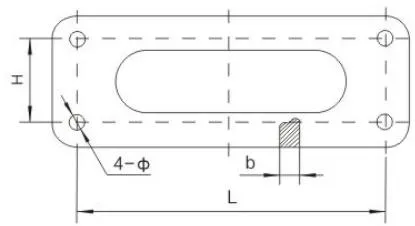
| Model | Main Dimensions (mm) | Nominal Failure Load (kN) | Reference Weight (kg) | |||
|---|---|---|---|---|---|---|
| H | L | b | Φ | |||
| LF-2140 | 70 | 400 | 16 | 20 | 210 | 5.5 |
| LF-2540 | 110 | 400 | 16 | 24 | 250 | 11.0 |
| LF-3040 | 120 | 400 | 18 | 26 | 300 | 11.2 |
| LF-4055 | 190 | 550 | 26 | 30 | 400 | 26.6 |
Related Pages
The same plate numbered load-then-centimetres: LJ yoke plate. The general design numbers, 100 to 160 kN: LXV yoke plate. The trapezoidal plates: LS trapezoidal. Triangular: L type triangular.
Note: the long form carries the throat in the code, which the LJ and LXV sheets do not. LF-21 and LF-25 differ only in the base hole, 20 against 24 mm, so the 40 kN between them is not in the table — and the weight gap swings from 1.1 kg at 400 mm to 0.1 kg at 500, which is not what two different parts do. H drives weight here: 110 against 70 mm on the same 210 kN plate is 3.4 kg. LF-4055 at 190 mm of throat and 26.6 kg outweighs a 420 kN plate at 18.6 kg.