LH Turnbuckle Round Eye
Models: LH-7 to LH-20 · Rows: 13 · Adjustment: L 250–980 mm · Nominal Failure Load: 70–200 kN · Reference Weight: 2.7–8.5 kg
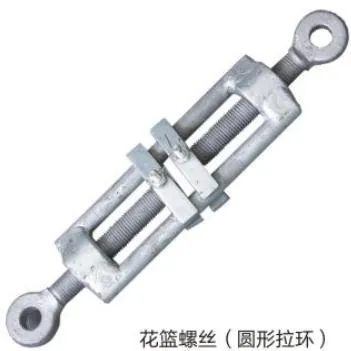
Two Eyes and a Screw
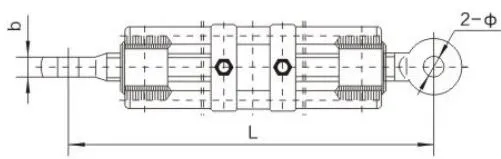
The drawing is the plain turnbuckle: a body with a right-hand and a left-hand thread, an eye forged on each end, and L measured eye to eye. b is the thickness of the strap at the eye and 2-Φ the bore of both eyes.
Every row is an adjustment range, printed with a tilde. LH-7(300-500) is 400 mm of stroke, not a 400 mm part. Order by the working length you need and the range has to contain it.
Six Ranges at 70 kN, and They Overlap
The 70 kN family alone has six entries:
| Range | Weight | |
|---|---|---|
| 250–290 | 2.7 kg | the short one |
| 270–320 | 2.8 kg | overlaps the above by 20 mm |
| 300–500 | 4.0 kg | |
| 470–740 | 4.3 kg | overlaps 300–500 by 30 mm |
| 500–800 | 4.6 kg | |
| 530–850 | 4.8 kg | overlaps 500–800 almost completely |
| 640–980 | 8.5 kg | the long one |
Two pairs overlap enough to be interchangeable on paper — 500–800 and 530–850 differ by 30 mm at each end and by 0.2 kg, and a 700 mm working length fits both. The catalogue does not say which to prefer.
The practical reading is that the range is a family of body lengths, and the overlaps exist because a shorter body extended to its limit is cheaper than the next body up. Where two ranges both fit, take the shorter one: it is lighter, and the screw is less exposed.
The 8.5 kg Row Is Off the Ladder
Read the weights against the maximum length and they climb gently — 4.0, 4.3, 4.6, 4.8 for 500, 740, 800 and 850 mm. Then 640–980 prints 8.5 kg, almost twice the 4.8 kg of the 850 mm body.
A 130 mm longer body is not 3.7 kg of extra steel: the 900 mm row is a bigger body class than the rest of the 70 kN family, and 8.5 kg is that body. If your design needs 900 mm of stroke at 70 kN, quote it by the stroke and we confirm the body on the drawing.
One Row Breaks the Naming
Eleven rows are named LH-7(300-500). One is named LH-10-450 — a hyphen instead of brackets — and its entry is 375~525, 4.4 kg. Sorted between LH-10(360-500) at 4.3 and LH-10(450-650) at 4.8, it is a legitimate 100 kN body with a 150 mm stroke, just written differently.
Order it by the string as printed. A system that strips punctuation will turn it into “LH-10-450” and match nothing.
One Pin Covers 70 and 100 kN
Every row up to and including 100 kN uses b 16 and Φ 20 — one strap thickness, one pin size, across both ratings. The two 200 kN rows jump to b 24 and Φ 30.
So the pin is not a strength dimension below 200 kN: a 100 kN turnbuckle takes the same 20 mm pin as a 70 kN one. If you are matching an existing hole in a pole bracket, Φ 20 covers both, and you can substitute a 100 kN body for a 70 kN one on the same hardware — the difference is 0.3 to 0.6 kg, not a new bracket.
Technical Parameters
| Model | Main Dimensions (mm) | Nominal Failure Load(kN) | Reference Weight (kg) | ||
|---|---|---|---|---|---|
| L | b | Φ | |||
| LH-7(250-290) | 250~290 | 16 | 20 | 70 | 2.7 |
| LH-7(270-320) | 270~320 | 16 | 20 | 70 | 2.8 |
| LH-7(300-500) | 300~500 | 16 | 20 | 70 | 4.0 |
| LH-7(470-740) | 470~740 | 16 | 20 | 70 | 4.3 |
| LH-7(500-800) | 500~800 | 16 | 20 | 70 | 4.6 |
| LH-7(530-850) | 530~850 | 16 | 20 | 70 | 4.8 |
| LH-7(640-980) | 640~980 | 16 | 20 | 70 | 8.5 |
| LH-10(360-500) | 360~500 | 16 | 20 | 100 | 4.3 |
| LH-10(450-650) | 450~650 | 16 | 20 | 100 | 4.8 |
| LH-10-450 | 375~525 | 16 | 20 | 100 | 4.4 |
| LH-10(500-800) | 500~800 | 16 | 20 | 100 | 5.1 |
| LH-20(450-650) | 450~650 | 24 | 30 | 200 | 7.5 |
| LH-20(570-730) | 570~730 | 24 | 30 | 200 | 8.0 |
Related Pages
The grooved clevis version: LH turnbuckle grooved clevis. The U-eye version: LH turnbuckle U shape eye. Fixed-length links: PH extension link. Clevis hardware for the ends: U clevis, Z clevis.
Note: every L is an adjustment range, and several ranges overlap — quote the model string in full. b 16 / Φ 20 covers both the 70 and the 100 kN rows; only the 200 kN rows go to b 24 / Φ 30. LH-7(640-980) prints 8.5 kg against 4.8 kg for the 850 mm body of the same rating.