LJ Yoke Plate
Models: LJ-1040 – LJ-6045A, plus LJ-1640F · Nominal Failure Load: 100–600 kN · Reference Weight: 6.45–28.0 kg · Spans: 400 and 450 mm
Eight Plates, Two Spans
This is the plain square yoke plate: a flat rectangle with two eyes at each end and a solid body between them. Every code on the page reads the same way — load in kilonewtons, then span in centimetres:
- LJ-1040 — 100 kN over 400 mm
- LJ-2540 — 250 kN over 400 mm
- LJ-6045A — 600 kN over 450 mm
The trailing A is not a revision letter. Every A-suffixed plate here is a 450 mm span, and every plate without one is a 400 mm span. LJ-3045A and LJ-4045A sit 50 mm longer than the same load without the suffix, and those 50 mm are real in the string: check which one your hardware is drilled for before you price it.
The one plate that obeys neither the load nor the span reading is LJ-3034, and it gets its own section below.
The A Series Is Where the Weight Jumps
Three plates over the same 450 mm span, and the weight does not climb evenly:
| Model | Load | b | Weight | Step |
|---|---|---|---|---|
| LJ-3045A | 300 kN | 18 mm | 12.0 kg | — |
| LJ-4045A | 400 kN | 22 mm | 17.0 kg | +4 mm, +5 kg |
| LJ-6045A | 600 kN | 32 mm | 28.0 kg | +10 mm, +11 kg |
The first two steps cost 5 kg between them. The last one costs more than both, and it buys 10 mm of plate where the step below bought 4. LJ-6045A is a different class of part, not a scaled LJ-4045A — if you are sizing for 600 kN, neither plate below it is a reference point.
A Bigger Hole Weighs Less
Two rows on the 400 mm span are identical except for one hole:
| Model | Load | Φ1 | Φ2 | Weight |
|---|---|---|---|---|
| LJ-1040 | 100 kN | 18 | 20 | 6.50 kg |
| LJ-1240 | 120 kN | 18 | 24 | 6.45 kg |
The 120 kN plate is the lighter one, and it is correct. Opening one hole from 20 to 24 mm removes about 0.02 kg of steel; the sheet prints a 0.05 kg difference — same direction, different arithmetic. Either way the point holds: the weight column is a computed net figure, not a strength ranking. It moves with the drilling as much as with the load, so do not read it as “heavier means stronger” anywhere on this page.
LJ-1640F Is a Second Leaf
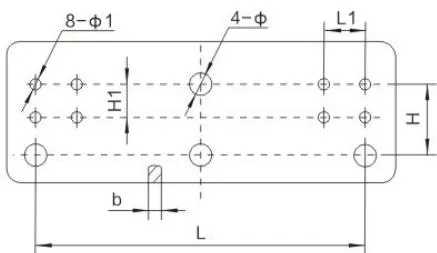
The plain LJ-1640 is on this page at 9.54 kg: 160 kN, 400 mm span, 18 mm plate, H 100. The LJ-1640F carries the same rating over the same span on the same 18 mm section and weighs 17.60 kg — eight kilos more, and it adds two dimensions the plain plate does not have: H1 = 40 mm (end offset) and L1 = 50 mm (end pitch).
Eight kilos is not a drilling difference. On a 400 mm plate that is the weight of a second leaf, and H1 and L1 are exactly the two dimensions you would need to locate one. The catalogue never says so, so we do: LJ-1640F and LJ-1640 are not interchangeable and not the same weight. If the drawing says LJ-1640 and the offer says LJ-1640F, the price difference is real and it is not a rounding.
LJ-3034: The Code and the Column Disagree
Every other item in the family reads load-then-span, so LJ-3034 should be 300 kN over 340 mm. The row instead prints 400 kN and L = 400 mm.
The column is the rating and the code is the old series number: LJ-3034 is a 400 kN plate over 400 mm, which is what 13.57 kg buys at this outline, between the 250 kN LJ-2540 at 11.10 kg and a heavier 400 kN build. Order it on L 400 and take the load from the drawing.
Order the 34 series by the load and the span you need, and we confirm both against the drawing before the order is booked. LJ-3034 prints 400 kN over 400 mm where the code reads 300 over 340, and at 13.57 kg it is a 400 mm plate: take L 400, and take the load from the drawing that goes out with the price.
Why the 250 kN Plate Is Lighter Than the 160 kN One
LJ-2540 is 11.10 kg at 250 kN. LJ-1640F is 17.60 kg at 160 kN. The lighter plate is the stronger one, and the reason is in the columns: LJ-2540 is a 16 mm single plate with a 120 mm throat; LJ-1640F is an 18 mm double leaf with an 80 mm throat.
Rating is not what sets the weight on this family — the leaf count and the section are. That is the thing to carry away: read b and the throat before you read the load.
Technical Parameters
LJ-1640F, the double leaf
| Model | Main Dimensions (mm) | Nominal Failure Load (kN) | Reference Weight (kg) | ||||||
|---|---|---|---|---|---|---|---|---|---|
| H | H1 | L | L1 | b | Φ | Φ1 | |||
| LJ-1640F | 80 | 40 | 400 | 50 | 18 | 26 | 14 | 160 | 17.6 |
Plain LJ plates, 400 and 450 mm spans
| Model | Main Dimensions (mm) | Nominal Failure Load (kN) | Reference Weight (kg) | ||||
|---|---|---|---|---|---|---|---|
| H | L | b | Φ1 | Φ2 | |||
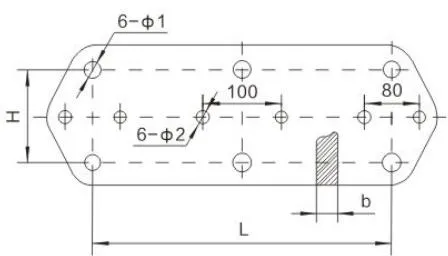
| LJ-1040 | 70 | 400 | 16 | 18 | 20 | 100 | 6.50 |
| LJ-1240 | 70 | 400 | 16 | 18 | 24 | 120 | 6.45 |
| LJ-1640 | 100 | 400 | 18 | 20 | 26 | 160 | 9.54 |
| LJ-2540 | 120 | 400 | 16 | 24 | 18 | 250 | 11.10 |
| LJ-3045A | 110 | 450 | 18 | 26 | 26 | 300 | 12.0 |
| LJ-3034 | 120 | 400 | 18 | 26 | 18 | 400 | 13.57 |
| LJ-4045A | 110 | 450 | 22 | 32 | 30 | 400 | 17.0 |
| LJ-6045A | 120 | 450 | 32 | 39 | 39 | 600 | 28.0 |
The 450 mm span plates
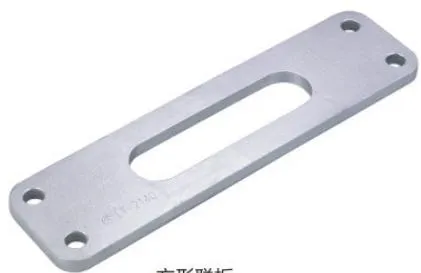
The three A-suffixed rows are drawn on the square-plate sheet: two eyes on the 450 mm span, a two-hole pattern at each end, and the body between them 18, 22 and 32 mm thick.
Related Pages
The other two square-plate numbering systems: LXV yoke plate and LF yoke plate. Two-hole LB plates: LB yoke plate. Compact plates: LBD yoke plate. Multi-hole plate: LBS yoke plate. Triangular plates: LV yoke plate and L type triangular.
Note: the trailing A means a 450 mm span, not a revision — LJ-3045A and LJ-4045A are 50 mm longer than the same load without it. LJ-1640F is 17.60 kg against the plain LJ-1640’s 9.54 kg because it is a second leaf, not a bigger plate. The LJ-3034 row prints 400 kN and L = 400 mm while its code reads 300 kN over 340 mm; confirm before ordering. Weight is a computed net figure, so LJ-1240 is lighter than LJ-1040.