LV Yoke Plate
Models: LV-1240, LV-1612, LV-1620, LV-1640, LV-2040 · Nominal Failure Load: 120–200 kN as printed · Reference Weight: 2.5–3.8 kg · Spans: 120–400 mm
A Gable, Not a Rectangle
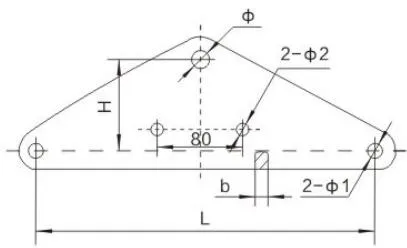
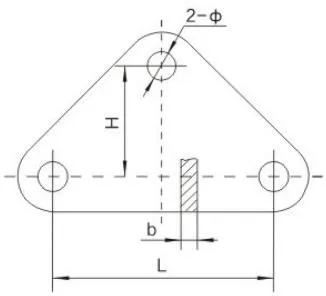
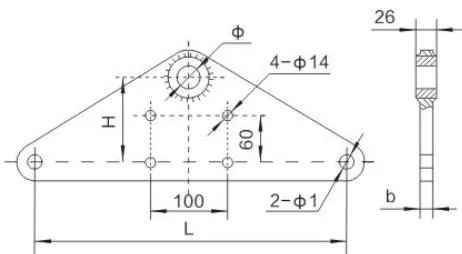
The LV plate is a triangle: one eye at the apex, two eyes in the base, and — on the larger sizes — a rectangular group of small holes in the middle of the web for a spacer or a second connection.
That shape changes what the dimensions mean:
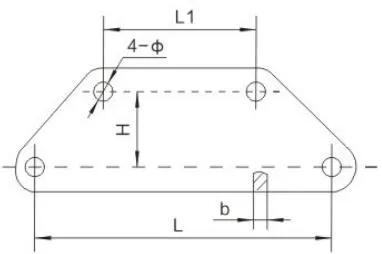
- H is the height of the apex eye above the base hole line — how deep the gable is.
- L is the span between the two base holes — how wide it stands.
- b is the plate thickness, and on the larger plates the eye also has a raised boss thicker than b (see below).
H and L are not independent sizes on a ladder. They are a shape, and the pair tells you the angle: LV-1612 is 100 mm high on a 120 mm base, steep, for a tight space; LV-1620 is 60 mm high on a 200 mm base, flat and wide.
The Load Column Disagrees With the Model Number
Every model number in this family reads load-then-span:
| Model | Code says | Load column prints | Span |
|---|---|---|---|
| LV-1240 | 120 kN | 120 kN ✓ | 400 mm |
| LV-1612 | 160 kN | 160 kN ✓ | 120 mm |
| LV-1620 | 160 kN | 160 kN ✓ | 200 mm |
| LV-1640 | 160 kN | 120 kN ✗ | 400 mm |
| LV-2040 | 200 kN | 120 kN ✗ | 400 mm |
Two of the five rows print a load 40 to 80 kN below what their own code says — 120 kN against a 160 and a 200. On LV-1640 and LV-2040 order by the class you need and we confirm it on the drawing; the column is not the rating to write into a tender.
Three Plates, One Weight
LV-1240, LV-1640 and LV-2040 are all exactly 3.8 kg, and they are not the same part:
| Model | H | b | Holes | Weight |
|---|---|---|---|---|
| LV-1240 | 70 mm | 16 | Φ 18, Φ1 18, Φ2 14 | 3.8 kg |
| LV-1640 | 100 mm | 18 | 4-Φ 18 upper row on L1 = 200 | 3.8 kg |
| LV-2040 | 100 mm | 16 | Φ 30, Φ1 20, 4-Φ14 | 3.8 kg |
Thirty millimetres of gable, 2 mm of plate and a completely different drilling cannot come out at the same tenth of a kilogram. On the LJ plates the weights clearly are computed per part — here the column looks copied down.
Treat 3.8 kg as a nominal figure for the three 400 mm plates, not as a measured weight, until we send you a packing list. The 120 and 200 mm plates at 2.5 and 3.0 kg are plausible on their own scale.
The Boss Is Thicker Than b
On LV-2040 the drawing marks the eye at 26 mm through the boss while the table gives b = 16 mm. On the 1240 and 1640 sheets the boss is drawn but not dimensioned.
That is the same convention as the LBD plate, where the boss thickness gets its own column (b1). Here it does not. If you are checking bearing at the eye, the number is on the drawing, not in the table — ask us for it on any size where the eye is stacked between two other parts.
LV-1620 Is Two Different Plates
The guy-wire page lists an LV-1620 as well: H = 100 mm, 3.4 kg. This page lists LV-1620 as H = 60 mm, 3.0 kg. Same code, same 200 mm span, 40 mm difference in the gable and 0.4 kg in weight.
Both are printed as the catalogue gives them. When you order an LV-1620, quote the H you need as well as the model number, or you may get the other one.
Technical Parameters
LV-1240
| Model | Main Dimensions (mm) | Nominal Failure Load(kN) | Reference Weight (kg) | |||||
|---|---|---|---|---|---|---|---|---|
| H | L | b | Ø | Ø1 | Ø2 | |||
| LV-1240 | 70 | 400 | 16 | 18 | 18 | 14 | 120 | 3.8 |
LV-1612 and LV-1620
| Model | Main Dimensions (mm) | Nominal Failure Load(kN) | Reference Weight (kg) | |||
|---|---|---|---|---|---|---|
| H | L | b | Ø | |||
| LV-1612 | 100 | 120 | 18 | 26 | 160 | 2.5 |
| LV-1620 | 60 | 200 | 18 | 26 | 160 | 3.0 |
LV-1640
| Model | Main Dimensions (mm) | Nominal Failure Load(kN) | Reference Weight (kg) | ||||
|---|---|---|---|---|---|---|---|
| H | L | b | Ø | L1 | |||
| LV-1640 | 100 | 400 | 18 | 18 | 200 | 120 | 3.8 |
LV-2040
| Model | Main Dimensions (mm) | Nominal Failure Load(kN) | Reference Weight (kg) | ||||
|---|---|---|---|---|---|---|---|
| H | L | b | Ø | Ø1 | |||
| LV-2040 | 100 | 400 | 16 | 30 | 20 | 120 | 3.8 |
Related Pages
Guy-wire version with its own sizes: LV yoke plate for guy wire. Rectangular plates: LB, LBD, LBS, LFB. Universal square plates: LJ, LXV and LF.
Note: LV-1640 and LV-2040 print 120 kN while their codes read 160 and 200 kN — confirm the class before quoting. Three different 400 mm plates all weigh 3.8 kg. LV-1620 exists twice: H 60 mm here, H 100 mm on the guy-wire page.