LV Yoke Plate Guy Wire
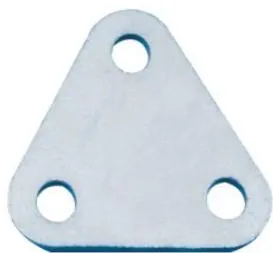
Models: LV-1012 – LV-5020 (10 sizes) · Nominal Failure Load: 100–500 kN · Reference Weight: 1.80–9.50 kg · Base spans: 120–250 mm
Ten Sizes, One Code Rule
The code is load-then-span, and every row on this page obeys it: LV-3014 is 300 kN over a 140 mm base, LV-5020 is 500 kN over 200 mm. That matters because the plain LV page prints two rows where the load column breaks the same rule — here the column and the code agree on all ten.
Pick the Base Span First
The two base eyes land on the pole band, the bracket or the anchor plate, so L is set by what you are fixing to, not by the load. Once L is chosen, H follows: it is the apex height, and together with L it sets how steep the legs are.
Read down the 300 kN group and you can see H staying at 120 mm while the base opens from 140 to 160 to 180 — the same gable getting progressively flatter, at 4.60, 5.40 and 5.90 kg. The two 150 mm gables, LV-4025 and LV-5020, are the tallest on the page.
b and b1 Are Two Thicknesses
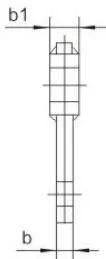
On every size from 210 kN up, the plate has two thicknesses: b is the body of the plate, b1 is the eye end. The section drawing on this page shows it — the eye is a heavier block, the shank between the eyes is thinner.
| Model | Load | b1 (eye) | b (body) | Head is thicker by |
|---|---|---|---|---|
| LV-1012 | 100 kN | 16 | 16 | none |
| LV-1212 | 120 kN | 16 | 16 | none |
| LV-1620 | 160 kN | 18 | 18 | none |
| LV-2115 | 210 kN | 26 | 16 | +10 mm |
| LV-2518 | 250 kN | 30 | 16 | +14 mm |
| LV-3014 / 16 / 18 | 300 kN | 26 | 18 | +8 mm |
| LV-4025 | 400 kN | 36 | 24 | +12 mm |
| LV-5020 | 500 kN | 38 | 30 | +8 mm |
The three small plates are the same thickness throughout. From 210 kN up, the eye carries 8 to 14 mm more steel than the shank — LV-2518 is the extreme, with a 30 mm head on a 16 mm body. If your pin bears on the eye, b1 is the number that matters; if you are clamping the shank, b is. The table gives both, in that order.
The 500 kN Plate Is Lighter Than the 400 kN One
| Model | Load | H | L | b1 / b | Weight |
|---|---|---|---|---|---|
| LV-4025 | 400 kN | 150 | 250 | 36 / 24 | 9.50 kg |
| LV-5020 | 500 kN | 150 | 200 | 38 / 30 | 8.20 kg |
Fifty millimetres less base at the same height takes more off the legs than the extra thickness adds, so the stronger plate is the lighter one — by 1.3 kg. The same thing happens lower down: LV-2115 (210 kN) is 2.50 kg and LV-1620 (160 kN) is 3.40 kg, because 150 mm of base with a 16 mm body beats 200 mm of base with an 18 mm body.
On a guy assembly, the base span and the thickness are what you live with. Do not pick a size by weight or assume the higher class is the bigger part.
Where the Steps Are Uneven
Inside the 300 kN group the weights go 4.60 → 5.40 → 5.90 kg for base spans of 140, 160 and 180 mm. Twenty millimetres of base costs 0.80 kg the first time and 0.50 kg the second. On a part this small, twenty millimetres of one leg should cost the same both times, so one of the three figures is probably rounded. It does not change how the part works; it does matter if you are tendering on tonnage.
Technical Parameters
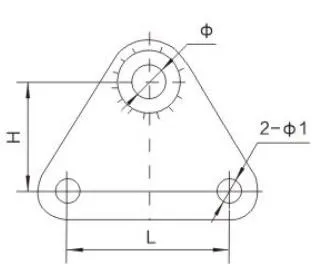
| Model | Main Dimensions(mm) | Nominal Failure Load(kN) | Reference Weight(kg) | |||||
|---|---|---|---|---|---|---|---|---|
| H | L | b1 | b | Φ | Φ1 | |||
| LV-1012 | 60 | 120 | 16 | 16 | 20 | 20 | 100 | 1.80 |
| LV-1212 | 90 | 120 | 16 | 16 | 24 | 20 | 120 | 2.30 |
| LV-1620 | 100 | 200 | 18 | 18 | 26 | 26 | 160 | 3.40 |
| LV-2115 | 100 | 150 | 26 | 16 | 30 | 24 | 210 | 2.50 |
| LV-2518 | 100 | 180 | 30 | 16 | 33 | 24 | 250 | 2.70 |
| LV-3014 | 120 | 140 | 26 | 18 | 39 | 26 | 300 | 4.60 |
| LV-3016 | 120 | 160 | 26 | 18 | 39 | 26 | 300 | 5.40 |
| LV-3018 | 120 | 180 | 26 | 18 | 39 | 26 | 300 | 5.90 |
| LV-4025 | 150 | 250 | 36 | 24 | 45 | 30 | 400 | 9.50 |
| LV-5020 | 150 | 200 | 38 | 30 | 45 | 33 | 500 | 8.20 |
Related Pages
Triangular plates for other duties: LV yoke plate. Rectangular plates: LB, LBD, LBS, LFB. Square plates: LJ, LXV and LF, LJ yoke plate.
Note: b1 is the eye end and b the plate body — from 210 kN up the head is 8 to 14 mm thicker than the shank. The 500 kN LV-5020 is lighter than the 400 kN LV-4025 because its base is 50 mm shorter. Every code on this page matches its load column.