LS Type Trapezoidal Yoke Plate
Models: LS-1212 – LE-845550 · Rows: 13 · Nominal Failure Load: 100–840 kN · Reference Weight: 5.00–32.12 kg
A Trapezoid, and What the Two Spans Mean
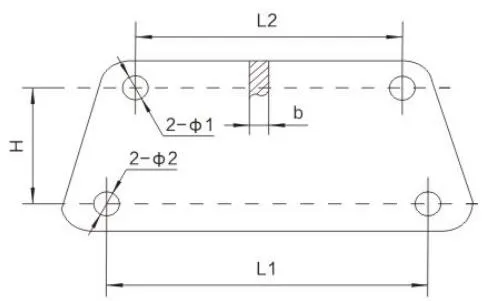
The plate is a flat trapezoid: two eyes on the short edge, two on the long edge, and a straight taper between them. The drawing fixes the vocabulary:
- L1 — the hole spacing on the long edge (the lower one on the drawing).
- L2 — the hole spacing on the short edge (the upper one).
- H — the vertical distance between the two hole rows, i.e. how far the taper runs.
- Φ1 — the two holes on the short edge; Φ2 — the two on the long edge. They are often the same size and sometimes not.
L1 and L2 are not interchangeable and they are not a size ladder. They are the two ends of one taper, and the pair of them plus H defines the outline. On the LS-12 series the long edge is fixed at 400 mm and only the short edge moves, which makes the six plates a family of tapers from very steep (120 mm top on a 400 mm bottom) to nearly rectangular (370 on 400).
The Code Carries the Spans, and the Order Reverses
Three naming conventions run across these two sheets, and they disagree about which span comes first:
| Code | Reads as |
|---|---|
| LS-1237 | 120 kN, short edge 370 mm (L2 ÷ 10) |
| LE-425550 | 420 kN, short edge 550, long edge 500 — L2 then L1 |
| LT-64-120/500/450 | 640 kN, H 120, long edge 500, short edge 450 — L1 then L2 |
The four-digit LS code and the six-digit LE code put L2 first. The slashed LT code puts H first and then L1 then L2. Same page, opposite order.
So LE-845550 and LT-64-120/600/450 both contain a 550 or a 600, and neither number means the same edge. Order by the dimension columns, not by the code, or state both spans explicitly.
Four Rows Stand Upside Down
In six of the ten LS and LE rows, L1 exceeds L2 — the plate is wider at the bottom than the top, which is what a trapezoidal yoke should look like when it hangs under an insulator string.
Four rows invert it:
| Model | L1 (long edge) | L2 (short edge) | Load |
|---|---|---|---|
| LS-1255 | 400 | 550 | 120 kN |
| L-305045 | 450 | 500 | 300 kN |
| LE-425550 | 500 | 550 | 420 kN |
| LE-845550 | 500 | 550 | 840 kN |
On these four the “short” edge is the longer one, so the plate flares upward. That is not necessarily wrong — a yoke plate can open upward if it spreads two insulator strings from a single tower attachment — but it is a different part, and it explains the weight anomaly on LS-1255 below.
The 300 kN Part Is Built on the 840 Blank
The heaviest arithmetic on the page:
| Model | Load | H | b | Φ | Weight |
|---|---|---|---|---|---|
| L-305045 | 300 kN | 130 | 32 | 39 | 29.59 kg |
| LE-425550 | 420 kN | 150 | 20 | 26 | 17.56 kg |
| LE-845550 | 840 kN | 150 | 32 | 39 | 32.12 kg |
A 300 kN plate weighing 12 kg more than a 420 kN plate is not a mystery once you look at the thickness column: L-305045 uses the 32 mm section with the Φ 39 eye — the section the 840 kN plate uses.
Compare the last row against it. LE-845550 and L-305045 differ in span only (550/500 against 500/450) and in weight by 2.53 kg, on an identical plate section. L-305045 is, for practical purposes, a 840 kN plate cut 50 mm shorter and stamped 300 kN.
That is harmless structurally and expensive commercially. If a 300 kN trapezoidal yoke is what you need, ask us to quote it in the b 20 / Φ 26 section — the LE-425550 outline, which carries 420 kN at 17.56 kg. On a 500-unit order, 12 kg a piece is the whole freight budget.
One Row Sits Off the Line
The seven LS-12 plates have a straight weight gradient: from LS-1221 onward, every 40 mm of short edge costs 0.19 kg (5.35 → 5.54 → 5.73 → 5.92 → 6.11).
LS-1255 breaks it. On the same gradient, a 550 mm short edge would come out near 6.97 kg; the sheet prints 8.66 kg, 1.7 kg above the line. And LS-1255 is one of the four rows that stand upside down — its short edge is longer than its long edge, so it is not a longer version of the same trapezoid but a different outline. The weight is probably right and the family resemblance is not.
The Second Drawing Has Holes the Table Does Not
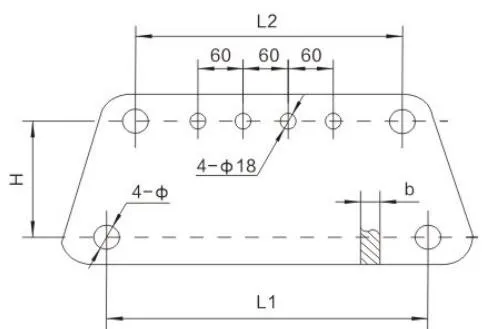
The LT design-number sheet is drawn with four extra Φ 18 holes at 60 mm pitch along the short edge, between the two Φ 1 eyes. There is no column for them on either table.
On a 640 kN plate that is a second bolting row for a twin-string or a spacer, and it is part of the part. If you are checking a mating split-pin pattern against this drawing, those four holes are real and the table is not the authority. Ask us for the hole schedule before you drill anything.
Technical Parameters
LS-1212 to LE-845550
| Model | Main Dimensions (mm) | Nominal Failure Load (kN) | Reference Weight (kg) | |||||
|---|---|---|---|---|---|---|---|---|
| H | L1 | L2 | b | Φ1 | Φ2 | |||
| LS-1212 | 65 | 400 | 120 | 16 | 20 | 18 | 120 | 5.00 |
| LS-1221 | 65 | 400 | 210 | 16 | 20 | 18 | 120 | 5.35 |
| LS-1225 | 65 | 400 | 250 | 16 | 20 | 18 | 120 | 5.54 |
| LS-1229 | 65 | 400 | 290 | 16 | 20 | 18 | 120 | 5.73 |
| LS-1233 | 65 | 400 | 330 | 16 | 20 | 18 | 120 | 5.92 |
| LS-1237 | 65 | 400 | 370 | 16 | 20 | 18 | 120 | 6.11 |
| LS-1255 | 65 | 400 | 550 | 16 | 20 | 18 | 120 | 8.66 |
| L-305045 | 130 | 450 | 500 | 32 | 39 | 39 | 300 | 29.59 |
| LE-425550 | 150 | 500 | 550 | 20 | 26 | 26 | 420 | 17.56 |
| LE-845550 | 150 | 500 | 550 | 32 | 39 | 39 | 840 | 32.12 |
LT design numbers
| General Design No. | Main Dimensions (mm) | Nominal Failure Load (kN) | Reference Weight (kg) | ||||
|---|---|---|---|---|---|---|---|
| H | L1 | L2 | b | Φ | |||
| LT-10-80/400/340 | 80 | 400 | 340 | 16 | 20 | 100 | 6.1 |
| LT-64-120/500/450 | 120 | 500 | 450 | 28 | 33 | 640 | 23.5 |
| LT-64-120/600/450 | 120 | 600 | 450 | 28 | 33 | 640 | 26.0 |
Related Pages
The triangular plates, 70 to 640 kN: L type triangular yoke plate. Two-plate trapezoidal work: L double layer. Square plates: LJ, LXV and LF. Adjusting plates with the same outline family: PT type adjusting plate.
Note: the LE and LT codes list the two spans in opposite order — order by the dimension columns. L-305045 (300 kN, 29.59 kg) is built on the 840 kN plate section; the 420 kN version of the same outline is 17.56 kg. Four rows have the short edge longer than the long edge, and LS-1255 sits 1.7 kg above the weight line for that reason.