L Type Double Layer Yoke Plate
Models: L-1240S – L-20457S (6 sizes) · Nominal Failure Load: 120–200 kN · Reference Weight: 6.0–9.4 kg · Spans: 400 and 457 mm
Two Plates, Four Bolts, One Gap
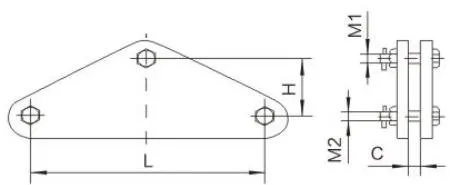
The drawing is a gable — one eye at the apex, two on the base line — but the side view shows two plates standing parallel with a bolt through each eye. The columns describe that assembly, not a single plate:
- H — apex height above the base-hole line, the same as on the LV plate.
- L — span between the two base holes.
- C — the clear gap between the two plates. This is the dimension that decides what the yoke can hold.
- M1 — the bolt through the apex eye. M2 — the bolt through the two base eyes.
Note that C and M1/M2 are different things. C is a hole in space, in millimetres; M1 and M2 are thread sizes. A plate with C 18 and M1 20 takes a 20 mm bolt and leaves 18 mm of clear daylight between the layers — enough for a 16 mm tongue, not for a 20 mm one.
Match C to the b of whatever goes between the plates. On the P clevis page the tongue thickness b runs 6 to 16 mm; on the U clevis the mouth is C 20 to 38. An L-1240S with C 18 will not take a U-21.
The 120 kN Plate Comes in Two Heights
H is not a strength dimension here, and the six rows show it plainly:
| Model | H | L | Load |
|---|---|---|---|
| L-1240S | 180 mm | 400 | 120 kN |
| L-1640S | 100 mm | 400 | 160 kN |
| L-2040S | 110 mm | 400 | 200 kN |
| L-12457S | 80 mm | 457 | 120 kN |
| L-16457S | 100 mm | 457 | 160 kN |
| L-20457S | 110 mm | 457 | 200 kN |
The 160 and 200 kN rows keep H constant across the two spans. Only the 120 kN row moves — and it moves the wrong way: the longer plate has the shallower ear, 180 mm on the 400 span against 80 mm on the 457 span.
A 100 mm difference in ear height on the same thickness and load should move the weight by about half a kilo, and it moves 0.4 kg — but in the direction of the shorter ear being heavier (6.0 against 6.4 kg). The two 120 kN plates have different outlines: the shorter ear sits on a wider body, and that is where the 0.4 kg goes. Quote H with the model number on the 120 kN size; on the other four rows the number alone is safe.
Six Kilos Is Not Two Plates
The span step is honest: +57 mm of span costs 0.3 to 0.5 kg across all three pairs (6.0 → 6.4, 7.3 → 7.6, 8.9 → 9.4).
The absolute figures are the problem. L-1240S is 6.0 kg for two plates, while the single-plate L-1240 on the triangular page is 4.66 kg for one. Two of those would be over 9 kg. So either 6.0 is the weight of one layer, or the two layers are slim strips rather than two copies of the triangular plate — the drawing is schematic and cannot settle it.
Before quoting a set, ask. A factor of two on a 457 mm yoke is a real freight line.
Bolt Sizes Are Minimal
M2 stays at M16 from 120 kN to 160 kN and only goes to M18 at 200. M1 runs 20 / 24 / 27. On a two-plate yoke the base bolt is in double shear across two plates, which is why M16 carries a 160 kN string — but check it against your own ear thickness before you rely on it.
Technical Parameters
| Model | Main Dimensions (mm) | Nominal Failure Load (kN) | Reference Weight (kg) | ||||
|---|---|---|---|---|---|---|---|
| H | L | C | M1 | M2 | |||
| L-1240S | 180 | 400 | 18 | 20 | 16 | 120 | 6.0 |
| L-1640S | 100 | 400 | 22 | 24 | 16 | 160 | 7.3 |
| L-2040S | 110 | 400 | 26 | 27 | 18 | 200 | 8.9 |
| L-12457S | 80 | 457 | 18 | 20 | 16 | 120 | 6.4 |
| L-16457S | 100 | 457 | 22 | 24 | 16 | 160 | 7.6 |
| L-20457S | 110 | 457 | 26 | 27 | 18 | 200 | 9.4 |
Related Pages
The single-plate triangular family: L type triangular yoke plate. The trapezoidal plates: LS trapezoidal. The double-layer rectangular plate: BN2. Gable plates: LV, LB.
Note: C is the clear gap between the two layers and must match the tongue thickness of the mating fitting; M1 and M2 are bolt thread sizes, not dimensions. On the 120 kN size H reads 180 mm at 400 span and 80 mm at 457 span — confirm which outline you need. 6.0 kg is not the weight of two 400 mm plates.