BN2 Yoke Plate
Models: BN2-16, BN2-30, BN2-1640 · Nominal Failure Load: 160–300 kN · Reference Weight: 10.0–20.3 kg · Span: L 400 mm on all three
A Double Layer, Not a Single Plate
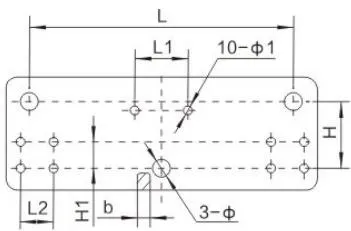
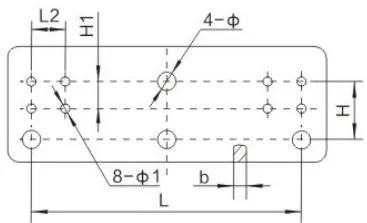
The two drawings are not a front view and a section — they are the two layers of the same yoke. One layer is drilled 10-Φ1 with a 3-Φ group, the other 8-Φ1 with a 4-Φ group. Different hole counts on the two faces is the whole point of a double-layer plate: the inner face bolts to the hardware, the outer face bolts to whatever closes the string.
The columns describe the pair:
- H1 = 40 mm — the vertical pitch of the small-hole clusters, i.e. the pitch at which the two layers bolt together. It is the same on all three rows.
- L1 = 80 mm — the horizontal pitch of the central Φ group, where the two layers share the load. Blank on BN2-1640.
- L2 = 50 mm — the edge distance of the small-hole clusters. Same on all three rows.
- b = 22 mm — the plate thickness of one layer.
Why The Weight Doubles
Put the first two rows side by side:
| H | H1 | L | L1 | L2 | b | Φ | Φ1 | Load | Weight | |
|---|---|---|---|---|---|---|---|---|---|---|
| BN2-16 | 100 | 40 | 400 | 80 | 50 | 22 | 26 | 14 | 160 kN | 10.0 kg |
| BN2-30 | 120 | 40 | 400 | 80 | 50 | 22 | 26 | 14 | 300 kN | 20.3 kg |
Every cell is identical except H, which moves 20 mm — under 0.3 kg of steel on a 22 mm plate. The weight doubles anyway: 10.0 × 2 = 20.0 against a printed 20.3. So does the rating, 160 → 300 kN, and two layers of a 160 kN plate carrying 300 kN is what a double-layer yoke is for.
The arithmetic agrees: 10.0 kg on a 22 mm plate is a 579 cm² footprint and 20.3 kg is 1 176 cm² — exactly two of them, not 20 mm taller.
So BN2-16 is one layer and BN2-30 is the pair, and the rating column already states the pair’s figure. Quote the layer count with the order — one plate or a set of two — and the bill of materials and the freight both follow from it.
BN2-1640 Is a Third Variant
The second sheet lists BN2-1640 with the same H, H1, L, L2, b, Φ and Φ1 as BN2-16, L1 blank, and 12.3 kg — 2.3 kg heavier than the row it otherwise copies.
A blank L1 means the central Φ pair is not drilled on that part — there is no second layer for it to bolt to. BN2-1640 is therefore a single-layer plate and 12.3 kg is the weight of one plate.
Order it the same way as the others: state the layer count. A single plate and a set of two are two different lines on the quotation.
Technical Parameters
BN2-16 and BN2-30
| Model | Main Dimensions (mm) | Nominal Failure Load(kN) | Reference Weight (kg) | |||||||
|---|---|---|---|---|---|---|---|---|---|---|
| H | H1 | L | L1 | L2 | b | Ø | Ø1 | |||
| BN2-16 | 100 | 40 | 400 | 80 | 50 | 22 | 26 | 14 | 160 | 10.0 |
| BN2-30 | 120 | 40 | 400 | 80 | 50 | 22 | 26 | 14 | 300 | 20.3 |
BN2-1640
| Model | Main Dimensions (mm) | Nominal Failure Load(kN) | Reference Weight (kg) | |||||||
|---|---|---|---|---|---|---|---|---|---|---|
| H | H1 | L | L1 | L2 | b | Ø | Ø1 | |||
| BN2-1640 | 100 | 40 | 400 | 50 | 22 | 26 | 14 | 160 | 12.3 | |
Related Pages
The single-plate 300 kN parts: BN, BN1. Another double-layer plate, joined by bolts rather than spacers: L double layer. The 120 kN plates: BL, BL1.
Note: the two drawings are the two layers, drilled 10-Φ1 + 3-Φ and 8-Φ1 + 4-Φ. BN2-16 and BN2-30 differ only in H (100 against 120) because the weight and the rating both double — 10.0 kg and 160 kN for one layer, 20.3 kg and 300 kN for the pair. b 22 is the thickness of one layer, not of the assembly, and BN2-1640 is a single-layer plate.