BL Yoke Plate
Models: BL-12, BL-1240 · Nominal Failure Load: 120 kN both · Reference Weight: 13.6 and 17.0 kg · Span: L 400 mm on both
One Prefix, Two Bodies
Both sheets describe a 120 kN plate with the same 400 mm span, the same 16 mm plate and the same Φ 18 end eyes. What differs is the steel between the eyes, and that changes what every letter means:
- BL-12 — a gable. One 3-Φ eye at the apex, a pair of 2-Φ1 holes 80 mm apart below it, two eyes on the base line at the ends of L, and the drawing marks the depth of the plate at its ends as 20 mm. H runs from the base line up to the Φ1 pair, not to the top of the plate.
- BL-1240 — a rounded rectangle. 4-Φ in the corners, 2-Φ1 at 240 mm centres in the middle. H is the vertical distance between the two corner-hole rows, and L the horizontal one.
So H 70 and H 250 are not one dimension measured twice. They are two different plates, and neither sheet prints the overall outline.
The Weight Back-Computes the Outline
Take the rectangle. A 400 × 250 × 16 mm slab of steel weighs 12.6 kg, and the holes only take material away — yet the sheet prints 17.0 kg. Seventeen kilos on a 16 mm plate is 2 165 cm³, which is 450 × 300 × 16. That is 25 mm of steel outside every hole centre, on both axes: 450 − 400 and 300 − 250.
That rule holds for the whole rectangular plate family: L and H are centre distances. Add about 25 mm per side to get the outline. It is why these plates look oversized next to their own dimensions, and it is the fastest way to sanity-check a weight before you quote freight.
Same Rating, Same Eyes, 4.3 kg Apart
The BL1 sheet prints a plate with the same 120 kN, the same L 400, the same b 16, the same Φ 18 and the same Φ1 14, and gives it 9.3 kg against the BL-12’s 13.6 kg.
The BL1 carries ten Φ1 holes where the BL-12 carries two, so the drilling is not where the 4.3 kg went — eight extra 14 mm holes in a 16 mm plate take out about 0.2 kg. It is the body. At 16 mm, 4.3 kg is 342 cm² of steel, and that is the difference between a gable whose outline stands about 240 mm above the base line and the BL1’s rectangle at about 165 mm.
Both figures are per plate, and both back-compute: 450 × 240 × 16 mm comes to 13.5 kg and 450 × 165 × 16 mm to 9.3 kg. Compare them on the height you have room for, not on the kilogramme.
The Pin Size Decides the Application
Φ1 is 14 mm on the BL-12 and 24 mm on the BL-1240. Both are 120 kN, so this is not a strength step, it is a hardware step:
- BL-12, Φ1 14 — takes a 12–14 mm pin and hangs under a small ball eye or a Q / QP class fitting.
- BL-1240, Φ1 24 — takes a 22–24 mm pin and matches the W-7 / U-21 class.
Choose by the pin you already have in the string, not by the kilonewton.
Technical Parameters
BL-12
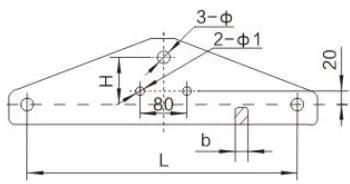
| Model | Main Dimensions (mm) | Nominal Failure Load(kN) | Reference Weight (kg) | ||||
|---|---|---|---|---|---|---|---|
| H | L | b | Ø | Ø1 | |||
| BL-12 | 70 | 400 | 16 | 18 | 14 | 120 | 13.6 |
BL-1240
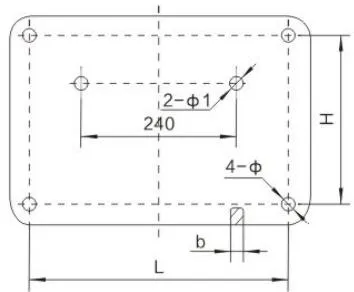
| Model | Main Dimensions (mm) | Nominal Failure Load(kN) | Reference Weight (kg) | ||||
|---|---|---|---|---|---|---|---|
| H | L | b | Ø | Ø1 | |||
| BL-1240 | 250 | 400 | 16 | 18 | 24 | 120 | 17 |
Related Pages
The same rating with a taller ear and a bolting cluster: BL1 yoke plate. Rigid rectangular plates: BN, BN1, BN2. Light triangular plates: L type triangular. The LB family: LB, LBD, LBS, LFB.
Note: BL-12 and BL-1240 are both 120 kN at a 400 mm span with Φ 18 end eyes; only the body shape, H and Φ1 differ. L and H are hole-centre distances on both sheets, so add about 25 mm per side for the real outline. BL1 carries the same rating and the same end eyes at 4.3 kg less, and that is its 165 mm body against the BL-12’s 240 mm.