DTJ Type Inverted Joint Fitting
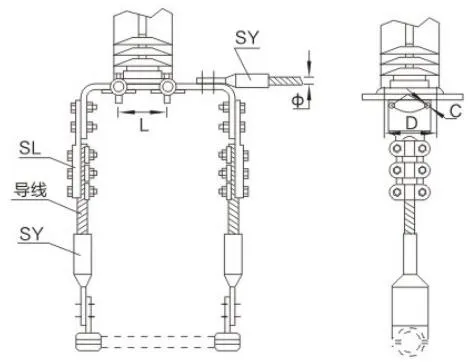
Models: DTJ-140, DTJ-190, DTJ-225, DTJ-250 (4 body sizes, 15 downlead combinations)
DTJ is the fitting that hangs a downlead off a tubular busbar. It clamps the busbar, carries the insulator fixing, and presents the outlets the downlead clamps bolt to. It is fitted upside down relative to an ordinary busbar clamp — the busbar sits above, the downleads drop away below — which is what the inverted in the name refers to.
One thing about this code trips people up, so it is worth stating before the table.
The number is the insulator hole spacing, not a size
DTJ-140 does not mean 140 mm² and it does not mean a 140 mm busbar. 140 is the centre-to-centre distance between the two bolt holes on the insulator the fitting mounts to. The factory note is explicit: busbar LGJ-240, downlead LGJ-185, insulator hole spacing 140 → DTJ-140.
So the four body sizes are four insulator patterns, not four conductor ranges:
| Model | Insulator hole spacing (D, mm) | Fits insulator studs |
|---|---|---|
| DTJ-140 | 140 | φ14 |
| DTJ-190 | 190 | φ14 |
| DTJ-225 | 225 | φ18 |
| DTJ-250 | 250 | φ18 |
Get this wrong and the fitting will not bolt to the post insulator, whatever else is right about it. Measure the insulator, not the busbar, when you pick the code.
The busbar is yours
The Ø column on the factory sheet reads busbar by user. There is no busbar diameter to choose here because the clamp is made to the tube you are installing — tubular busbar comes in a range of diameters and wall thicknesses per project, and the same fitting body serves them. Send the tube OD with the order.
Ordering string
The catalogue code alone is not enough to buy this part. The factory example gives the full string, and it is worth copying the shape of it:
DTJ-140/4-φ14 (SY-240 / LGJ-185 / 120)
Read it as DTJ- insulator hole spacing / variant -φ bolt diameter ( busbar clamp / downlead / L ). That string buys: a body for a 140 mm insulator pattern, φ14 bolts, an SY-240 clamp for the LGJ-240 busbar, an LGJ-185 downlead, and L = 120.
Two consequences for the buyer:
- The busbar conductor is not in the model number. Two orders both reading
DTJ-140can differ in the bracket that grips the tube. State the busbar in the bracket. - The downlead clamps are ordered with the body. SL, SY and SYG are separate clamp types; the body is drilled and spaced for whichever one you name. Changing clamp type after the body is made is not a bolt-on.
Technical parameters
| Model | Downlead conductor | Downlead fitting | L (mm) | D (mm) | C (mm) |
|---|---|---|---|---|---|
| DTJ-140 | LGJ-185 | SL-185 | 120 | 140 | 14 |
| DTJ-140 | LGJ-185 | SY-185 | 120 | 140 | 14 |
| DTJ-140 | LGJ-185 | SYG-185 | 120 | 140 | 14 |
| DTJ-140 | LGJ-240 | SL-240 | 120 | 140 | 14 |
| DTJ-190 | LGJ-240 | SY-240 | 120 | 190 | 14 |
| DTJ-190 | LGJ-240 | SYG-240 | 120 | 190 | 14 |
| DTJ-190 | LGJ-300 | SL-300 | 120 | 190 | 14 |
| DTJ-225 | LGJ-300 | SY-300 | 200 | 225 | 18 |
| DTJ-225 | LGJ-300 | SYG-300 | 200 | 225 | 18 |
| DTJ-225 | LGJ-400 | SL-400 | 200 | 225 | 18 |
| DTJ-225 | LGJ-400 | SY-400 | 200 | 225 | 18 |
| DTJ-250 | LGJ-400 | SYG-400 | 200 | 250 | 18 |
| DTJ-250 | LGJ-500 | SL-500 | 200 | 250 | 18 |
| DTJ-250 | LGJ-500 | SY-500 | 200 | 250 | 18 |
| DTJ-250 | LGJ-500 | SYG-500 | 200 | 250 | 18 |
How to read the rows. Each body size covers two downlead conductor sizes, and the factory splits the three clamp types across them — DTJ-140 covers LGJ-185 with all three clamp types but LGJ-240 with SL only, while DTJ-190 picks up SY-240 and SYG-240. This is not a range, it is the combination list. If your job needs a pairing that is not on it, the factory note says the model can be built to order from the busbar, the downlead and the insulator pattern — ask, but ask before the body is machined.
Reading the columns
- D (mm) — insulator hole spacing, centre to centre. The number in the model code.
- C (mm) — bolt diameter for the insulator fixing, φ14 or φ18. Not the conductor.
- L (mm) — the span dimensioned across the clamp body: 120 on the 140 and 190 bodies, 200 on the 225 and 250.
- Ø — not tabulated. Busbar outside diameter, supplied by the user; the clamp is bored to it.
DTJ or DTJ1
There are two codes, and the honest answer is short: the two sheets print the same numbers, row for row. Same four bodies, same fifteen combinations, same L, D and C. What differs is the drawing — on the DTJ1 sheet the L and D callouts sit in opposite views from this one, which suggests two mounting conventions drawn separately rather than two sizes.
Practical effect: quote both the code and the insulator hole spacing, and send the insulator drawing if you have it. A supplier who quotes “140 spacing” without the code can ship the wrong bracket.
What it works with
- Aluminium tubular busbar — the tube this fitting grips.
- SYG copper-aluminium transition clamp — where the downlead is copper and the busbar is aluminium, the transition happens at the clamp, not at the fitting.
- STR and SST — compression equipment clamps for the same downlead position when the joint is bolted rather than clamped.
- MGZ terminal ball — the hardware that terminates the downlead run at the other end.
Ordering
Send the full string in the shape above. At minimum we need: insulator hole spacing, bolt diameter, busbar outside diameter, downlead conductor size, and which clamp type (SL, SY or SYG). Say if the busbar is not a standard tube — a bored clamp is made to the tube, not shimmed to it.
FAQ
Is DTJ-140 for a 140 mm² conductor? No. 140 is the insulator hole spacing in millimetres. The conductor size sits in the bracket of the ordering string and has nothing to do with the body code.
Can I fit a different downlead than the table shows? The factory note allows a model built from your busbar, downlead and insulator pattern. What you cannot do is change the downlead clamp type after the body is made — the drilling follows the clamp.
Why is there no busbar diameter in the table? Because it is made to your tube. The sheet prints busbar by user, so the outside diameter comes with the order.
Does DTJ include the downlead clamps? The sheet lists them as part of the assembly and the ordering string names them. Order the clamps with the body and they arrive matched to the drilling.
Is it the same as DTJ1? Same dimensions on every row. The drawings differ in which view carries L and which carries D. Order by code.