DTJ1 Type Inverted Joint Fitting
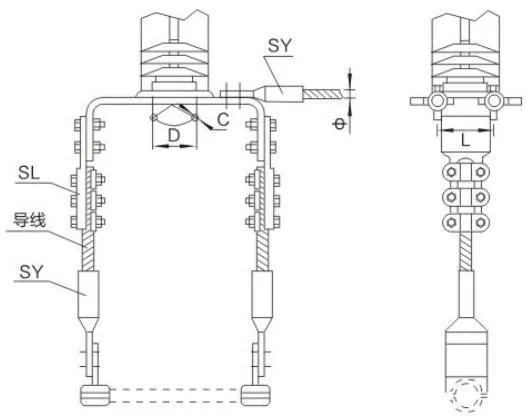
Models: DTJ1-140, DTJ1-190, DTJ1-225, DTJ1-250 (4 body sizes, same 15 downlead combinations as DTJ)
DTJ1 does the same job as DTJ — it hangs downleads off a tubular busbar, clamped from below, with the insulator fixing built into the body. The two sheets are not variants in size. They print identical figures on all fifteen rows: the same four insulator patterns, the same L of 120 and 200, the same φ14 and φ18 bolts, the same SL / SY / SYG clamp split.
What is different is the drawing, and that difference is worth understanding before you order.
What the two drawings actually show
Both sheets carry the same four callouts: Ø, L, D, C. On the DTJ sheet, L is dimensioned across the clamp bolts in the front view and D across the clamp body in the side view. On the DTJ1 sheet those two callouts swap views — D moves to the front, L to the side.
The numbers are unchanged because the part is unchanged. Two drawings that dimension the same geometry from opposite views, with the same table attached, are two drawing conventions for one fitting — which is why the factory gives them separate sheet numbers but not separate data.
What this means for the buyer: the code alone will not tell you whether the bracket is drilled to hang with L running along the busbar or across it. If you have the original drawing, order by its code. If you only have the insulator hole spacing, say so, and send the insulator drawing — the hole pattern decides the orientation, not the code.
The four bodies
| Model | Insulator hole spacing (D, mm) | L (mm) | Bolt (C, mm) | Downleads covered |
|---|---|---|---|---|
| DTJ1-140 | 140 | 120 | 14 | LGJ-185 (SL, SY, SYG), LGJ-240 (SL) |
| DTJ1-190 | 190 | 120 | 14 | LGJ-240 (SY, SYG), LGJ-300 (SL) |
| DTJ1-225 | 225 | 200 | 18 | LGJ-300 (SY, SYG), LGJ-400 (SL, SY) |
| DTJ1-250 | 250 | 200 | 18 | LGJ-400 (SYG), LGJ-500 (SL, SY, SYG) |
The fifteen-row combination table — every body against every clamp type — is on the DTJ page. It applies here unchanged; only the prefix differs.
The number is insulator spacing
Same warning as on the DTJ sheet, because the mistake is the same one: DTJ1-140 is not 140 mm² and not a 140 mm busbar. 140 is the centre-to-centre distance between the insulator’s bolt holes. The busbar diameter is not in the code at all — the sheet prints busbar by user and the clamp is bored to the tube you supply.
Ordering string
Identical shape to DTJ, with the prefix changed:
DTJ1-140/4-φ14 (SY-240 / LGJ-185 / 120)
That is: insulator hole spacing / variant -φ bolt diameter ( busbar clamp / downlead / L ). The busbar conductor sits in the bracket, not in the code — that is where the clamp that grips your tube gets specified.
When to pick DTJ1 over DTJ
- You are matching an existing installation. If the line already has DTJ1 bodies and you are adding a bay, stay with the code so the brackets, drilling and spares stay common.
- Your drawing says DTJ1. Order what the drawing says. The dimensions are the same either way, so there is no technical reason to substitute and one good reason not to — a substituted bracket hanging at 90° to the original is a field argument.
- You only have the insulator pattern. Then the code is not yet decided: both codes take the same four patterns, so the choice is about bracket orientation. Send the insulator drawing with the order.
Ordering
Send the full string, the busbar outside diameter, and the downlead conductor. If the insulator drawing is available, send it — that is the only document that settles which of the two codes you want. Everything else on this sheet is common to both.
FAQ
Is DTJ1 bigger or smaller than DTJ? Neither. Every dimension on both sheets matches, row for row: 140 / 190 / 225 / 250 spacing, L of 120 or 200, bolts of φ14 or φ18.
Why does the factory list two codes then? Because the drawings are dimensioned from different views, which comes from two mounting conventions. Same part, two sheets.
Can I mix DTJ and DTJ1 on one structure? Physically the bodies interchange on the same insulator pattern. Structurally, do not — mixing bracket orientation on one busbar run puts the two downleads in different planes. Use one code per structure.
Do I need to tell you the busbar size? Yes. It is not in the model code; the clamp is bored to your tube.