GD Type Attachment Point Fitting
Models: GD-12S – GD-60 (10 sizes) · Failure Load: 120–600 kN · Weight: 1.35–6.5 kg
The Model Number Is The Load
Every row, without exception:
GD-12 → 120 kN · GD-21 → 210 · GD-30 → 300 · GD-42S → 420 · GD-60 → 600
The digits are the nominal failure load in tens of kilonewtons. Ten rows out of ten, including the S variants. That makes this the easiest family in the catalogue to select from: read the number, divide by ten, and you have the rating.
Just be clear about which way it rounds. GD-32S is 320 kN and GD-30 is 300 kN — two models 20 kN apart, so a design that needs 310 kN has no margin in either. If the tension calculation lands between two numbers, the next model up is the only safe choice.
Three Matched Pairs, And No Consistent Meaning For S
Three loads are offered both ways — with the S suffix and without — which is the only chance to find out what S does:
| GD-12S | GD-12 | GD-21S | GD-21 | GD-50S | GD-50 | |
|---|---|---|---|---|---|---|
| Load | 120 kN | 120 kN | 210 kN | 210 kN | 500 kN | 500 kN |
| b | 16 | 16 | 20 | 18 | 32 | 34 |
| Φ | 24 | 24 | 26 | 26 | 39 | 44 |
| H | 30 | 30 | 40 | 35 | 48 | 50 |
| H1 | 30 | 35 | 35 | 35 | 50 | 40 |
| L | 230 | 250 | 250 | 250 | 278 | 264 |
| Weight | 1.7 kg | 1.35 kg | 2.1 kg | 1.8 kg | 4.6 kg | 6.0 kg |
Three pairs, three different answers:
- GD-12/12S — the S version is 20 mm shorter and 0.35 kg heavier.
- GD-21/21S — the S version is the same length and 0.3 kg heavier, with a wider b and a taller H.
- GD-50/50S — the S version is 14 mm longer and 1.4 kg lighter, with a smaller b and Φ.
So S does not mean short, small or light. It is a design variant whose geometry changes in a different direction at each rating, and the pairs cannot be substituted for each other. Compare the row, not the suffix.
The reverse also matters: a lighter part at a higher rating is not a saving to be assumed. GD-50S at 4.6 kg carries the same 500 kN as GD-50 at 6.0 kg, with Φ 5 mm smaller — if the fitting has to pass a 44 mm pin or clamp a 44 mm item, the lighter one will not fit.
Weight Per 100 kN
Dividing weight by rating shows where the range is efficient:
| Model | Load | Weight | kg per 100 kN |
|---|---|---|---|
| GD-21 | 210 kN | 1.8 kg | 0.86 |
| GD-50S | 500 kN | 4.6 kg | 0.92 |
| GD-21S | 210 kN | 2.1 kg | 1.00 |
| GD-42S | 420 kN | 4.2 kg | 1.00 |
| GD-60 | 600 kN | 6.5 kg | 1.08 |
| GD-30 | 300 kN | 3.3 kg | 1.10 |
| GD-32S | 320 kN | 3.6 kg | 1.13 |
| GD-12 | 120 kN | 1.35 kg | 1.13 |
| GD-50 | 500 kN | 6.0 kg | 1.20 |
| GD-12S | 120 kN | 1.7 kg | 1.42 kg |
GD-12S is the least efficient part on the sheet — 65 per cent more metal per kilonewton than GD-21, and 20 per cent more than its own non-S twin. The small end is where a fitting is bought in quantity, so that is where the difference shows in a budget.
L1 Is 112 mm On Nine Rows Out Of Ten
L1 — the dimension across the attachment — is 112 mm on every row except GD-42S, which prints 130 mm.
That is not a load effect: GD-42S is rated 420 kN, and both the 500 kN parts sit at 112. It is not a size effect either, since the largest fitting (GD-60) is also 112. GD-42S is the only row that departs, and it departs in the direction of a bigger part at a lower rating.
If a bracket or a yoke is drilled around 112 mm, GD-42S will not fit it. Check that row specifically.
L itself runs 230 to 290 mm in no particular order relative to the load — GD-12 is 250 while GD-12S is 230, and GD-30 at 300 kN is 264 against GD-50S at 500 kN being 278.
What Is Not On The Page
- No material, no galvanising specification — for an attachment fitting that carries the full conductor tension, the material is the qualification.
- No pin or bolt size for the attachment, only M (22 to 42 mm), which is the clamp bolt.
- No proof load, no safety factor — only the nominal failure load, so it is not stated whether the 120 kN is a breaking figure or a working figure. Assume nominal failure and apply your own factor until we confirm.
- No weight tolerance.
Technical Parameters
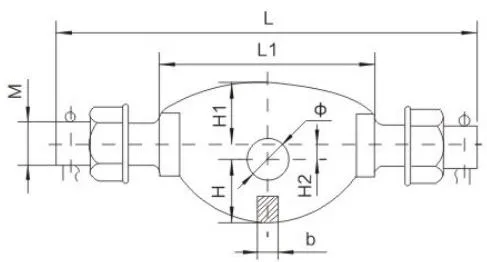
| Model | Main Dimensions (mm) | Nominal Failure Load (kN) | Reference Weight (kg) | |||||||
|---|---|---|---|---|---|---|---|---|---|---|
| b | Φ | H | H1 | H2 | M | L | L1 | |||
| GD-12S | 16 | 24 | 30 | 30 | 12 | 22 | 230 | 112 | 120 | 1.7 |
| GD-21S | 20 | 26 | 40 | 35 | 12 | 24 | 250 | 112 | 210 | 2.1 |
| GD-32S | 28 | 33 | 40 | 36 | 12 | 30 | 258 | 112 | 320 | 3.6 |
| GD-42S | 32 | 39 | 45 | 36 | 12 | 36 | 278 | 130 | 420 | 4.2 |
| GD-50S | 32 | 39 | 48 | 50 | 12 | 36 | 278 | 112 | 500 | 4.6 |
| GD-12 | 16 | 24 | 30 | 35 | 12 | 22 | 250 | 112 | 120 | 1.35 |
| GD-21 | 18 | 26 | 35 | 35 | 12 | 24 | 250 | 112 | 210 | 1.8 |
| GD-30 | 30 | 33 | 46.5 | 35 | 12 | 30 | 264 | 112 | 300 | 3.3 |
| GD-50 | 34 | 44 | 50 | 40 | 12 | 36 | 264 | 112 | 500 | 6.0 |
| GD-60 | 42 | 50 | 50 | 46 | 16 | 42 | 290 | 112 | 600 | 6.5 |
Related Pages
Plates and rods that attach to these fittings: QY and QP towing plate, YL / YLP extension rod, DB adjusting plate. Yoke plates of matching rating: BL yoke plate, BN yoke plate. Arcing protection at the same point: ZH arcing horn.
Note: Ten fittings, and the model number times ten is the nominal failure load on all ten. Three loads are offered with and without the S suffix, and S behaves differently in each: shorter and heavier at 120 kN, same length and heavier at 210 kN, longer and lighter at 500 kN — so the pairs are not interchangeable and S cannot be used as a size hint. Weight per 100 kN runs from 0.86 (GD-21) to 1.42 (GD-12S). L1 is 112 mm on nine rows and 130 mm on GD-42S alone, a 420 kN part. GD-30 and GD-32S are 20 kN apart. Only the nominal failure load is printed — no proof load, no safety factor, no material.