QY and PQ Type Towing Plate
Models: QY-7 – PQ-32240 (14 rows) · Failure Load: 70–320 kN · Weight: 0.80–7.30 kg
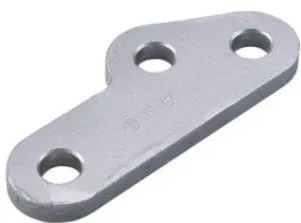
Two Codes, One Table, Two Columns Swapped
The sheet holds two families:
- QY-7 to QY-30 — seven rows, with the model in the Model column.
- PQ-07100 to PQ-32240 — seven rows, with the code in the General Design No. column and Model left empty.
Same product, same table, and the identifier sits in a different column depending on which family you are reading. That is worth knowing before searching the table for a part number.
Both codes decode:
- QY-7 → 70 kN. The digits are the load in tens of kilonewtons, on all seven.
- PQ-07100 → 70 kN at L 100. The first pair is the load in tens of kilonewtons, the rest is the length. All seven agree: PQ-16180 is 160 kN at 180 mm, PQ-32240 is 320 kN at 240 mm.
So the QY is named by rating and the PQ by rating and length. That difference matters when the length changes but the rating does not — the QY row would be the same part number.
For Five Sizes, The PQ Is The Same Plate Made Lighter
The first five rows of each family have identical dimensions:
| Load | L | L1 | H | Φ | b | QY weight | PQ weight |
|---|---|---|---|---|---|---|---|
| 70 kN | 100 | 38 | 22 | 18 | 16 | 0.80 kg | 0.80 kg |
| 100 kN | 120 | 42 | 25 | 20 | 16 | 1.10 kg | 1.00 kg |
| 120 kN | 150 | 52 | 30 | 24 | 16 | 1.90 kg | 1.50 kg |
| 160 kN | 180 | 55 | 35 | 26 | 18 | 2.60 kg | 2.10 kg |
| 210 kN | 200 | 75 | 45 | 30 | 26 | 4.70 kg | 3.60 kg |
At 70 kN the two are the same part. From 100 kN up, the PQ is 0.1 to 1.1 kg lighter on identical dimensions — 21 per cent lighter at 120 kN, 23 per cent at 160 kN, 23 per cent at 210 kN.
Identical dimensions and a quarter less metal means the PQ is a different material or a thinner section in a place the table does not dimension. Neither is stated. If the two are interchangeable on a drawing, that difference is what a quotation will be built on — and it is also what decides which one survives a fault.
At The Top They Diverge, And The Weight Does Not
The last two rows are no longer the same part:
| QY-25 | PQ-25220 | QY-30 | PQ-32240 | |
|---|---|---|---|---|
| Load | 250 kN | 250 kN | 300 kN | 320 kN |
| L | 220 | 220 | 240 | 240 |
| L1 | 95 | 85 | 95 | 95 |
| H | 70 | 50 | 80 | 57 |
| Φ | 33 | 30 | 39 | 33 |
| b | 22 | 24 | 32 | 28 |
| Weight | 6.20 kg | 6.20 kg | 7.30 kg | 7.30 kg |
Here the PQ is smaller in L1, H and Φ at both ratings — and weighs exactly the same. At 300/320 kN it also carries 20 kN more than the QY at the same 7.30 kg.
So the pattern inverts: below 210 kN the PQ is the same shape and lighter; above 250 kN it is a smaller shape at the same weight and, at the top, a higher rating. Neither family is simply the light version of the other — the two were designed on different principles at the top of the range.
The H difference is the one to watch: 70 mm against 50 mm at 250 kN. If H is the height at the attachment, a bracket sized around one will not take the other.
PQ-32240 Has No QY Equivalent
The QY family stops at 300 kN. The PQ goes to 320 kN, and there is no QY-32.
So a 320 kN requirement has exactly one answer on this sheet. It also means the two families cannot be compared like for like at the top: the most heavily loaded plate here is a PQ.
QY-25’s b Breaks Its Own Sequence
The b column on the QY rows runs 16, 16, 16, 18, 26, 22, 32.
It steps up to 26 at 210 kN, drops to 22 at 250 kN, then jumps to 32 at 300 kN. Every other dimension rises monotonically with rating, and so does b on the PQ rows (16, 16, 16, 18, 20, 24, 28).
A narrower plate at a higher rating is possible if the section is deeper, and H does rise from 45 to 70 over the same step — but the drop is the only place on the sheet where a dimension goes backwards. Check the b on QY-25 against the drawing rather than reading 22 as a design feature.
Metal Per Kilonewton Doubles Across The Range
| Load | QY | PQ |
|---|---|---|
| 70 kN | 1.14 kg/100 kN | 1.14 |
| 160 kN | 1.63 | 1.31 |
| 300 kN / 320 kN | 2.43 | 2.28 |
The smallest plate carries 70 kN on 0.8 kg; the largest carries four and a half times the load on nine times the metal. A design that can use several small plates instead of one large one is cheaper in steel — but each one needs its own attachment, which is where the saving usually goes.
What Is Missing
- No material and no finish — nothing on steel grade, forging or galvanising.
- No pin or hole size for the attachment, only Φ.
- No proof load, no safety factor — nominal failure only.
- No weight tolerance, which matters given the identical-dimension pairs above.
Technical Parameters
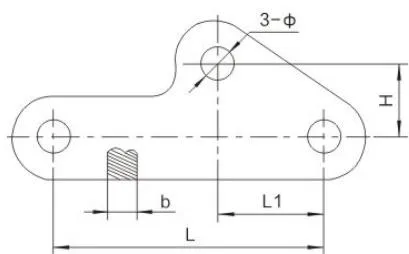
| General Design No. | Model | Main Dimensions (mm) | Nominal Failure Load (kN) | Reference Weight (kg) | ||||
|---|---|---|---|---|---|---|---|---|
| L | L1 | H | Φ | b | ||||
| QY-7 | 100 | 38 | 22 | 18 | 16 | 70 | 0.80 | |
| QY-10 | 120 | 42 | 25 | 20 | 16 | 100 | 1.10 | |
| QY-12 | 150 | 52 | 30 | 24 | 16 | 120 | 1.90 | |
| QY-16 | 180 | 55 | 35 | 26 | 18 | 160 | 2.60 | |
| QY-21 | 200 | 75 | 45 | 30 | 26 | 210 | 4.70 | |
| QY-25 | 220 | 95 | 70 | 33 | 22 | 250 | 6.20 | |
| QY-30 | 240 | 95 | 80 | 39 | 32 | 300 | 7.30 | |
| PQ-07100 | 100 | 38 | 22 | 18 | 16 | 70 | 0.80 | |
| PQ-10120 | 120 | 42 | 25 | 20 | 16 | 100 | 1.00 | |
| PQ-12150 | 150 | 52 | 30 | 24 | 16 | 120 | 1.50 | |
| PQ-16180 | 180 | 55 | 35 | 26 | 18 | 160 | 2.10 | |
| PQ-21200 | 200 | 75 | 45 | 26 | 20 | 210 | 3.60 | |
| PQ-25220 | 220 | 85 | 50 | 30 | 24 | 250 | 6.20 | |
| PQ-32240 | 240 | 95 | 57 | 33 | 28 | 320 | 7.30 | |
Related Pages
Plates and rods that connect to a towing plate: GD attachment point fitting, YL / YLP extension rod, DB adjusting plate. Yoke plates of the same rating: BL, BN.
Note: Fourteen rows in one table; QY codes sit in the Model column and PQ codes in the General Design No. column. QY is the rating in tens of kN, PQ is rating plus length. The first five sizes are dimensionally identical across the two families with the PQ 0 to 1.1 kg lighter — a quarter less metal on the same dimensions. Above 250 kN the PQ is smaller in L1, H and Φ at exactly the same weight, and PQ-32240 reaches 320 kN where the QY stops at 300. QY-25’s b of 22 mm is the only dimension on the sheet that falls as the rating rises. Metal per 100 kN doubles from 1.14 to 2.43. No material, finish, pin size or proof load printed.