QS Ball Clevis
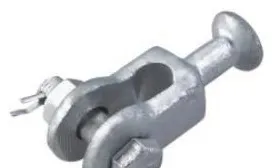
Models: Q-7U – QS-1680 · Nominal Failure Load: 70–160 kN · Reference Weight: 0.56–1.20 kg · Fork gap C: 20–22 mm · Ball D: 33.3–41.0 mm
Ball One End, Fork the Other
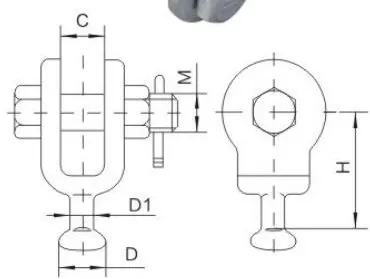
This is the ball eye with the eye replaced by a bolted fork. The ball end is unchanged — D is the ball, D1 the stem, and it drops into a socket clevis like every other ball in this range. The other end takes a bolt:
| Dimension | What it is |
|---|---|
| C | gap between the two cheeks — the tongue width |
| M | the bolt that closes the fork |
| H | overall length, top of the fork to the base of the ball |
| D / D1 | ball diameter and stem |
The difference from the Q / QP ball eye is what you bolt to: an eye needs a pin through it, a fork closes around a tongue with its own bolt. Same ball, different joint — that is the only decision that matters between the two families.
C Does Not Grow With the Load
| Model | C | M | H | D | Load | Weight |
|---|---|---|---|---|---|---|
| QS-0775 | 20 | 16 | 75 | 33.3 | 70 kN | 0.9 kg |
| QS-1075 | 22 | 18 | 75 | 33.3 | 100 kN | 0.9 kg |
| QS-1275 | 20 | 22 | 75 | 33.3 | 120 kN | 1.0 kg |
| QS-1680 | 22 | 24 | 80 | 41.0 | 160 kN | 1.2 kg |
The gap goes 20, 22, 20, 22 — it is not a ladder, and the 120 kN part is narrower than the 100 kN one. The bolt M does climb properly, 16 → 18 → 22 → 24.
So pick C by the tongue you have, and M by the load. They are independent on this sheet, and reading C off the rating will get the 120 kN size wrong.
The 70 kN Part Exists Twice
The first two lines are the same part under two numbers — and they disagree on weight:
| C | M | H | D | Weight | |
|---|---|---|---|---|---|
| Q-7U | 20 | 16 | 75 | 33.3 | 0.56 kg |
| QS-0775 | 20 | 16 | 75 | 33.3 | 0.90 kg |
Identical in every dimension and 0.34 kg apart — 60 per cent heavier on the second line. For the 70 kN size we weigh one before the price is fixed: at 0.6 kg a piece that difference is most of the casting, and the offer carries the weighed figure.
The 120 kN pair has the opposite problem — it is genuinely two parts:
| C | M | H | Weight | |
|---|---|---|---|---|
| Q-12U | 22 | 22 | 94 | 0.85 kg |
| QS-1275 | 20 | 22 | 75 | 1.00 kg |
The U-suffix part is 19 mm longer with a wider fork and yet 0.15 kg lighter. Q-12U and QS-1275 are not interchangeable: 19 mm of length on a 75 mm part changes where the string sits.
Only the 160 kN Changes Ball
Everything up to 120 kN uses the 33.3 mm ball with the 17 mm stem and coupling mark 16. The 160 kN steps to 41.0 / 21 / mark 20 — the only line that needs the medium socket. So a QS ball clevis is a small-ball part in all but one size.
Technical Parameters
| Universal Design Model | Model | Main Dimensions (mm) | Connection Marking | Nominal Failure Load(kN) | Reference Weight (kg) | ||||
|---|---|---|---|---|---|---|---|---|---|
| C | M | H | D1 | D | |||||
| Q-7U | 20 | 16 | 75 | 17 | 33.3 | 16 | 70 | 0.56 | |
| Q-12U | 22 | 22 | 94 | 17 | 33.3 | 16 | 120 | 0.85 | |
| QS-0775 | 20 | 16 | 75 | 17 | 33.3 | 16 | 70 | 0.9 | |
| QS-1075 | 22 | 18 | 75 | 17 | 33.3 | 16 | 100 | 0.9 | |
| QS-1275 | 20 | 22 | 75 | 17 | 33.3 | 16 | 120 | 1.0 | |
| QS-1680 | 22 | 24 | 80 | 21 | 41.0 | 20 | 160 | 1.2 | |
Related Pages
Eye instead of fork: Q and QP ball eye, QPJ, QSJ. Ball with an oval eye: QH ball eye. Mating sockets: W, WS, WSJ, WSY.
Note: C runs 20, 22, 20, 22 — the 120 kN fork is narrower than the 100 kN one, so choose the gap by the tongue and the bolt by the load. Q-7U and QS-0775 are dimensionally identical at 0.56 and 0.90 kg. Only the 160 kN uses the 41 mm ball.