W Socket Clevis
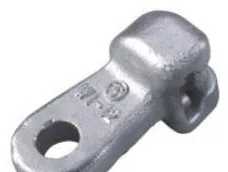
Models: W-7A – W-32110 · Nominal Failure Load: 70–320 kN · Reference Weight: 0.80–4.20 kg · Pin hole Φ: 20–39 mm
What This Part Does
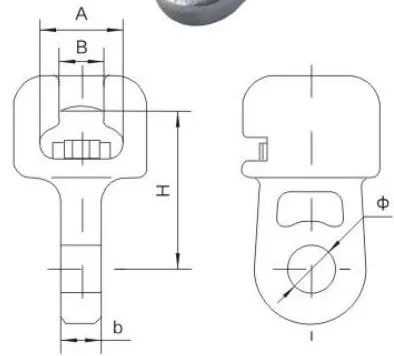
The top is the bowl: A across the outside, B across the mouth, with the ball of a mating ball-eye sitting in it and locked by a pin through the side slots. The bottom is a single-eye lug — Φ is the pin hole and b the thickness around it — and that eye is what carries on down the string to the insulator, the yoke plate or the next fitting.
So there are two separate questions on every line of this table: what goes in the bowl (A and B), and what hangs from the eye (Φ and b). H is how far apart they are.
Three Mouths, Not Seven
The rating column runs 70, 70, 100, 120, 300, 70, 70, 100, 120, 160, 320 kN — eleven lines. The mouth does not follow it. A and B only take three values:
| Mouth | A | B | Coupling mark | Lines |
|---|---|---|---|---|
| Small | 34.5 mm | 19.2 mm | 16 | 70, 100 and 120 kN — eight lines |
| Medium | 42.5 mm | 23.0 mm | 20 | 160 kN |
| Large | 51.0 mm | 27.5 mm | 24 | 300, 320 kN |
The coupling marking in the table takes the same three values, 16, 20 and 24, so it is telling you which of the three bowls you have — not a size per part. Eight of the eleven lines share the small bowl, which is why a 70 kN and a 120 kN clevis can look nearly the same from the top.
H Is the Only Real Ladder
Within the small bowl, H takes only four lengths — 70, 85, 90 and 115 mm — and each of them appears under both numbering systems. Compare the two 70 kN parts: W-7A at H 70 and W-7B at H 115 are otherwise identical, 0.80 kg against 0.92 kg. That is 45 mm of shank for 0.12 kg, and it is the cleanest proof on the page that H is length, not strength.
If your string needs to reach further, you change H. If it needs to hold more, you change b and Φ. They are independent, and the table lets you do either.
What Sets the Weight
Weight tracks b, the thickness of the eye, far more than it tracks the rating:
| b | Φ | H | Weight | |
|---|---|---|---|---|
| W-7A | 16 mm | 20 mm | 70 | 0.80 kg |
| W1-12 | 20 mm | 24 mm | 85 | 1.30 kg |
| W-30 | 32 mm | 39 mm | 110 | 3.50 kg |
| W-32110 | 28 mm | 33 mm | 110 | 4.20 kg |
The 70 kN and the 300 kN part differ by 4 mm of bowl and 40 mm of H — everything else is the eye. That is also why the eye is the part to check first: a 39 mm hole through 32 mm of steel is a different connection from a 20 mm hole through 16 mm.
Two Lists, and One Rating Only in Each
Eleven lines, but five model numbers and six design numbers, and the two blocks do not cover the same ratings:
| Block | Numbers | Covers |
|---|---|---|
| Model only | W-7A, W-7B, W1-10, W1-12, W-30 | 70, 100, 120, 300 kN |
| Design only | W-0770 … W-32110 | 70, 100, 120, 160, 320 kN |
The 160 kN part exists only under the design number and the 300 kN only under the model number. An enquiry quoting one of those two ratings can only be answered from one column.
Reading the pairs across by rating, the two lists are not the same part either:
| Rating | Model | Design | Difference |
|---|---|---|---|
| 70 kN, H 70 | W-7A, 0.80 kg | W-0770, 0.90 kg | same size, 0.10 kg apart |
| 70 kN, H 115 | W-7B, 0.92 kg | W-07115, 1.00 kg | same size, 0.08 kg apart |
| 100 kN | W1-10, b 18 | W-1085, b 16 | 2 mm of eye, same weight 1.10 |
| 120 kN | W1-12, b 20, H 85 | W-1290, b 16, H 90 | eye and length, same weight 1.30 |
On the two 70 kN lines the dimensions agree and the weight does not; on the 100 and 120 kN lines the weight agrees and the dimensions do not. For those two sizes, quote b and H as well as the number, or you may be sent the other eye.
300 and 320 kN: The Geometry Runs Backwards
| W-30 | W-32110 | |
|---|---|---|
| Bowl A / B | 51.0 / 27.5 | 51.0 / 27.5 |
| Coupling mark | 24 | 24 |
| H | 110 | 110 |
| Pin hole Φ | 39 mm | 33 mm |
| Eye thickness b | 32 mm | 28 mm |
| Load | 300 kN | 320 kN |
| Weight | 3.50 kg | 4.20 kg |
Same bowl, same length, and the higher-rated part has the smaller pin and the thinner eye — while weighing 0.7 kg more. They are two designs, not one part under two numbers: the 320 kN body carries the heavier casting and the smaller pin, and the extra 20 kN is in the material rather than in the outline. Do not substitute one for the other: a pin that fits W-30 will not pass through W-32110, and that is 6 mm on a 300 kN connection.
Technical Parameters
| Universal Design Model | Model | Main Dimensions (mm) | Connection Marking | Nominal Failure Load(kN) | Reference Weight (kg) | ||||
|---|---|---|---|---|---|---|---|---|---|
| Φ | b | H | A | B | |||||
| W-7A | 20 | 16 | 70 | 34.5 | 19.2 | 16 | 70 | 0.80 | |
| W-7B | 20 | 16 | 115 | 34.5 | 19.2 | 16 | 70 | 0.92 | |
| W1-10 | 20 | 18 | 85 | 34.5 | 19.2 | 16 | 100 | 1.10 | |
| W1-12 | 24 | 20 | 85 | 34.5 | 19.2 | 16 | 120 | 1.30 | |
| W-30 | 39 | 32 | 110 | 51.0 | 27.5 | 24 | 300 | 3.50 | |
| W-0770 | 20 | 16 | 70 | 34.5 | 19.2 | 16 | 70 | 0.90 | |
| W-07115 | 20 | 16 | 115 | 34.5 | 19.2 | 16 | 70 | 1.00 | |
| W-1085 | 20 | 16 | 85 | 34.5 | 19.2 | 16 | 100 | 1.10 | |
| W-1290 | 24 | 16 | 90 | 34.5 | 19.2 | 16 | 120 | 1.30 | |
| W-1695 | 26 | 18 | 95 | 42.5 | 23.0 | 20 | 160 | 1.90 | |
| W-32110 | 33 | 28 | 110 | 51.0 | 27.5 | 24 | 320 | 4.20 | |
Related Pages
Same family with a bolted bottom: WS socket clevis. Two-arm version: WSY. Long body with the locking holes published: WJ, WSJ. Mating part: Q and QP ball eye.
Note: A and B take only three values across eleven lines, and the coupling marking repeats them — the bowl is chosen in three steps while the rating moves in seven. H is shank length (W-7A 70 mm, W-7B 115 mm, otherwise identical parts); b and Φ carry the load. The two numbering blocks do not cover the same ratings: 160 kN is design-only and 300 kN is model-only.