UL Shackle Guy Wire
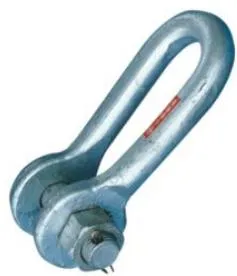
Models: UL-7 – UL-30 · Nominal Failure Load: 70–300 kN · Reference Weight: 0.65–4.83 kg · Inside height H: 120–170 mm · Bend radius R: 15–25 mm
Long Body, Bigger Bend
Same joint as the U clevis — a U closed by a bolt, with the load taken on a pin — but built for stays rather than for a horizontal pin:
| U clevis | UL | |
|---|---|---|
| H (inside height) | 80–130 mm | 120–170 mm |
| R (bend radius) | 10–19 mm | 15–25 mm |
| Weight at 70 kN | 0.50 kg | 0.65 kg |
Both grow on every size — H by 40 to 60 mm, R by 1 to 8 mm — and both matter for a guy wire. H gives the room for the grip and the turnbuckle; R is the radius the stay bends around at the top of the U. A wire pulled over too tight a radius kinks and loses strength right where the load is highest, which is what the extra radius buys.
R Does Not Climb
| Model | Load | H | R | Weight |
|---|---|---|---|---|
| UL-7 | 70 kN | 120 | 15 | 0.65 kg |
| UL-10 | 100 kN | 140 | 17 | 0.92 kg |
| UL-12 | 120 kN | 140 | 18 | 1.43 kg |
| UL-16 | 160 kN | 140 | 19 | 1.78 kg |
| UL-21 | 210 kN | 160 | 18 | 2.60 kg |
| UL-25 | 250 kN | 170 | 25 | 3.50 kg |
| UL-30 | 300 kN | 170 | 20 | 4.83 kg |
R goes 15, 17, 18, 19, 18, 25, 20. It drops at 210 kN and again at 300 kN — so the strongest shackle on the page has a smaller bend radius than the 250 kN one, and only 1 mm more than the 160 kN one.
If the wire radius is your constraint, do not assume the biggest shackle has the gentlest bend. UL-25 at R 25 is the one to pick, and UL-30 at R 20 is not a substitute even though it is rated higher.
H Comes in Three Steps
120, then 140 three times, then 160, then 170 twice. So there are three body lengths, not seven: a short one at 70 kN, a medium one covering 100 to 160 kN, and a long one for 210 and above. Within a group the difference between sizes is the bar and the pin, not the reach.
That makes the buying rule simple: choose the group by the room you need, then the size inside it by the load.
What the Extra Costs
UL-7 against U-7: 0.15 kg for 40 mm of body and 5 mm of radius. UL-30 against U-30: 0.53 kg for 40 mm and 1 mm. The long version costs 0.15 to 0.55 kg depending on size — small next to the value of keeping the stay straight.
Technical Parameters
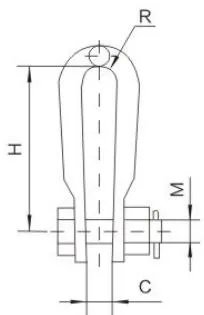
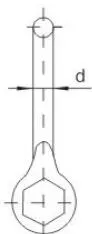
| Model | Main Dimensions(mm) | Nominal Failure Load(kN) | Reference Weight(kg) | ||||
|---|---|---|---|---|---|---|---|
| C | M | d | H | R | |||
| UL-7 | 20 | 16 | 16 | 120 | 15 | 70 | 0.65 |
| UL-10 | 22 | 18 | 18 | 140 | 17 | 100 | 0.92 |
| UL-12 | 24 | 22 | 20 | 140 | 18 | 120 | 1.43 |
| UL-16 | 26 | 24 | 22 | 140 | 19 | 160 | 1.78 |
| UL-21 | 30 | 27 | 24 | 160 | 18 | 210 | 2.60 |
| UL-25 | 34 | 30 | 26 | 170 | 25 | 250 | 3.50 |
| UL-30 | 38 | 36 | 30 | 170 | 20 | 300 | 4.83 |
Related Pages
Standard body: U clevis. Short body: UF clevis. Deep fork: U clevis reinforced. Two bolts: UB clevis. Guy-wire yoke plates: LV for guy wire.
Note: H is 40 to 60 mm longer than the U clevis and R 1 to 8 mm larger, which is what a stay needs. R is not monotone — 19 at 160 kN, 18 at 210, 25 at 250, 20 at 300 — so the strongest size does not have the gentlest bend. H comes in three body lengths, not seven.