UB Clevis For Suspension
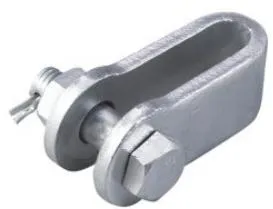
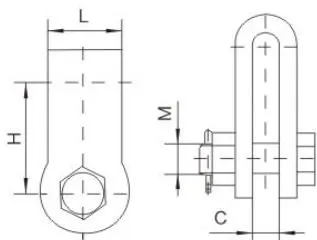
Models: UB-6-1, UB-9-1, UB-7G · Nominal Failure Load: 70–100 kN · Reference Weight: 0.80–1.20 kg · Mouth C: 20 mm on all three
Three Parts That Share Everything but the Length
| Model | C | M | H | L | Load | Weight |
|---|---|---|---|---|---|---|
| UB-6-1 | 20 | 16 | 65 | 30 | 70 kN | 0.82 kg |
| UB-9-1 | 20 | 18 | 65 | 40 | 100 kN | 1.20 kg |
| UB-7G | 20 | 16 | 65 | 40 | 70 kN | 0.80 kg |
C is 20 mm and H is 65 mm on every line — the mouth and the drop are fixed across the family, which is what makes it a suspension part: it is sized to one insulator cap and one bracket, not to a range.
What moves is L, the body width: 30 mm on the UB-6-1, 40 mm on the other two. And M, the bolt: 16 or 18 mm.
The Shorter One Is the Heavier One
UB-6-1 and UB-7G are both 70 kN, both C 20 / M 16 / H 65, and differ only in L — 30 against 40 mm. The short one weighs 0.82 kg, the long one 0.80 kg.
Twenty grams is inside the tolerance of a galvanised casting, so this is not a real difference in design — but it does mean the weight column cannot tell you which of the two you have. Read the marking.
And the pairing matters more than the weight: L 30 mm is for a narrow bracket, L 40 mm for a standard one. If you are replacing a part on an existing pole, measure the bracket before ordering.
The 100 kN Step Is the Bolt
UB-9-1 keeps everything except M 18 instead of 16, and gains 0.40 kg — 50% more than either 70 kN part. That is the same pattern as the rest of the U family: the rating on these fittings is bought with the bolt, and the body follows.
So the choice is: L by the bracket, M by the load. Two decisions, three parts.
The Numbers Are Not the Load
| Model | Reads like | Load |
|---|---|---|
| UB-6-1 | “6”, revision 1 | 70 kN |
| UB-9-1 | “9”, revision 1 | 100 kN |
| UB-7G | “7”, G suffix | 70 kN |
Three parts, three naming styles: two dash-numbers and one letter suffix. None of the digits is a kilonewton, and they are not in order of capacity either — the 6 and the 7 are both 70 kN while the 9 is the 100.
That matters when a drawing or another supplier’s sheet quotes one of these codes. Match on C, M, H and L, not on the number.
Where It Sits
This is the light end of the UB range. The UB clevis starts at 70 kN too but with a 70 mm height and a 45 mm body — it hangs 5 mm lower and is wider. The suspension version is the compact one.
Technical Parameters
| Model | Main Dimensions (mm) | Nominal Failure Load(kN) | Reference Weight (kg) | |||
|---|---|---|---|---|---|---|
| C | M | H | L | |||
| UB-6-1 | 20 | 16 | 65 | 30 | 70 | 0.82 |
| UB-9-1 | 20 | 18 | 65 | 40 | 100 | 1.20 |
| UB-7G | 20 | 16 | 65 | 40 | 70 | 0.80 |
Related Pages
Full-range UB with the two-bolt geometry explained: UB clevis. Heavy range: UB T clevis. Single-bolt links: U clevis, PD clevis, PS clevis.
Note: C 20 mm and H 65 mm are the same on all three sizes — only L (30 or 40 mm) and M (16 or 18 mm) change. UB-6-1 and UB-7G are both 70 kN with the same bolt and differ only in body length, yet the shorter one is listed 0.02 kg heavier.