UB Clevis
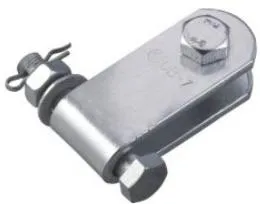
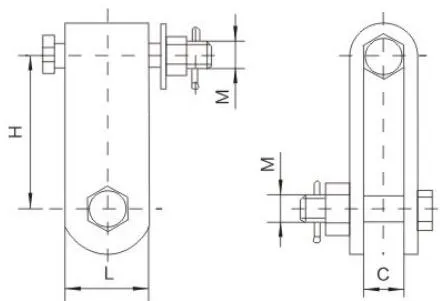
Models: UB-7 – UB-21100 (11 table lines) · Nominal Failure Load: 70–300 kN · Reference Weight: 0.75–5.50 kg · Mouth C: 18–39 mm
Two Bolts, Not One
Every other U fitting on the site is closed by one bolt and takes its load on a pin. The UB has a bolt at each end:
| Dimension | What it is |
|---|---|
| C | clear opening at the mouth |
| M | the bolt — the drawing labels both bolts with the same M |
| H | distance between the two bolt centres |
| L | width of the body |
So the UB hangs on one bolt and holds another. That makes it a link rather than a hook: it does not need a separate pin, and it can be taken out of an assembly without dismantling the pin on the other side. Only one M is published, so both bolts are the same size — confirm that on the drawing if you are ordering spares.
The Body Width Does Not Follow the Load
L takes three values only — 45, 60 and 70 mm — and it is not a ladder with the rating:
| Model | C | M | H | L | Load |
|---|---|---|---|---|---|
| UB-7 | 18 | 16 | 70 | 45 | 70 kN |
| UB-10 | 20 | 18 | 80 | 45 | 100 kN |
| UB-12 | 24 | 22 | 100 | 60 | 120 kN |
| UB-16 | 26 | 24 | 100 | 60 | 160 kN |
| UB-21 | 30 | 27 | 120 | 70 | 210 kN |
| UB-30 | 39 | 36 | 150 | 70 | 300 kN |
The 120 and 160 kN parts share L and H and differ only 4 mm of mouth and 2 mm of bolt. That is the cheapest 40 kN step in the range: if your connection takes a 26 mm mouth, the 160 only costs you the 2 mm of bolt.
One Outline, Two Ratings
The design-number block fixes C, M, H and L, so on paper the 160 and the 210 kN line measure the same:
| Model | C | M | H | L | Load | Weight |
|---|---|---|---|---|---|---|
| UB-16100 | 26 | 24 | 100 | 45 | 160 kN | 2.30 kg |
| UB-21100 | 26 | 24 | 100 | 45 | 210 kN | 3.20 kg |
The 50 kN is not in the outline — it is in the plate. A fixed envelope has only one place to put extra steel, and that is thickness: 3.20 against 2.30 kg is 39 per cent more metal for 31 per cent more rating. That is the whole difference between the two parts, and it is why the drawing carries one shape while the load column carries two figures.
This is useful rather than awkward. Both take the same 26 mm mouth, the same M24 bolt and the same 100 mm bolt centres, so a string can be rated up from 160 to 210 kN without changing the socket clevis above it or the clamp below. What you cannot do is tell them apart on the tower, or order one from a drawing that gives dimensions only — quote the full number, and put the rating on the purchase order.
Note also that the design-number UB-21100 is not the model-number UB-21. The design row is C 26 / L 45 / 3.20 kg; the model row is C 30 / L 70 / 4.20 kg. Two quite different parts under one code.
The Design List Is Narrower and Shorter
Reading 70 kN across: UB-7 has a 18 mm mouth, UB-0770 has 20 mm — here the model-number part is the narrower one, the opposite of the U clevis family, where the model series is the wider.
Above 120 kN the design list keeps L at 45 mm while the model list opens to 60 and then 70. So the two lists are not interchangeable at all above 100 kN — different width, different mouth.
And the top of the range only exists once: UB-30 at 300 kN has no design-number twin. The design list stops at 210.
Technical Parameters
| Universal Design Model | Model | Main Dimensions (mm) | Nominal Failure Load(kN) | Reference Weight (kg) | |||
|---|---|---|---|---|---|---|---|
| C | M | H | L | ||||
| UB-7 | 18 | 16 | 70 | 45 | 70 | 0.75 | |
| UB-10 | 20 | 18 | 80 | 45 | 100 | 1.08 | |
| UB-12 | 24 | 22 | 100 | 60 | 120 | 2.82 | |
| UB-16 | 26 | 24 | 100 | 60 | 160 | 2.89 | |
| UB-21 | 30 | 27 | 120 | 70 | 210 | 3.80 | |
| UB-30 | 39 | 36 | 150 | 70 | 300 | 5.50 | |
| UB-0770 | 20 | 16 | 70 | 45 | 70 | 0.80 | |
| UB-1080 | 20 | 18 | 80 | 45 | 100 | 1.10 | |
| UB-12100 | 24 | 22 | 100 | 45 | 120 | 2.10 | |
| UB-16100 | 26 | 24 | 100 | 45 | 160 | 2.30 | |
| UB-21100 | 26 | 24 | 100 | 45 | 210 | 3.20 | |
Related Pages
One bolt instead of two: U clevis. Short body: UF clevis. Long body for guy wire: UL shackle. Deep fork: U clevis reinforced.
Note: UB has a bolt at each end and the drawing labels both with the same M — a link, not a hook. L only takes 45, 60 or 70 mm and does not follow the rating. UB-16100 and UB-21100 share one outline at 2.30 and 3.20 kg, so the 50 kN is plate thickness — same socket, same bolt, different rating. And the design-number UB-21100 is a different part from the model-number UB-21.