UF Clevis
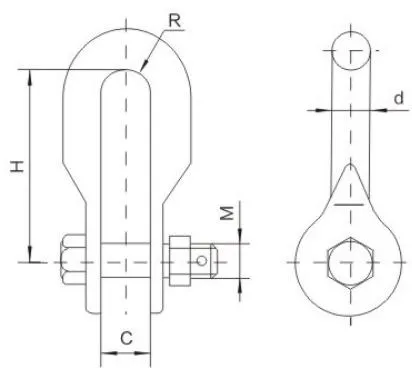
Models: UF-7 – UF-50 · Nominal Failure Load: 70–500 kN · Reference Weight: 0.50–7.00 kg · Mouth C: 20–44 mm
The U Clevis, Shortened
C, M, d and R on this sheet follow the same ladder as the U clevis model series — 20/16/16/10 at 70 kN, 30/27/24/15 at 200, 38/36/30/19 at 300. What is different is H: 60, 70, 80, 90, 100, 110, 130 instead of 80, 85, 90, 95, 100, 110, 130.
So the UF is the same joint with 20 mm less inside height at the bottom of the range, converging with the U at 300 kN. Short body, same mouth, same pin.
When to take the UF: where the clevis has to sit close to the fitting above it and the extra 20 mm of a U would foul. There is no load advantage either way — the two are rated the same at every size.
The Same Part Under Two Names
| C | M | d | H | R | Load | Weight | |
|---|---|---|---|---|---|---|---|
| UF-20 | 30 | 27 | 24 | 100 | 15 | 200 kN | 2.20 kg |
| U-21 | 30 | 27 | 25 | 100 | 15 | 210 kN | 2.20 kg |
Mouth, bolt, height and radius match and the weight is identical at 2.20 kg, but one sheet calls it 200 kN and the other 210, and the pin is 1 mm different. That is not two designs — it is one casting with two sets of paperwork.
If you are ordering a “200 kN clevis”, say which family. And if a substitution is offered on a 210 kN line, a UF-20 is the same part apart from that millimetre on the pin.
The same thing happens at the top: UF-30 and U-30 are identical in every dimension — 38 / 36 / 30 / 130 / 19 — at 3.70 kg and 4.30 kg. Six hundred grammes on a 4 kg part is not rounding: the UF body carries a heavier head than the plain U, and 4.30 kg is that head. Quote by the code rather than by the rating.
400 and 500: Two Millimetres Apart
| C | M | d | H | R | Load | Weight | |
|---|---|---|---|---|---|---|---|
| UF-40 | 42 | 42 | 36 | 150 | 21 | 400 kN | 7.00 kg |
| UF-50 | 44 | 42 | 36 | 150 | 22 | 500 kN | 7.00 kg |
Two millimetres of mouth and one of radius, and the rating moves 100 kN on the same weight: the two are one casting certified at two levels, and what the higher figure buys is the test, not the steel. The certificate goes out with the delivery.
For a 400 or 500 kN duty the tested figure goes on the certificate. That is the largest gap on the page and the one most likely to be written into a tender, so it is confirmed in writing with the offer.
The Weight Jumps at 400
0.50, 0.54, 0.96, 1.47, 2.20, 2.79, 3.70, 7.00, 7.00.
The step from 300 to 400 kN nearly doubles the weight — 3.70 to 7.00 kg — while every step below it adds 0.3 to 0.8 kg. That is the point where the part stops being a bent bar and becomes a heavy forging, and it is consistent with the rating jump being real even if the 400/500 pair is not.
Technical Parameters
| Model | Main Dimensions(mm) | Nominal Failure Load(kN) | Reference Weight(kg) | ||||
|---|---|---|---|---|---|---|---|
| C | M | d | H | R | |||
| UF-7 | 20 | 16 | 16 | 60 | 10 | 70 | 0.50 |
| UF-10 | 22 | 18 | 18 | 70 | 11 | 100 | 0.54 |
| UF-12 | 24 | 22 | 20 | 80 | 12 | 120 | 0.96 |
| UF-16 | 26 | 24 | 22 | 90 | 13 | 160 | 1.47 |
| UF-20 | 30 | 27 | 24 | 100 | 15 | 200 | 2.20 |
| UF-25 | 34 | 30 | 26 | 110 | 17 | 250 | 2.79 |
| UF-30 | 38 | 36 | 30 | 130 | 19 | 300 | 3.70 |
| UF-40 | 42 | 42 | 36 | 150 | 21 | 400 | 7.00 |
| UF-50 | 44 | 42 | 36 | 150 | 22 | 500 | 7.00 |
Related Pages
Standard body: U clevis. Long body: UL shackle for guy wire. Deep fork: U clevis reinforced. Two bolts: UB clevis.
Note: Same C, M, d and R as the U clevis, with H 20 mm shorter at the bottom of the range — no load advantage either way. UF-20 and U-21 are the same part at 2.20 kg, rated 200 and 210 kN. UF-40 and UF-50 differ by 2 mm of mouth and 100 kN at identical 7.00 kg.