V Type Clevis
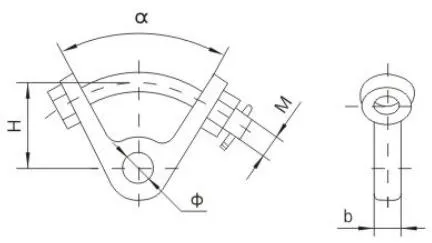
Models: V-7, VD-7 · Nominal Failure Load: 70 kN · Reference Weight: 1.4–1.8 kg · Angle α: 60° on both
A V, Not a U
The V clevis takes the load on a pin through its apex and hands it to two bolts set at 60° to each other. That geometry is the whole product:
| Dimension | What it is |
|---|---|
| Φ | pin hole at the apex |
| α | included angle between the two arms — 60° |
| M | the bolt through each arm |
| H | apex pin centre to the bolt centres |
| b | the plate dimension marked on the side view |
Both parts are 70 kN, both at 60°, both with an 18 mm pin and a 20 mm bolt. The only difference is b: 40 mm on the V-7, 28 mm on the VD-7, which is why one weighs 1.8 kg and the other 1.4.
What 60 Degrees Does to the Bolts
The apex carries the full 70 kN. Each of the two arms takes a share, and the share depends on the angle:
Each bolt = 70 / (2 × cos 30°) = 40.4 kN
So each bolt carries 58% of the load, and the two together carry 15% more than the apex load because they are pulling at an angle rather than straight down. If you are specifying the bolts or the plate they land on, 40 kN each is the number — not 35.
At 60° the arms are steep enough to keep that penalty small. A wider V (say 90°) would put only 49 kN on each bolt but pull the plate harder sideways; a narrower V would load the bolts more.
Two Parts, One Choice
| Model | b | Weight |
|---|---|---|
| V-7 | 40 mm | 1.80 kg |
| VD-7 | 28 mm | 1.40 kg |
Same rating, same pin, same bolt, same angle. The 12 mm of b is worth 0.4 kg — 29% more weight for the same nominal load.
That is a decision about stiffness, not strength: the wider part resists the two arms spreading under load. On a short span with a stiff bracket, the VD-7 does the job at 0.4 kg less. Where the arms are long or the load is cyclic, the V-7’s extra material is what keeps the angle from opening.
The page does not publish a working load or a stiffness figure for either, so if the choice is close, tell us the span and the dynamic duty and we will advise on the drawing.
Where a V Is Worth It
Against a U clevis of the same rating, the V spreads the load into two bolts instead of one — useful where a single bolt would need a heavier bracket, or where the fitting has to sit around an existing crossarm. The price is the angle penalty on the bolts and a heavier part: 1.4 to 1.8 kg at 70 kN, against 0.50 kg for a U-7.
Technical Parameters
| Model | Main Dimensions (mm) | Nominal Failure Load (kN) | Reference Weight (kg) | ||||
|---|---|---|---|---|---|---|---|
| b | Φ | M | H | α | |||
| V-7 | 40 | 18 | 20 | 75 | 60° | 70 | 1.8 |
| VD-7 | 28 | 18 | 20 | 75 | 60° | 70 | 1.4 |
Related Pages
Single-bolt forged U: U clevis. Plate clevises: P clevis, PS clevis. Flat link: PD clevis. Two-bolt link: UB clevis.
Note: Both sizes are 70 kN, 60°, 18 mm pin and 20 mm bolt; only b differs, 40 against 28 mm, for 0.4 kg. At 60° each of the two bolts carries 58% of the apex load — 40.4 kN on a 70 kN fitting — so specify the bolts to that, not to 35 kN.