U Clevis
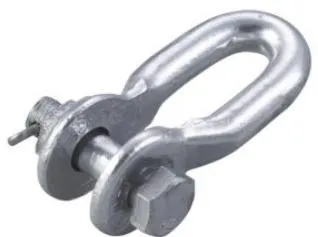
Models: U-7 – UK-1290T (22 lines) · Nominal Failure Load: 70–320 kN · Reference Weight: 0.50–4.30 kg · Mouth C: 20–38 mm
Five Dimensions, One Joint
| Dimension | What it is |
|---|---|
| C | clear opening between the two legs — the width of what goes in |
| M | the bolt that closes the mouth |
| d | the pin or bar that goes through the mouth |
| H | inside height, bolt centre to the top of the bend |
| R | inner radius of the bend |
The clevis closes on a tongue with a bolt, and the tongue is held by a pin through the two legs. C and d are the two numbers that decide whether your hardware fits, and neither of them is the load rating.
Fifteen Numbers, Twenty-Two Lines
The table has 22 rows but only 15 sizes, and the numbering reconciles the two figures:
- 15 rows carry a model number — seven U (U-7 to U-30), six UK (UK-0770 to UK-32130), two UK-T.
- 7 rows carry a design number instead — U-0770 to U-32115. That is a parallel list, not seven extra sizes.
So the same rating appears up to twice, once under each system, and it is the design rows that run narrow. Count numbers, not rows.
Three Mouth Widths at Every Rating
The same table carries three parallel series — U with a two-digit code, U with a design number, and UK — plus a UK-T variant. At any given rating the mouth is different, and the rest is not:
| Rating | U-model (C) | U-design (C) | UK (C) | UK-T (C) |
|---|---|---|---|---|
| 70 kN | 20 | 20 | 24 | 28 |
| 100 kN | 22 | 20 | 26 | — |
| 120 kN | 24 | 22 | 26 | 28 |
| 160 kN | 26 | 24 | 28 | — |
| 210 kN | 30 | 24 | 30 | — |
| 250 kN | 34 | 28 | — | — |
| 300 kN | 38 | — | — | — |
| 320 kN | — | 32 | 36 | — |
At 70 kN you can have a 20, 24 or 28 mm mouth on the same rating. That is the point of the UK and T lines: widening the mouth without changing the bolt or the pin. A UK part uses the same M and the same d as the U part at its rating — check the rows and you will see M and d identical and only C and R moving.
Use it the other way round too: if a wide mouth part is out of stock, the same rating in a narrower mouth is the same joint, it just will not straddle the same plate.
Two Different Parts Called 210 kN
The clearest trap on the page:
| U-21 | U-21100 | |
|---|---|---|
| C | 30 mm | 24 mm |
| d | 24 mm | 20 mm |
| M | 27 mm | 24 mm |
| R | 15 mm | 12 mm |
| Weight | 2.20 kg | 1.45 kg |
Both are 210 kN. One is 1.5 times the weight of the other, with a 4 mm bigger pin, a 3 mm bigger bolt and a 6 mm wider mouth. The heavier one is the model-number series; the lighter one is the design-number series.
The same divergence runs through the whole table above 160 kN — at 250 kN it is 3.00 kg against 2.10 kg. Only at 70 kN do the two series agree exactly (0.50 kg each, C 20, d 16, M 16).
So quote the full number, not the rating. “210 kN clevis” does not identify a part on this page, and the two are not interchangeable: the 24 mm pin will not go through a 20 mm hole.
The T Widens the Mouth, Not the Steel
| Model | C | M | d | H | Weight |
|---|---|---|---|---|---|
| UK-0770 | 24 | 16 | 16 | 70 | 0.55 kg |
| UK-0770T | 28 | 16 | 16 | 70 | 0.55 kg |
| UK-1290 | 26 | 22 | 18 | 90 | 1.10 kg |
| UK-1290T | 28 | 22 | 18 | 90 | 1.10 kg |
Four and two millimetres more mouth, and the weight does not move by a gram. A wider mouth at the same weight means thinner legs somewhere, so the T is a wide-mouth variant, not a stronger one. If you are loading near the nominal figure, ask us for the leg section before you specify the T.
The one place a wider mouth does cost weight is 210 kN: the UK is 0.75 kg heavier than the U on the same bolt and the same pin — half again the weight of the part. That is not a widened leg, it is a different forging, and it is the only such jump on the page.
R Is a Real Limit
R runs 10 to 19 mm and is the inner radius of the bend. It sets the largest round thing that can pass through the top — a cable, a rod, a stay. A C of 30 mm with an R of 15 cannot take a 20 mm radius bend, even though the mouth looks wide enough.
R is not monotone either: 10, 11, 12, 13, 15, 17, 19 on the model series but 12, 13, 13, 14, 15, 18 on the UK. Read the line.
Technical Parameters
| General Design Model | Model | Main Dimensions(mm) | Nominal Failure Load(kN) | Reference Weight(kg) | ||||
|---|---|---|---|---|---|---|---|---|
| C | M | d | H | R | ||||
| U-7 | 20 | 16 | 16 | 80 | 10 | 70 | 0.50 | |
| U-10 | 22 | 18 | 18 | 85 | 11 | 100 | 0.80 | |
| U-12 | 24 | 22 | 20 | 90 | 12 | 120 | 1.20 | |
| U-16 | 26 | 24 | 22 | 95 | 13 | 160 | 1.60 | |
| U-21 | 30 | 27 | 24 | 100 | 15 | 210 | 2.20 | |
| U-25 | 34 | 30 | 26 | 110 | 17 | 250 | 3.00 | |
| U-30 | 38 | 36 | 30 | 130 | 19 | 300 | 4.30 | |
| U-0770 | 20 | 16 | 16 | 70 | 10 | 70 | 0.50 | |
| U-1085 | 20 | 18 | 16 | 85 | 10 | 100 | 0.65 | |
| U-1290 | 22 | 22 | 18 | 90 | 11 | 120 | 1.00 | |
| U-1695 | 24 | 24 | 20 | 95 | 12 | 160 | 1.35 | |
| U-21100 | 24 | 24 | 20 | 100 | 12 | 210 | 1.45 | |
| U-25110 | 28 | 27 | 24 | 110 | 14 | 250 | 2.10 | |
| U-32115 | 32 | 30 | 28 | 115 | 16 | 320 | 3.00 | |
| UK-0770 | 24 | 16 | 16 | 70 | 12 | 70 | 0.55 | |
| UK-1085 | 26 | 18 | 16 | 85 | 13 | 100 | 0.65 | |
| UK-1290 | 26 | 22 | 18 | 90 | 13 | 120 | 1.10 | |
| UK-1695 | 28 | 24 | 20 | 95 | 14 | 160 | 1.35 | |
| UK-21100 | 30 | 24 | 20 | 100 | 15 | 210 | 2.20 | |
| UK-32130 | 36 | 30 | 28 | 130 | 18 | 320 | 3.10 | |
| UK-0770T | 28 | 16 | 16 | 70 | 12 | 70 | 0.55 | |
| UK-1290T | 28 | 22 | 18 | 90 | 13 | 120 | 1.10 | |
Related Pages
Shorter U: UF clevis. Long U for guy wire: UL shackle. Two-bolt body: UB clevis. Reinforced: U clevis reinforced.
Note: C, M and d — not the rating — decide whether your hardware fits. The same 70 kN is available with a 20, 24 or 28 mm mouth, bolt and pin unchanged. At 210 kN there are two parts, 2.20 kg with a 24 mm pin and 1.45 kg with a 20 mm pin. The T adds mouth without adding weight, so it is a wider fork, not a stronger one.